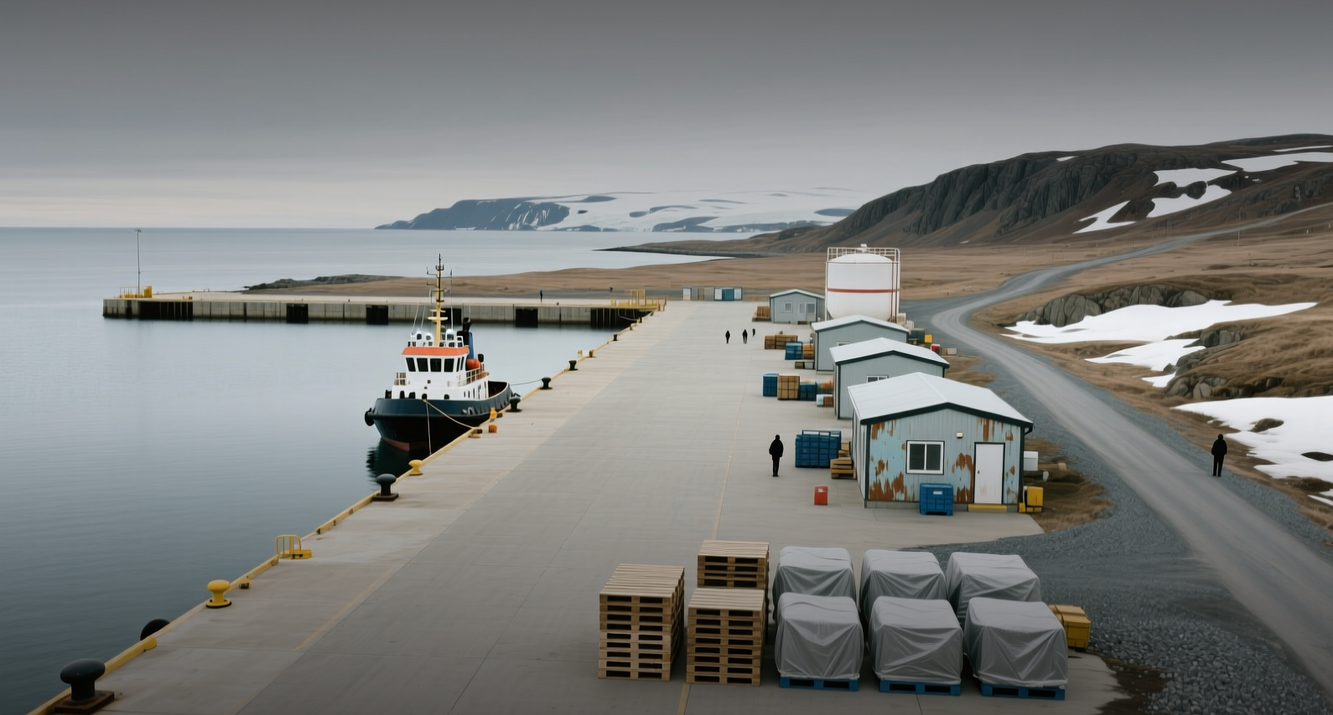
Greenland Energy surged as much as 150% in U.S. premarket trading Monday, leading a narrow cluster of Arctic-exposed shares higher after Washington, Copenhagen and Nuuk agreed a security pact that bars non-NATO adversaries from basing on the island.
The deal, which President Donald Trump said on Truth Social gives the United States "permanent control over security, and all other needs, in Greenland," is expected to be signed at the UN General Assembly in New York on Tuesday. Danish Foreign Minister Lars Lokke Rasmussen told national broadcaster TV2 that responsibility for Arctic security "is not only Danish or American," adding that to a large extent "it would be NATO that looks after the Arctic."
The move was concentrated in thinly traded names rather than the wider resource complex. Greenland Mines rose more than 80%, while Critical Metals Corp. gained nearly 25%, according to premarket quotes. No revenue, contract award or reserve estimate accompanied the advance — the entire repricing rests on a security headline whose text has not been published.
That gap between headline and disclosure is the central risk. Key details remain undisclosed, including whether the agreement amends the 1951 defense agreement that forms the legal basis for the U.S. presence in Greenland. The pact also requires approval from Danish and Greenlandic lawmakers, and officials have said it leaves Greenland under Danish sovereignty while blocking China, Russia and other non-NATO adversaries from establishing military bases or making certain sensitive investments.
Pituffik already anchors the missile-warning chain
The strategic case predates the deal. The U.S. has maintained an outpost in northwestern Greenland since 1953 at Pituffik Space Base, now operated by the U.S. Space Force, where the 12th Space Warning Squadron runs an Upgraded Early Warning Radar providing warning and assessment data on intercontinental and sea-launched ballistic missiles threatening the United States and Canada. On Sept. 10, F-35A Lightning II fighters from the Wisconsin Air National Guard's 115th Fighter Wing operated from Pituffik during Operation Arctic Vanguard, demonstrating the base can support advanced combat aircraft in Arctic conditions.
Greenland's geography also matters for maritime surveillance. Russian attack submarines operating from Northern Fleet bases can transit Arctic waters toward the North Atlantic, where they would threaten the sea lanes used to reinforce NATO in a major confrontation. Greenland sits near the northern approaches to the Greenland-Iceland-United Kingdom gap, historically one of the most important corridors between Arctic waters and the wider Atlantic.
The resource dimension is where equity investors are extrapolating. China accounts for roughly 60% of global rare-earth mining and more than 90% of processing capacity, and rare earths feed the high-performance magnets used in electric vehicles, wind turbines, generators and precision-guidance systems, as well as missile guidance, radar, sonar, satellites and advanced aircraft. Greenland's rare-earth and critical-mineral deposits have been cast as a potential counterweight to that concentration, though no commercial-scale project on the island has yet been financed on the back of this agreement.
A 56,000-person island with Alaska-scale geography
Scale cuts both ways. Greenland is nearly the size of Alaska and Texas combined, but roughly 80% of it is covered by an ice sheet and its population is about 56,000 people spread across five municipalities, most living in small coastal towns. That combination of vast, unmapped resource potential and almost no existing infrastructure is precisely what makes the equity reaction so reflexive: there is little in the way of contracted cash flow to anchor a valuation against.
The historical template is unflattering. The last time Washington escalated Arctic territorial rhetoric, in January, the push triggered a diplomatic crisis inside NATO and forced Denmark and Greenland into negotiations aimed at defusing the pressure — a sequence that produced headlines and volatility without a single binding commercial commitment. Denmark has since acknowledged it underinvested in Greenland's defense for decades and pledged to expand its military presence on the island, including more NATO troops.
What happens next is procedural, and it is where the trade either holds or unwinds. Danish and Greenlandic lawmakers must ratify the text; the agreement's publication will reveal whether it grants new U.S. basing rights, expanded military access, force-posture changes or additional weapons deployments — none of which can currently be confirmed. A NATO spokesperson said Saturday the alliance welcomed the agreement, which would "help advance security, stability and cooperation in this vital region."
For investors, the distinction is between a structural re-rating of Arctic resource access and a one-day flow event. The security architecture around Greenland is being rebuilt on a multi-decade horizon, and the exclusion of Chinese and Russian capital from sensitive island investments narrows the field of developers who can eventually bid for those deposits. But Greenland Energy's 150% move and Greenland Mines' 80% gain were achieved on premarket volume, before any of that is contractually real. Until the text is published and ratified, the equity move is a bet on a document nobody outside the negotiating room has read.
This article is for informational purposes only and does not constitute investment advice.