Alibaba Group Holding Ltd. (09988.HK) won a reiterated Buy from Goldman Sachs with HKD172 and USD177 price targets, as the broker pointed to a Model-as-a-Service business that has more than doubled its annual recurring revenue since mid-May.
The call followed the company's Apsara Conference, where Alibaba presented updates spanning AI infrastructure, foundation models and applications. Goldman kept its FY2027 and FY2028 EPS growth forecasts at 58% and 27% year on year, and held Alibaba Cloud revenue growth estimates at 53%, 55% and 55% for the fiscal quarters ending September 2026, December 2026 and March 2027 — all above market expectations. Alibaba did not disclose updated guidance at the conference.
The monetization math is the core of the call. MaaS annual recurring revenue reached RMB20 billion at the end of August, up from RMB16 billion in mid-August and RMB8 billion in mid-May, and Goldman expects the RMB30 billion target to be met by the end of 2026. That trajectory implies ARR roughly 2.5 times its mid-May level in about three and a half months.
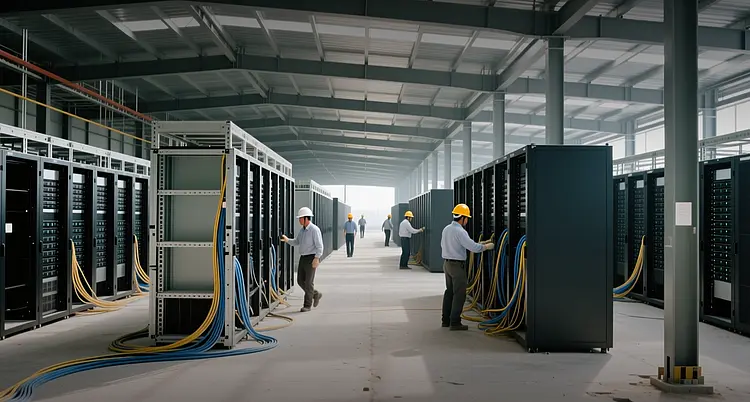
The capex plan is larger. Alibaba's target of 20 gigawatts of global data center capacity by 2032 compares with roughly 5-6 gigawatts at the end of 2025, implying annual additions of 1-2 gigawatts and annual capital expenditure of RMB200-300 billion over the next few years. Goldman's estimate assumes about USD20-25 billion per gigawatt, supported by T-Head self-developed chips and a mix of heavy-asset, light-asset and leased computing power.
T-Head, Alibaba's chip design unit, unveiled the Zhenwu V900 AI training and inference processor at the conference, with 216 GB of GPU memory, 1,200 GB/s of inter-chip bandwidth and three times the performance of the Zhenwu M890 released in May. Mass production and commercial release are scheduled for the first quarter of 2027. Goldman said the self-developed silicon creates a USD-per-gigawatt cost advantage over domestic and overseas peers, and that T-Head could supply about half of Alibaba Cloud's computing power in the medium term, against roughly 10% now.
Overseas, Alibaba Cloud operates 107 availability zones across 31 regions and more than 3,200 edge nodes. Over the next 12 months it will open its first cloud regions in Türkiye, Finland and the Netherlands and expand data centers in Malaysia, Germany, the United Arab Emirates, France and Hong Kong — nine markets in total.
The bullish note sits against a crowded short side. Alibaba's H-shares fell 3.223% to HKD111.10, with short selling of $932.46 million representing 17.605% of turnover as of 12:25 p.m. Hong Kong time on Sept. 23. BofA separately said the same conference reinforced full-stack AI opportunities at the company.
For holders, the divergence matters more than the target. Goldman's HKD172 implies roughly 55% upside from the Sept. 23 close, but a short ratio above 17% means the path there depends on whether the MaaS ARR ramp converts into reported cloud revenue in the December-quarter print. Alibaba's next scheduled earnings release is the September-quarter report, where the 53% cloud growth estimate faces its first test.