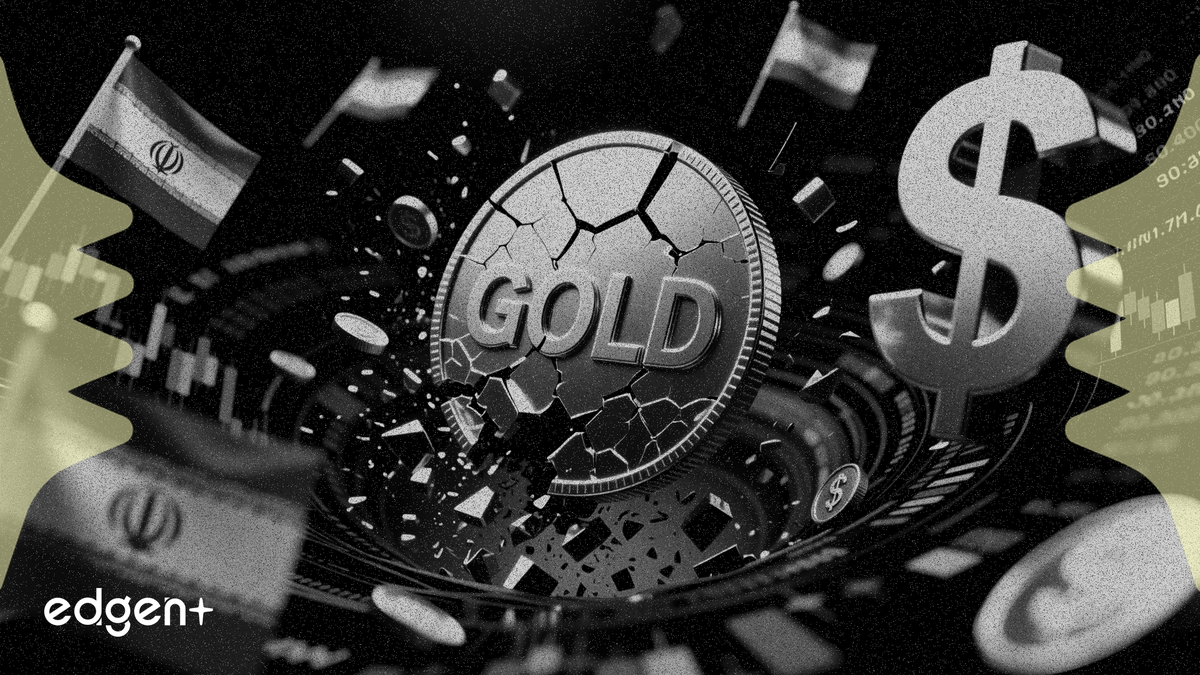
Gold suffered its steepest weekly decline in five months as a resurgent dollar and hawkish Fed repriced the outlook for non-yielding assets.
Gold fell more than 5% this week to near $4,046 an ounce, its lowest since November, as uncertainty over a potential Iran nuclear deal and a hawkish Federal Reserve stance drove the dollar to a three-month high.
"Gold is caught between two powerful dollar-supportive forces — geopolitical risk premium flowing into the greenback and a Fed that has pushed back against rate-cut expectations," said Mary McNamara, senior commodities strategist at Goldman Sachs.
Spot gold traded at $4,076.88 an ounce Thursday, down 5% on the week and 10% from a month ago, after briefly breaching $4,030 — a level not seen since November 2025. Silver fell to $61.95 before recovering to near $64. The dollar index climbed above 100, up 0.6% this week, while the 10-year US Treasury yield held above 4.5%. In India, MCX gold futures dropped 1,573 rupees to 146,444 rupees per 10 grams, tracking the global selloff.
The selloff reflects a double headwind for gold: a stronger dollar that makes bullion more expensive for foreign buyers and higher real yields that increase the opportunity cost of holding non-yielding assets. Markets now price a 72% probability of a Fed rate hike by December, up from 67% a week ago, according to CME FedWatch data.
Geopolitical Risk Shifts to Dollar
The escalation in the Middle East has, unusually, weighed on gold rather than supported it. After the US military launched strikes against multiple targets in Iran, Iran's Islamic Revolutionary Guards Corps responded by targeting US bases in Kuwait, Bahrain and Jordan. Iran also announced the closure of the Strait of Hormuz, which handles about 21% of global oil trade, sending Brent crude above $95 a barrel and WTI above $92.
Typically, such geopolitical turmoil would boost gold's safe-haven appeal. But the dollar has absorbed those flows instead, with the greenback strengthening against all major peers. USD/JPY pushed toward 160.60, near levels that triggered Japanese intervention in April, while EUR/USD drifted around 1.1500 ahead of the European Central Bank's policy decision. The dollar index has gained 0.6% this week alone, extending its advance above the psychologically important 100 mark.
The last time gold fell more than 5% in a week while geopolitical tensions escalated was in March 2022, following Russia's invasion of Ukraine, when a dollar surge and margin calls forced a 7% gold selloff in five sessions. The pattern repeated this week as COMEX gold futures posted their longest losing streak in five months, dropping nearly $87 to $4,046 an ounce.
Fed Hawkishness Compounds Pressure
US inflation data reinforced the case for higher-for-longer rates. The Consumer Price Index rose 4.2% in May, the highest in three years, while core CPI increased 0.2% month over month — below the 0.4% prior reading and the 0.3% consensus estimate. Producer price inflation stood at 6.5%, well above the central bank's 2% target, keeping pressure on the Fed to maintain its restrictive stance.
The combination of sticky inflation and a resilient labor market has pushed the Fed to push back against market expectations for early rate cuts. The fed funds rate has remained at 5.25% to 5.5% since July 2023, and markets now price a 72% probability of a hike by December, up from 67% a week earlier. The last time the Fed signaled such a hawkish stance while inflation ran above 4%, gold fell 12% over the subsequent two months in 2022 before bottoming near $1,620.
For gold buyers, the near-term outlook hinges on whether the dollar rally exhausts itself or accelerates. If the ECB delivers a hawkish surprise Thursday, the dollar could weaken and lift gold toward $4,200 resistance. If the Fed maintains its current trajectory and geopolitical tensions persist, gold could test support at $4,000 an ounce — a level that would represent a 12% decline from its recent peak near $4,385. Gold-backed ETF holdings have declined for five consecutive sessions, data from the World Gold Council show, as institutional investors reduced exposure to the metal.
This article is for informational purposes only and does not constitute investment advice.