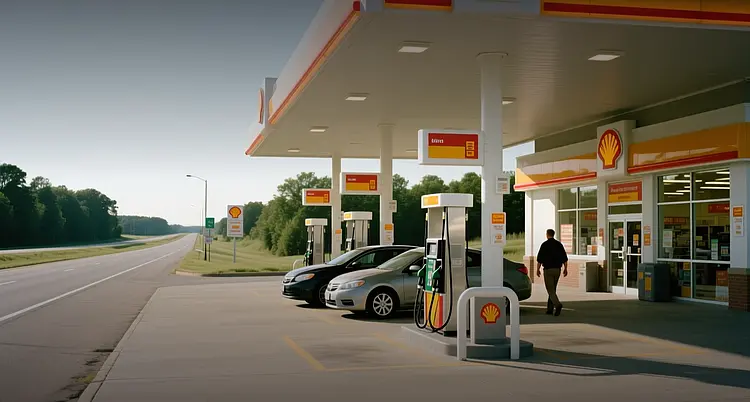
Getty Realty Corp. has added 41 convenience stores to its net lease portfolio in a $260.9 million transaction with Refuel Operating Company, a deal that installs the fuel retailer as the REIT's third-largest tenant at roughly 7.7% of annualized base rent.
"We are excited to partner with Refuel on its first portfolio sale leaseback transaction and to further advance the relationship we have cultivated over the last several years," Christopher J. Constant, Getty's President and Chief Executive Officer, said. "Refuel is one of the leading operators in the convenience store sector, and its premium brand, growing platform, and high-quality real estate align well with Getty's underwriting criteria for convenience store acquisitions."
The New York-based net lease REIT, which trades on the NYSE under GTY, simultaneously signed four long-term unitary net leases covering the portfolio. The properties split into 17 stores in South Carolina, 12 in North Carolina, seven in Texas and five in Mississippi, with each state's assets bundled under a single lease carrying a 20-year initial term, multiple renewal options and rent increases every five years. The sites average nearly 5,000 square feet and 2.5 acres, and include proprietary hot food programs or branded quick-service restaurants.
Refuel, founded in 2008 and a First Reserve portfolio company since 2019, operates roughly 250 locations under the Refuel and Double Quick brands across South Carolina, North Carolina, Texas, Mississippi and Arkansas. It was already a Getty tenant at six convenience stores, five of which Getty financed through its development funding program as new-to-industry construction.
The deal is the largest single piece of a year in which Getty has committed about $455.2 million to convenience and automotive retail assets at a 7.1% initial cash yield, including roughly $35.7 million of investment activity closed after June 30. Getty holds a committed pipeline of more than $125.0 million for development and acquisition at initial cash yields averaging 7.8%, above the blended rate on what it has already bought this year.
Funding stack leans on forward equity and a new term loan
Getty expects to fund the Refuel purchase on a leverage-neutral basis through three channels. It entered new forward sale agreements after June 30 for about 0.8 million shares at roughly $26.4 million in anticipated gross proceeds, bringing total shares subject to outstanding forward sales to about 6.6 million and anticipated gross proceeds to about $216.9 million. Getty plans to apply about $100.0 million of that toward Refuel.
A second $100.0 million tranche comes from a new $200.0 million unsecured term loan, for which Getty has commitments from a group of existing lenders. The facility is expected to close in October 2026 and mature in October 2028, with three one-year extension options exercisable at the company's discretion subject to standard conditions. The remaining piece is dispositions: Getty has identified properties expected to generate at least $50.0 million in gross proceeds, after selling 13 properties year to date for $19.1 million at a 5.7% cap rate on stabilized assets.
The structure matters because the acquisition yield sits above the cost of the capital raised to fund it. A 7.1% blended initial cash yield on the year's investments, and 7.8% on the pipeline, compares with a quarterly dividend of $0.485 per share — an annualized $1.94 — against a Sept. 22 close of $29.45, a yield of about 6.6%. Getty's 2026 adjusted funds from operations guidance stands at $2.52 to $2.54 per share, in line with the $2.53 FactSet consensus, after second-quarter AFFO of $0.62 matched estimates and rental revenue of $58.6 million edged past the $58.5 million consensus.
Concentration is the trade-off. Refuel's 7.7% share of annualized base rent places it behind only Getty's two largest tenants, and the four unitary leases mean a single operator's credit now governs a meaningful slice of rent roll across four states. Getty's portfolio totals 1,269 freestanding properties in 46 states plus Washington, D.C., so the new stores represent about 3.2% of property count while contributing a larger share of rent — a function of the sites' size and format relative to the legacy automotive-service mix.
Analysts already marked targets higher before the deal
Sell-side positioning was constructive into the announcement. Bank of America raised its Getty price target to $38 from $37 on July 27, and RBC lifted its target to $36 from $35 on July 24 while keeping a Sector Perform rating. The consensus of eight analysts sits at Outperform with an average target of $36.43, implying about 23.6% upside from the last close. The stock slipped 0.07% to $29.45 on Sept. 22, is down 6.30% over five sessions and up 7.60% year to date.
The read-through extends past Getty. Sale-leasebacks have become the default route for convenience store and fuel operators to monetize real estate without giving up store operations, and Refuel's decision to sell 41 sites while retaining the operating business follows the same logic that has driven similar portfolio transactions across the sector. For net lease REITs competing for the same assets, Getty's willingness to underwrite a 20-year unitary structure at a 7.1% blended yield sets a pricing reference for large-format convenience portfolios with foodservice components.
Getty's next test comes with third-quarter results, when investors will see whether the forward equity settles as planned and whether the identified dispositions close at or above the $50.0 million target. The term loan is scheduled to close in October 2026, and the dividend goes ex on Sept. 24 with payment on Oct. 8.
This article is for informational purposes only and does not constitute investment advice.