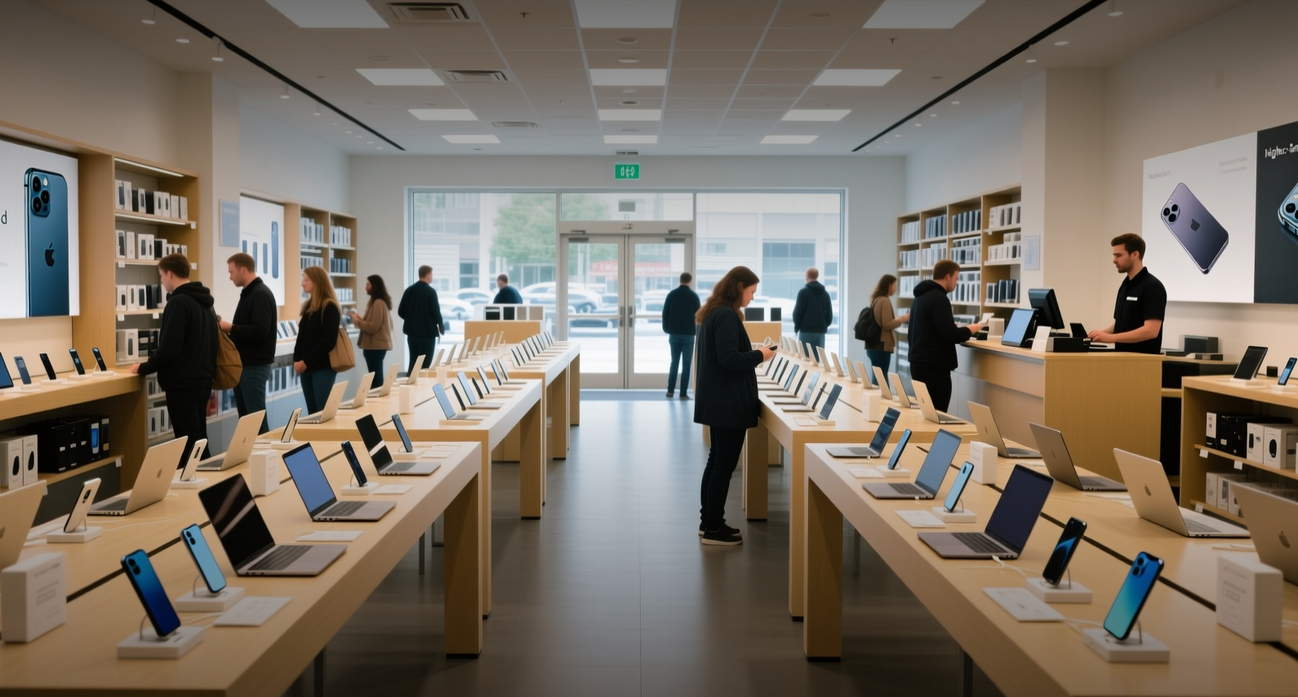
Device makers are now selling fewer machines at higher prices, and the arithmetic that decides whether that trade works is average selling price growth against unit decline — a gap that has widened to roughly 3 percentage points across the smartphone and PC markets in 2026.
"The industry has stopped pretending volume is coming back," Angelo Zino, senior equity analyst at CFRA Research, said. "Every roadmap we review now assumes flat-to-down units and asks a single question: can mix and price carry the revenue line?"
The shift is visible in the numbers. Global smartphone shipments are tracking toward roughly 1.2 billion units in 2026, down from a 2016 peak of about 1.47 billion, according to IDC. PC shipments are running near 260 million units a year, well below the 365 million shipped in 2011. Yet revenue has held: Apple's iPhone revenue rose 13% year over year in its fiscal third quarter of 2026, and the company's gross margin reached 46.3%, up from 45.2% a year earlier, according to its quarterly filing. Samsung Electronics' mobile experience division reported a similar pattern, with revenue up while handset sell-in volumes were roughly flat.
The mechanism is price. Apple's iPhone Pro models now start at $1,099, and the Pro Max at $1,199 — price points that did not exist a decade ago. Samsung's Galaxy S Ultra line sits at $1,299. On the PC side, Dell Technologies and HP Inc. have both pushed premium tiers above $1,500, while Lenovo Group's premium mix has climbed as a share of total notebook shipments. Counterpoint Research estimates the share of smartphones sold above $600 has risen to about 30% of the market, from roughly 20% five years ago.
The cost side is what makes the bet fragile. Memory prices have climbed sharply through 2026 as AI data-center demand absorbs DRAM and NAND capacity, raising the bill of materials for every handset and notebook. TrendForce data shows contract prices for conventional DRAM rising by double digits sequentially in the third quarter. That squeezes the very margin premiumization is supposed to protect — a $1,199 phone with a $60 higher memory cost loses five points of gross margin before any other input moves.
The AI feature is the price justification
Every premium tier now carries an AI story, and that story is doing the pricing work. Apple Intelligence, Samsung's Galaxy AI, and Qualcomm's Snapdragon 8 Elite platform are marketed as reasons to pay up, not as reasons to buy more devices. Qualcomm's own guidance implies handset ASPs rising even as its unit volumes stay flat, with the company leaning on premium-tier content gains rather than shipment growth.
The risk is that AI features have not yet produced a measurable replacement cycle. Consumers are holding phones for roughly three and a half years, up from about two and a half years in 2018, according to Counterpoint. A longer hold period means each premium sale must carry more revenue than the two mid-range sales it replaced.
Wearables and accessories show the same pattern with a smaller base. Apple's wearables, home and accessories segment has seen unit softness offset by higher-priced configurations, and the company has leaned on services revenue — which carries gross margins above 70% — to fill the gap. That services cushion is not available to Dell, HP, or Lenovo, whose businesses remain hardware-first.
What the market is pricing
The equity market has already rewarded the mix story. Apple trades near 32 times forward earnings, a premium to the S&P 500's roughly 22 times, and above its own five-year average of about 27 times. Dell and HP trade at roughly 14 and 11 times forward earnings respectively, reflecting investor skepticism that PC premiumization can offset a market that has not grown in 15 years.
Analyst positioning is split along that line. Morgan Stanley's Erik Woodring has argued that Apple's installed base of more than 2.3 billion active devices gives it pricing power that hardware peers lack, while several PC-focused analysts have cut unit forecasts for 2027 on the view that enterprise refresh budgets are being redirected toward AI servers rather than laptops.
The test arrives with the holiday quarter. If premium mix holds and memory costs stabilize, hardware gross margins stay in the mid-40s for Apple and the high teens for PC makers. If memory keeps climbing while units keep falling, the premiumization trade becomes a margin story with no volume floor underneath it — and the companies with services revenue to absorb the shock will be the ones that keep their multiples.
This article is for informational purposes only and does not constitute investment advice.