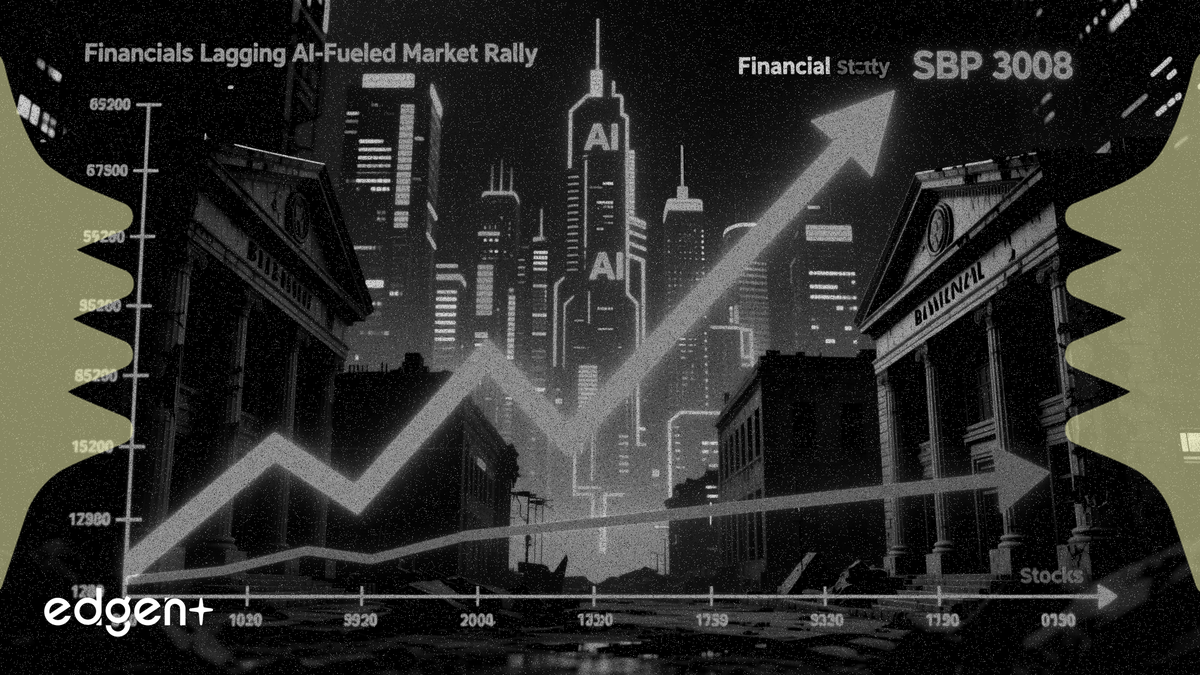
A key sector of the U.S. economy is flashing a warning sign, diverging from the S&P 500's record-setting rally by the widest margin in over 25 years.
The S&P 500 Index has climbed 7% this year to repeated new highs, but the financial sector has fallen 6% over the same period, creating a 13-point divergence that has historically preceded market downturns.
"American equities cannot advance without the support of the financial sector," Scott Brown, a technical analyst at Brown Technical Insights, said in a note. "History shows that financial stocks need to at least participate in a rally, and right now they are not participating at all."
The Financial Select Sector SPDR ETF (XLF) is trading below its 200-day moving average, a key long-term trend indicator. According to data from Brown, in 32 prior instances where the S&P 500 set a new high while the XLF was below this line, the broader index fell 29 times within a month for an average loss of 3.3%. The relative performance of the financial sector ETF against the S&P 500 has now fallen to its lowest level since the fund's inception in 1998.
This divergence highlights the narrowness of the current market, where a handful of AI-related technology stocks are driving index gains. The weakness in financials, a barometer for economic health, raises questions about the rally's sustainability and could signal broader economic instability not yet reflected in headline index levels.
A Rally on Narrow Foundations
The S&P 500's headline strength masks significant underlying weakness. The current rally is largely concentrated in a small cluster of large-cap technology firms tied to artificial intelligence, which are estimated to be driving 30% to 40% of the S&P 500's performance. This concentration explains how the broader index can advance while a critical, economically-sensitive sector like financials is in decline.
When market gains are concentrated in a small group of companies, the entire system becomes more sensitive to shifts in expectations for that single theme. While the AI growth story is powerful, this market structure is inherently fragile. A healthy market is defined by the breadth of its gains, reflecting diverse sources of growth across multiple sectors.
Historical Precedent and Defensive Positioning
This is not the first time the financial sector has diverged from a rising market ahead of a correction. The XLF's relative performance began to weaken 11 months before the S&P 500 peaked in the dot-com bubble and eight months before the 2008 financial crisis. While analysts suggest a turn to outright bearishness is difficult in the current environment, the signal warrants a cautious approach.
For investors, this may be a time to consider bolstering portfolio resilience rather than chasing performance in high-flying tech names. Proactive allocation into defensive areas of the market can help mitigate downside risk while preserving participation if market conditions improve.
In the current backdrop, investors may consider ETFs focused on quality, defensive, and value factors. These strategies prioritize companies with strong fundamentals, consistent earnings, and reasonable valuations, which can provide a buffer against volatility. Notable funds in these categories include the iShares MSCI USA Quality Factor ETF (QUAL), the Utilities Select Sector SPDR Fund (XLU), and the Vanguard Value ETF (VTV).
This article is for informational purposes only and does not constitute investment advice.