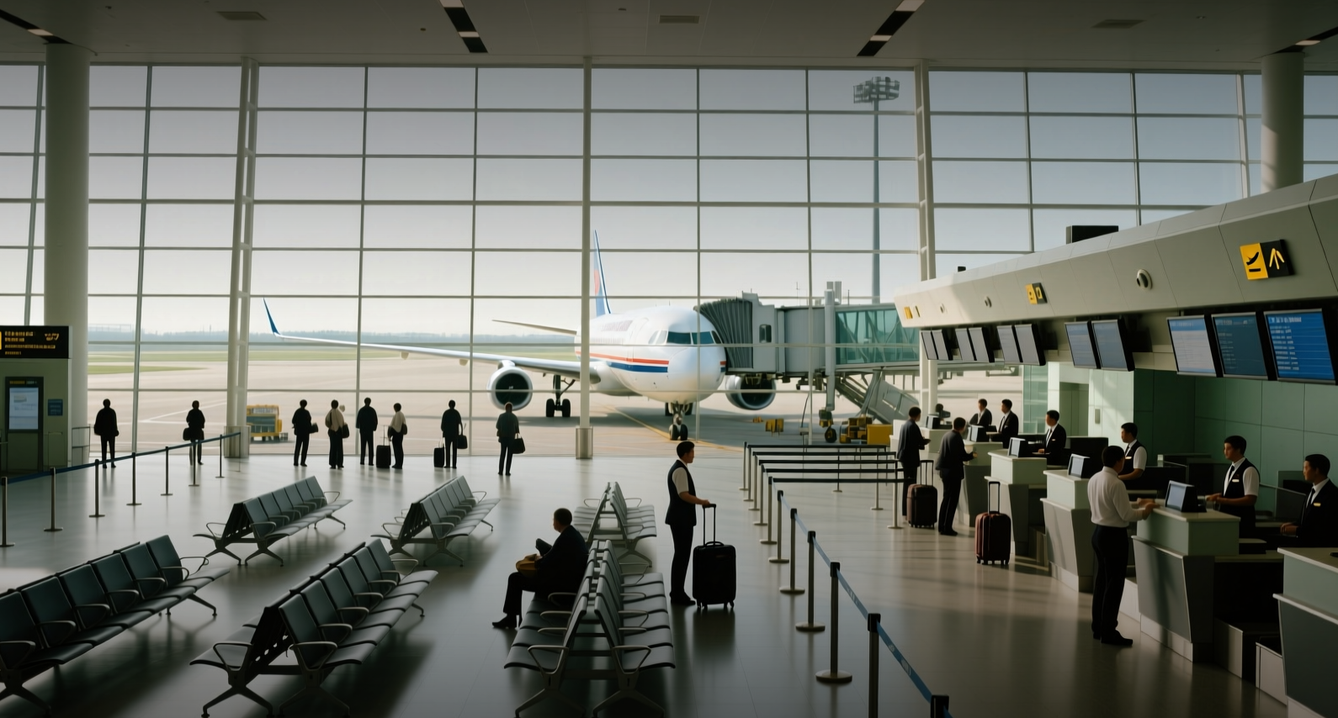
A single frequency fault at the Philadelphia air-traffic control hub left Newark Liberty International Airport shut to both inbound and outbound traffic for over three hours Monday, pushing average departure delays to 135 minutes and total delays past 200 by midday.
The FAA said the disruption stemmed from "issues with some frequencies at Philadelphia TRACON," the combined terminal radar approach control facility that serves both the Philadelphia and Newark airspace. The agency issued an initial ground stop for inbound Newark flights shortly after 10 a.m., then extended it to departures, with the restriction scheduled to run until 1:45 p.m. The FAA put the probability of a further extension at 30 percent to 60 percent.
"Ground stops of this kind are a capacity-management tool, not a safety event — controllers lose a radio frequency and the only way to keep separation margins intact is to stop feeding aircraft into the sector," said Elena Fischer, an analyst covering regulatory and infrastructure risk at Edgen. "The tell is how long the return-of-service estimate keeps sliding. It moved several times Monday, which means the fault was not a simple reset."
The FAA also paused flights into Philadelphia International Airport and Teterboro Airport, spreading the disruption across three of the busiest fields in the Northeast corridor. Flight tracking data showed dozens of jets queued on a Newark runway awaiting takeoff. The agency described the information as preliminary and subject to change.
The operational damage concentrated at Newark, where the ground stop began shortly after 10 a.m. and the estimated return of service was pushed back repeatedly, most recently to 12:45 p.m. before the restriction was extended again to 1:45 p.m. TRACON facilities handle approach and departure sequencing for multiple airports at once, so a single degraded frequency set propagates across every field in its coverage area rather than staying contained to one runway.
United waives fees as carriers absorb the schedule hit
United Airlines, Newark's largest carrier by departures, said it would waive change fees for travelers affected by the disruption. The waiver covers rebooking costs that would otherwise fall on passengers, shifting a portion of the disruption's cost onto the carrier's own balance sheet.
For airlines, a ground stop of this length compresses revenue in two directions. Aircraft and crews sit out of position, which cascades into later departures and cancellations well after the original restriction lifts, and rebooking waivers remove the fee revenue that normally offsets some of that cost. Newark's delay profile — 135 minutes average on departures as of noon — sits well beyond the threshold at which carriers typically begin cancelling rather than delaying, because crew duty-time limits make long tarmac waits operationally unworkable.
The event lands on a sector already carrying elevated scrutiny of air-traffic infrastructure reliability. Back-to-back control disruptions have pushed the question of FAA facility modernization from a budget line item into an operational risk that carriers and airport operators must price into scheduling. Investors in airline and airport infrastructure equities have treated each recurrence as a fresh data point on how much slack the system actually holds.
The regulatory question behind the frequency fault
The FAA has not disclosed what caused the Philadelphia TRACON frequency issues, and the agency said the details remain preliminary. That gap matters because the fix path differs sharply depending on the cause: a hardware failure at a single facility implies a localized repair timeline, while a systemic degradation across the frequency architecture points to a longer modernization cycle and a wider set of affected facilities.
TRACON consolidation has been a long-running theme in FAA planning, with the agency combining approach-control functions across metropolitan regions to cut cost and standardize equipment. The trade-off is concentration risk — the same design that makes a facility efficient to operate makes its failure mode broader. Monday's outage is a live demonstration of that trade-off, with three airports grounded by a fault at one site.
What happens next hinges on two disclosures. The FAA's return-to-service confirmation will determine whether Monday's delays resolve within the day or bleed into Tuesday's schedule, and the agency's account of the root cause will determine whether this becomes a single-facility repair or a trigger for broader scrutiny of frequency infrastructure across the TRACON network. Carriers including United will be watching the second question more closely than the first.
This article is for informational purposes only and does not constitute investment advice.