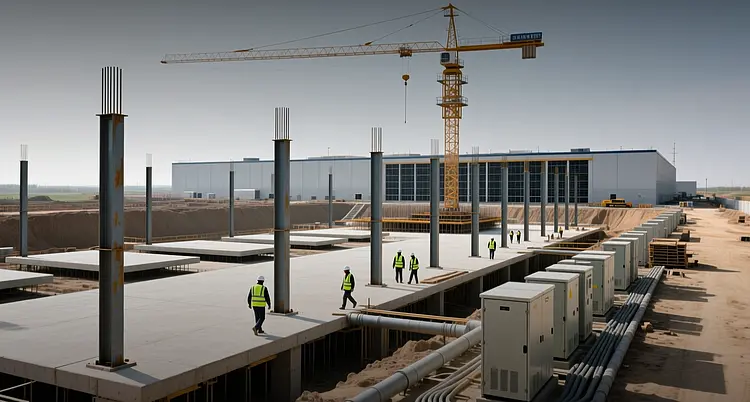
Equinix will spend $5 billion to $7 billion a year on new data center construction, a pace that would roughly replicate the capacity it added over its first 27 years in the next three to four, executives said at a Bank of America REIT conference.
"We're just a very customer-centric organization," Stu Thompson, Equinix's senior vice president of global real estate, said. "All of that is really because of the demand signals."
The Redwood City, California-based company owns and controls about 3 gigawatts of designed power, with 600 megawatts to 700 megawatts currently under development, spanning site work to vertical construction. Thompson said Equinix expects roughly 1 gigawatt under production by the beginning of next year and has visibility into power and permits for the remaining capacity. Ryan Burke, vice president of investor relations, said planned additions over the next three to four years could equal everything the company delivered in its prior 27 years.
The build is underwritten to cash-on-cash returns above 20%, with a target in the low 20% range and a two-to-three-year stabilization period per asset. That return threshold is the number that decides whether the program is accretive to adjusted funds from operations or a drag on a REIT that also carries a dividend commitment.
Where the demand signal comes from
Equinix's roughly 11,000 customers and more than 522,000 cross-connects give it a read on how enterprises are preparing for AI. Arquelle Shaw, president of the Americas, said that at a customer advisory board meeting more than a year ago, most participating large financial-services and Fortune 500 customers had not begun their AI journeys. A year later, each had started implementation, at varying stages.
Shaw said the majority of Equinix's business remains unrelated to AI today, and neocloud customers — the GPU-rental operators that have driven much of the sector's headline growth — represent about 1.5% of revenue. The company's bet is that AI inference, rather than training, pulls enterprise data across clouds, networks and end users, lifting interconnection demand. That is a slower-burning revenue line than a single hyperscaler lease, and it depends on Equinix's existing 270-plus facilities rather than new greenfield sites.
The demand backdrop is not in question. Nvidia said on its August earnings call that the top five U.S. hyperscalers are on track to spend $800 billion this year, rising to $1.3 trillion in 2027, a figure that excludes neocloud providers and AI labs such as OpenAI and Anthropic. PwC estimates cumulative AI infrastructure spending through 2050 could reach $31.6 trillion, with annual data center outlays climbing from about $800 billion in 2026 to $1.8 trillion by 2050.
Equinix is not chasing that spending at any cost. Thompson said the company does not announce projects before it controls the necessary capacity, drawing a distinction with what he called "bragawatts." About 30% of cabinets were pre-sold in the prior quarter, and Shaw said Equinix builds a customer mix into each facility's business case, balancing small, medium and large tenants rather than filling a site with a few large accounts.
Density, power and the local veto
The physical specification of the builds has changed. One of Equinix's newest U.S. facilities supports an average of up to 18 kilowatts per cabinet, against roughly three kilowatts when Thompson joined the company. New sites are being prepared for liquid and chip cooling, and some retain room for additional generators.
Power availability and local political resistance are the constraints executives acknowledged. Thompson said his responsibilities have increasingly included public-policy strategy as data centers draw greater public attention, and that the industry "needs to do a better job of telling the story," citing misinformation alongside legitimate community concerns. Equinix works with local authorities, community stakeholders and power providers before construction begins.
Maintenance capital expenditure remains a low-single-digit percentage of revenue, Burke said, because customers update their own IT equipment while Equinix supplies space, power, security and interconnection. The company can also redevelop owned properties to raise real-estate yields, which lowers the incremental cost of the expansion relative to greenfield development.
For investors, the arithmetic is straightforward and unresolved. A $5 billion to $7 billion annual program against low-20% cash-on-cash returns implies roughly $1 billion to $1.4 billion of stabilized annual cash yield once assets lease up, but the cash leaves the balance sheet two to three years before it arrives. Equinix shares trade as a rate-sensitive REIT, and Thompson said the development returns provide support amid interest-rate pressure. Peers including Digital Realty and American Tower face the same funding question, while power and cooling suppliers such as Vertiv and Eaton capture the spending regardless of which operator wins the lease.
The next checkpoint is the company's third-quarter results, when investors will see whether pre-sales and backlog growth keep pace with the accelerated construction schedule.
This article is for informational purposes only and does not constitute investment advice.