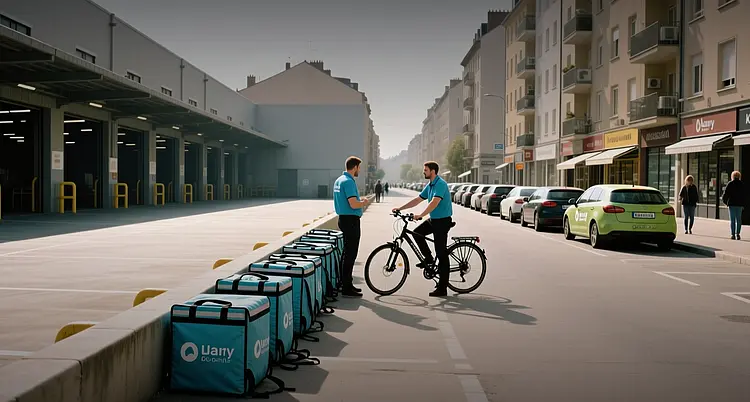
Niklas Östberg will stay on as Delivery Hero SE's chief executive past March 31, 2027, reversing a succession plan the Berlin-based company set out in May, after Uber Technologies Inc.'s $14.8 billion cash offer changed what the board called a fundamentally different set of circumstances.
"With the Uber and SSW transactions underway, we are delighted to have Niklas continue leading the company through the next phase," Kristin Skogen Lund, chair of Delivery Hero's supervisory board, said in a statement.
Östberg's contract now runs through April 30, 2029, according to the Wall Street Journal, extending a tenure that began with the company's founding in 2011. He said the period since the takeover announcement gave him room to focus on operations. "Our Everyday App strategy is working, and growth and profitability are accelerating," he said. "I am now more energized than ever to continue leading the company into this next phase."
The reversal is the first governance consequence of a deal that would create the largest food-delivery group outside China. Uber agreed in July to acquire Delivery Hero at €41.50 per share in cash, an equity value of $14.8 billion and a premium of roughly 127% over the unaffected three-month volume-weighted average share price before May 8, 2026. The combined businesses reported pro-forma gross bookings of $236 billion in 2025.
A 127% premium buys time, not certainty
The offer's size explains the board's willingness to unwind a transition it had spent four months preparing. Delivery Hero's management and supervisory boards endorsed the bid earlier this month and urged shareholders to accept it, saying the terms served the company, its shareholders, employees and other stakeholders. Prosus NV, the second-largest shareholder with roughly 17%, agreed to tender its stake — a commitment that removes the most obvious source of shareholder resistance before the vote.
Uber had been accumulating Delivery Hero stock before talks began, becoming the company's largest shareholder ahead of the announcement. That pre-positioning cuts both ways for the target's remaining investors: it signals conviction in the asset, but it also means the buyer already understood the business before pricing it.
The transaction is not a single purchase. As part of the broader structure, New York-based investment firm SSW Partners agreed to separately acquire Delivery Hero operations in 14 markets for approximately $1.6 billion. That carve-out matters for how regulators will read the deal. Divesting 14 country operations before closing reduces the overlap Uber must defend in Brussels and other jurisdictions, and it gives the combined group a cleaner geographic footprint than a straight acquisition would have produced.
What the CEO's extension signals to the market
Leadership continuity during a pending takeover is unusual, and the direction of the signal is worth stating plainly. A CEO who had already announced his departure and then reverses course is telling employees, franchise partners and regulators that the integration plan assumes the current management team is the one executing it. Delivery Hero's own framing — that the situation had changed — is the same logic a target uses when it wants to stop losing senior staff to uncertainty.
For Uber, the calculus is capital deployment against integration risk. The deal is expected to close in the second half of 2027, pending regulatory approvals, a timeline that leaves roughly a year of antitrust review and gives competitors room to respond. European food-delivery peers, including Just Eat Takeaway.com and the regional operators SSW is buying, now face a market where the number of independent scaled platforms shrinks by one. Consolidation in the sector has historically compressed delivery fees and courier costs for the surviving players while raising the bar for anyone trying to build a fourth national network from scratch.
The near-term question for Delivery Hero shareholders is whether the €41.50 offer survives contact with regulators intact. A blocked or materially conditioned deal would leave the company with a CEO contracted to 2029, a strategy built around the Everyday App, and no takeover premium — the outcome the 127% markup was designed to make unnecessary. Uber shares and Delivery Hero's Frankfurt-listed stock will trade the approval calendar from here, with the first substantive regulatory signals expected well before the second-half 2027 target.
This article is for informational purposes only and does not constitute investment advice.