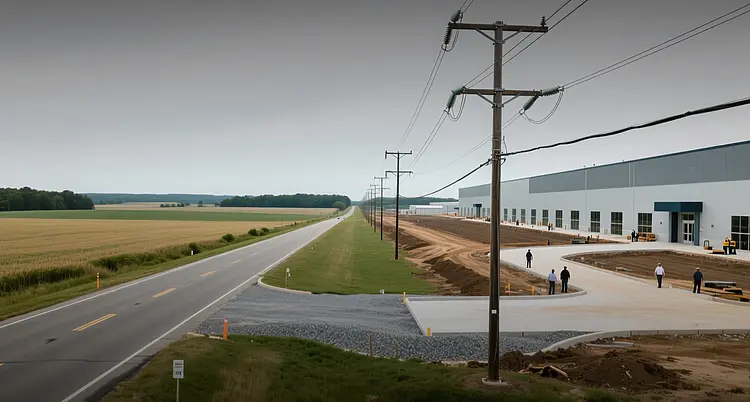
Local opposition and statehouse legislation blocked or delayed at least 45 US data center projects worth nearly $68 billion between April and June, more than half of all new large-scale facilities tracked in the quarter, as Microsoft, Alphabet and Amazon confront a permitting bottleneck that no amount of capital can buy through.
"The biggest obstacle data centers face right now is being a political target on both the left and the right, and we're in an election cycle where more money is going to flow into that," Amanda Peterson Corio, global head of data center energy at Google, said at a climate conference in New York this week.
The Q2 figure follows at least 75 projects worth roughly $130 billion disrupted in the first three months of 2026, according to Data Center Watch, which counted more than 840 active opposition groups across every state except Hawaii. Petition signatures gathered in the first quarter alone nearly matched the total for the entire second half of 2025. Nearly 600,000 signatures were collected against a 69,000-square-foot facility proposed next to the Nashville Zoo; the city imposed a moratorium that developer DC Blox is now contesting in court.
The pressure has moved from the zoning board to the statehouse. About 30 state legislatures have introduced or adopted bills, resolutions or executive actions this year covering project siting, infrastructure cost-sharing, and electricity and water constraints, according to Data Center Watch. Virginia's Loudoun County, home to more than 250 data centers, directed staff last week to prepare a 12-month moratorium on new applications. Sarasota County, Florida imposed its own pause in July, and North Port commissioners are weighing an 18-month moratorium that would freeze applications already filed — including one submitted on July 20, hours before the commission first discussed the measure.
Loudoun County, a 250-facility hub, moves to pause
The Loudoun County action matters because of what it sits on top of. The northern Virginia cluster is the densest concentration of computing capacity on earth and the primary landing zone for the buildout plans of Amazon Web Services, Microsoft Azure and Google Cloud. A 12-month freeze on applications there does not cancel existing capacity, but it removes the default option that hyperscalers have relied on for a decade when other markets turn hostile.
Illinois Governor JB Pritzker told a climate event that community concerns are "legitimate," citing water use, noise and zoning alongside electricity demand, and set conditions rather than calling for an outright ban. "If we're going to allow them, we have to make sure they bring their own clean energy and use closed-loop water systems," he said. "That has to be required."
Those conditions carry a price. On-site clean generation and closed-loop cooling raise upfront capital cost per megawatt and lengthen the interval between site selection and first revenue, which is the metric that matters for a hyperscaler trying to convert capex into AI capacity on a schedule. Brook Porter, a partner at G2 Venture Partners — an early investor in Crusoe, which is building OpenAI's large Abilene, Texas project — argued the intensity of the opposition is "a little irrational," rooted in the fact that most people have not yet experienced benefits from AI. "Right now it's just a scary threat, like it's going to take my job," he said.
The hyperscalers are responding on three fronts: cost, labor and water. Microsoft Chief Sustainability Officer Melanie Nakagawa said community questions have pushed the industry into a serious discussion about "what consumers should expect on the power side," and that the company is working to isolate data center costs so they are not passed to ordinary ratepayers, while focusing on workforce support and water efficiency. Microsoft disclosed site-level water consumption data for each of its data center campuses in this year's sustainability report. Amazon Chief Sustainability Officer Kara Hurst said the company does not use water-based cooling 90% of the time, calling that "an important data point because there's a lot of misinformation about water use," and called for policy that supports investment in wind, solar and nuclear generation.
The bill lands on ratepayers, and banks are circling
The cost question is where the politics get concrete. A bill in Congress aimed at limiting data center-driven electricity price increases passed to consumers is working its way through the chamber, and Data Center Watch expects data center issues to become a flashpoint in the midterm elections, with Republicans and Democrats both backing away from new projects as backlash has grown.
The same electricity demand is drawing the largest banks into grid financing. JPMorgan Chase's global head of sustainability, Heather Zichal, said the bank planned to meet with more than 100 clients during this week's New York conferences, with grid modernization financing among the core topics. "We are entering an era where access to power will increasingly determine where companies invest, grow and compete," Zichal said.
World Bank President Ajay Banga poured cold water on the idea that emerging markets can absorb the overflow. "Emerging markets don't have many data centers, and they won't — trust me," he said. "You need a lot of compute, you need a lot of power — in some cases more than developed countries can supply, let alone these developing countries."
For investors, the read-through splits three ways. Hyperscaler capex is not shrinking — Amazon alone is spending $220 billion in capital expenditure in 2026, and its carbon footprint rose for a second consecutive year in 2025 as the buildout accelerated — but the conversion of that spending into revenue-generating capacity now runs through county commissions and state legislatures, which is a slower and less predictable process than ordering servers. Utilities, electrical equipment makers and the banks financing transmission upgrades are on the other side of the trade, since every delayed project still has to be powered eventually. The middle group is the one to watch: developers and colocation operators with concentrated exposure to a single hostile jurisdiction, where a moratorium can strand land and interconnection queue positions that were priced as certain.
Amazon's Hurst, asked about the gap between voluntary disclosure and a national reporting framework, said voluntary reporting lets companies publish data, have scientists test the methodology, and revise it — rather than locking in a flawed standard. "We're saying, hold us accountable for our practices," she said. There is currently no US national framework requiring hyperscalers to report data centers' environmental impact, and with 30 statehouses writing their own rules, the accountability standard is being set jurisdiction by jurisdiction.
This article is for informational purposes only and does not constitute investment advice.