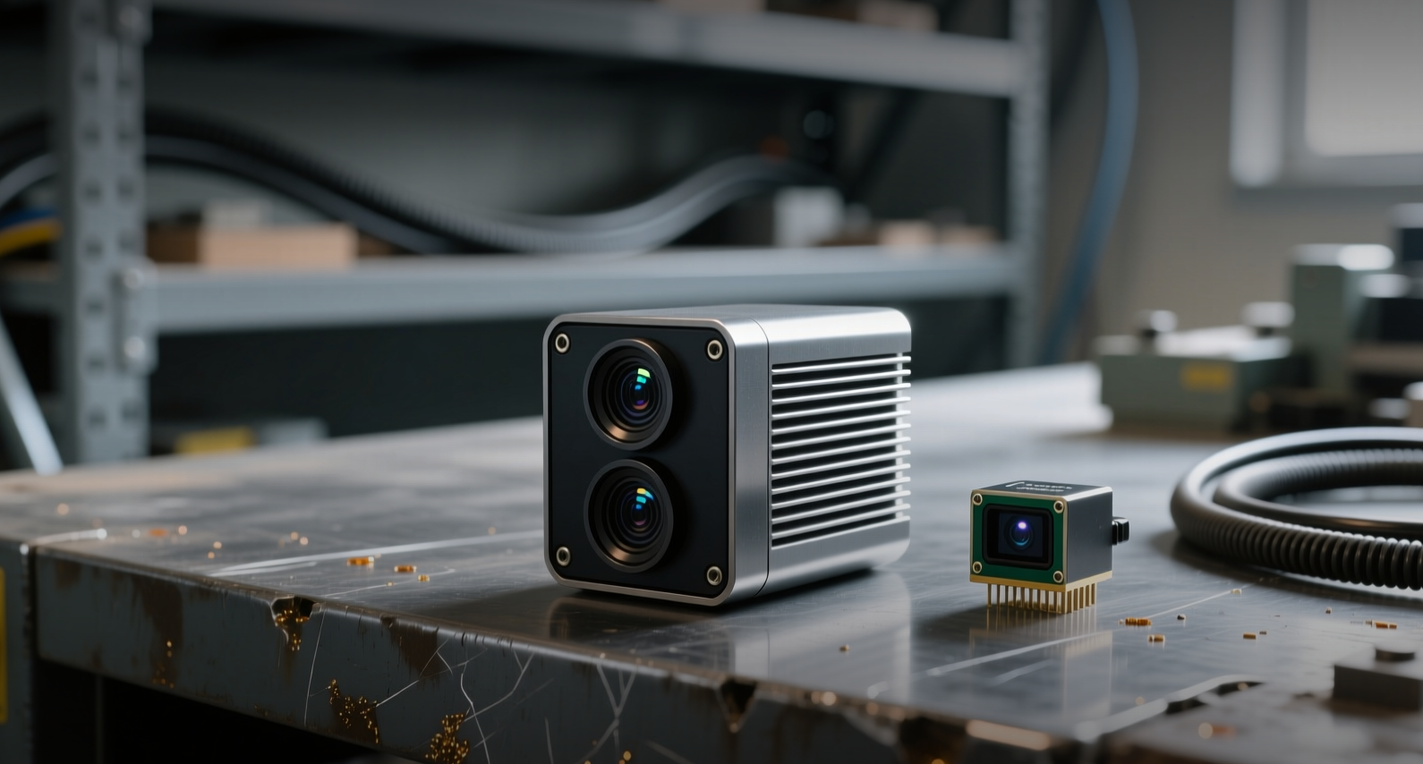
Cognex will pay $500 million in cash for RealSense, a depth-sensing camera maker spun out of Intel in 2025, in a deal that moves the industrial machine-vision leader into robotic perception and the software layer of Physical AI. The purchase price is funded entirely from Cognex's existing cash and investments, which stood at $755 million at the end of the second quarter, and the company expects the transaction to close in the fourth quarter of 2026.
"RealSense represents a compelling strategic expansion for Cognex into robotic perception, one of the most attractive adjacent markets in machine vision," Matt Moschner, president and chief executive officer of Cognex, said in a statement announcing the agreement. "Combined with Cognex's machine vision expertise and global reach, RealSense positions us to offer a full-stack visual intelligence platform."
The target is small in revenue terms and expensive on a multiple basis. RealSense is expected to generate $80 million to $90 million of revenue in 2026, growth of more than 50% over the prior year, which implies roughly 5.6x to 6.3x forward sales. Cognex trades at about 4.7x its own 2026 revenue guidance of $1.13 billion to $1.15 billion, according to the company's August guidance. RealSense carries a gross margin in the low 50% range, below Cognex's own profile, with management pointing to a path toward the mid-50s and eventually the high 50s as volume scales.
The strategic case rests on a market that is small today and forecast to grow quickly. Cognex estimates robotic perception is worth about $600 million now and will expand at more than 25% annually to roughly $1.6 billion by 2030. RealSense has shipped more than 1 million units, holds more than 70 patents and patent applications, employs about 160 people, and runs a software development kit downloaded more than 1.2 million times, with roughly 20,000 active developers. Its recently launched D585 system combines depth sensing, onboard AI and edge computing to calculate depth on the device up to 30 times per second.
The two product lines are complementary rather than overlapping. Cognex systems are built for precision measurement and guidance of fixed-arm robots in controlled factory settings, while RealSense hardware is designed for higher-frame-rate depth sensing that supports real-time motion, localization and collision avoidance. Fixed-arm and autonomous mobile robot deployments carry the near-term revenue, concentrated in automotive, logistics, semiconductor manufacturing, warehouse automation and e-commerce. Quadrupeds and humanoids are treated as longer-term optionality rather than a requirement of the investment case.
Retention costs push the real outlay past $600 million
The headline price understates the total commitment. Cognex expects to fund a three-year cash retention program for RealSense employees with a target value of about $56.5 million, subject to performance modifiers, and to grant restricted stock units valued at roughly $50 million that vest over three years. Both are incremental to the purchase price, taking the total package to about $606.5 million before any transaction fees. Evercore advised Cognex on the deal; no advisor to RealSense was disclosed.
Cognex said the acquisition will not materially affect its 2026 results because of the expected closing timing and financial-period alignment, which means the first full contribution lands in 2027. Over the longer term, management expects RealSense to reach Cognex's through-cycle framework of 25% to 31% adjusted EBITDA margins and free-cash-flow conversion above 100%, supported by scale and by selling through Cognex's existing commercial infrastructure. Dennis Fehr, Cognex's chief financial officer, described the transaction as "highly aligned with our disciplined M&A strategy" and said RealSense is expected to be "strongly accretive to Cognex's growth profile."
The deal is the clearest signal yet that machine-vision vendors are repositioning around robotics rather than factory inspection alone. Cognex competes with Keyence, Basler and Teledyne FLIR in industrial vision, and with Intel's own RealSense successor products, Nvidia's Isaac robotics platform and Chinese depth-camera suppliers in perception. Nvidia has pushed its Jetson and Isaac stack as the default compute and simulation layer for humanoid and mobile robots, and depth sensing is the input that stack requires. Owning a camera platform gives Cognex a position in that supply chain that its inspection business alone does not provide.
RealSense will spin out its Facial Authentication product line into an independent company before closing, retaining the functions needed to pursue its biometrics strategy separately. That carve-out removes a business with different customers and compliance requirements from the deal perimeter. Cognex shares fell 4.19% to $59.39 in Cboe BZX trading on the announcement, against a 52-week gain of 65.33%, while the consensus target price among 20 analysts sits at $80.05, implying 29.14% upside from the last close. The stock reaction suggests investors are weighing the cash outlay and integration work against a revenue contribution that will not show up in reported numbers until 2027.
This article is for informational purposes only and does not constitute investment advice.