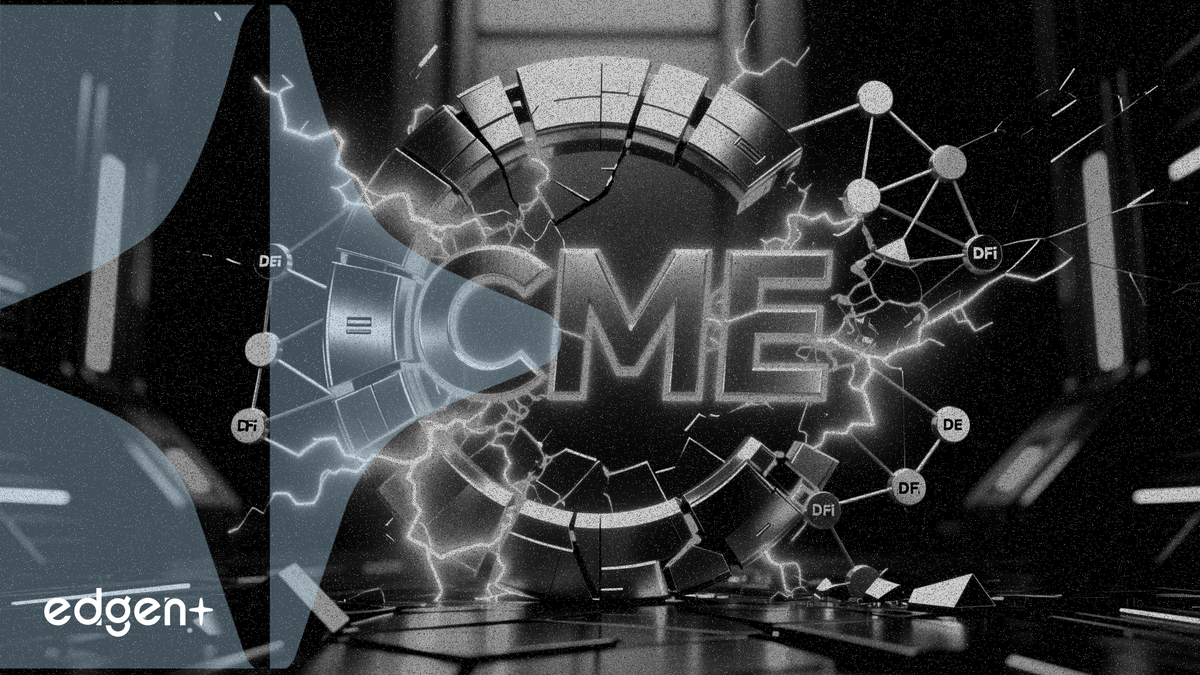
CME Group, the world's largest derivatives exchange, will launch 24/7 trading for its cryptocurrency futures and options on May 29, a significant expansion for a product line that reached $3 trillion in notional volume in 2025.
"Launching 24/7 trading for cryptocurrencies will provide regulated always-on risk management in a space that literally never sleeps and we are excited to bring that to market,” Giovanni Vicioso, global head of cryptocurrency products at CME Group, said in a recent interview.
The exchange's crypto complex is running 46% above its 2025 volume pace year-to-date, according to the company. The move to continuous trading follows the recent launch of futures for Avalanche (AVAX) and Sui (SUI), expanding CME's offerings to nine digital assets that represent more than 75% of the crypto market's capitalization.
This expansion puts CME in direct competition with crypto-native venues like Hyperliquid, which have long dominated the 24/7 derivatives landscape with products like perpetual futures. The ensuing rivalry could reshape market structure, as legacy exchanges reportedly push for tighter regulatory scrutiny of their fast-growing decentralized counterparts.
The Great Divide
The core of the conflict lies in the different operating models. CME acts as a neutral intermediary, matching buyers and sellers and earning fees independent of trading outcomes. In contrast, platforms like Hyperliquid use an internal liquidity vault, HLP, which acts as the direct counterparty to all trades. This means HLP profits when traders lose, creating what critics call an asymmetric risk structure.
Regulatory Crossroads
This structural difference is at the heart of a regulatory debate in the U.S. Terry Duffy, CEO of CME Group, has argued that perpetual futures—contracts without an expiry date that are popular on platforms like Hyperliquid—are "illegal" under the current Commodity Exchange Act. However, CFTC Chair Michael Selig has indicated the agency is working to clarify its stance, potentially allowing for regulated perpetual futures in the U.S. market soon. This regulatory uncertainty has so far pushed much of the perpetuals trading volume offshore.
An Industry in Motion
The entire sector is racing to expand. Coinbase Derivatives now offers 24/7 leveraged futures trading, while Kraken, through its acquisition of Bitnomial, now owns a complete CFTC-licensed derivatives stack in the U.S. These moves signal a broader convergence between traditional finance and crypto, with the control of 24/7 global markets as the ultimate prize.
This article is for informational purposes only and does not constitute investment advice.