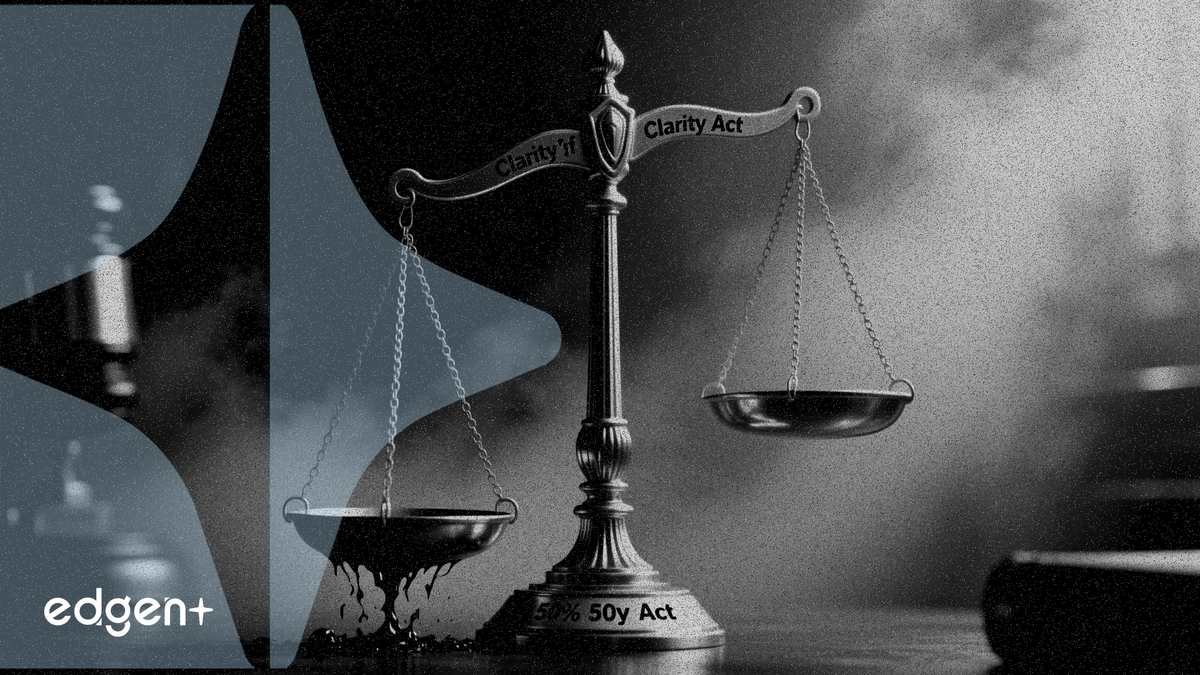
(P1) The Clarity for Digital Tokens Act has less than a 50 percent chance of passing the current Senate session, according to GSR’s legal chief, who points to unresolved legislative conflicts even as the bill recently cleared a key committee.

(P2) "The Clarity for Digital Tokens Act has less than a 50% chance of passing the current Senate session," Joshua Riezman, the legal chief of GSR, publicly stated, attributing the low odds to "legislative concerns over stablecoin yield and ethics."

(P3) The bill advanced from the Senate Committee on Banking in a 15-to-9 vote, but the bipartisan support was fragile. Two Democrats who voted for the bill, Senators Angela Alsobrooks and Ruben Gallego, said they would not support it in a full Senate vote without changes to ethics provisions, which Republicans have so far resisted.

(P4) The legislation’s failure would prolong regulatory ambiguity for the U.S. crypto industry, potentially hindering growth and pushing innovation to other jurisdictions. The bill now proceeds to a full Senate vote, likely in June, where it must secure 60 votes to become law.

### Expert Pessimism vs Market Optimism
Riezman's cautious assessment stands in sharp contrast to the sentiment on prediction markets. Data shows traders are pricing in a 68.5% probability that the Clarity Act will be signed into law in 2026, a figure that jumped from 58% after the bill’s bipartisan approval in the Senate Banking Committee.

The market’s positive reaction was also reflected in digital asset prices following the committee's vote. While Bitcoin and Ethereum saw modest gains, tokens sensitive to regulatory developments rose more sharply. Hyperliquid (HYPER) gained around 11 percent as traders bet on clearer rules for crypto derivatives, while XDC and Canton (CANTO) each rose nearly 10 percent on renewed interest in regulated on-chain finance.

### The Path Forward
The Clarity Act aims to create a unified framework for U.S. digital asset markets, defining which tokens fall under the Securities and Exchange Commission (SEC) and which are governed by the Commodity Futures Trading Commission (CFTC). The latest version includes new language on insider trading, bankruptcy protections, and a 360-day effective date after enactment.

Despite clearing the committee, the bill faces significant hurdles. Democratic senators have objected to President Donald Trump’s business investments in digital assets and are insisting on ethics provisions to limit officials from profiting from cryptocurrency. Disagreements also remain over the treatment of stablecoin rewards and rules for decentralized finance (DeFi). The bill must now be merged with a version from the Senate Agriculture Committee before the full Senate can vote.

This article is for informational purposes only and does not constitute investment advice.