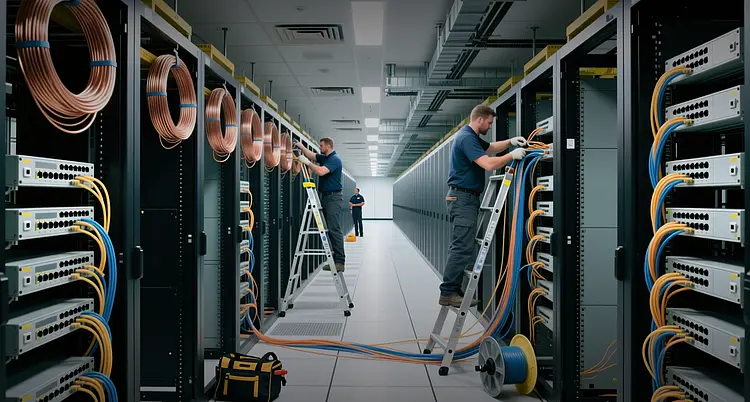
Cisco Systems and a cohort of long-neglected networking and hardware vendors are being pulled back into the critical path of AI data-center construction, reversing roughly two decades in which investors treated the sector as a legacy afterthought.
"Everybody forgot about them for 20 years," the market's re-rating of these names now runs on a single premise: that the switches, routers, optics and cabling moving data between racks of AI accelerators are as scarce as the chips themselves. "And now suddenly they're important again," the framing goes, as capital rotates toward the unglamorous plumbing of the buildout.
The shift is structural rather than cyclical in one respect and fragile in another. Demand for AI data-center capacity is the root driver — hyperscalers and neocloud operators are commissioning power and floor space faster than they can fill it, and every megawatt of new capacity requires a networking layer to connect thousands of GPUs into a single training cluster. That is a hardware problem Cisco and its peers have solved for decades. The second driver is sentiment: investors are re-rating "forgotten" legacy tech names as AI infrastructure plays, a narrative that can move multiples in days even when order books take quarters to confirm.
The distinction matters because the two drivers decay at different speeds. Capex-driven demand persists as long as hyperscaler budgets grow; narrative-driven re-rating can reverse on a single disappointing guidance print. Cisco's own history is the cautionary case — the company spent the dot-com era as the most valuable company in the world, then spent the following 20 years being valued as a mature, low-growth hardware supplier while software and cloud names absorbed the market's enthusiasm.
The bottleneck moved from chips to cabling
The mechanics of the re-rating are straightforward. Training a frontier model requires tens of thousands of accelerators to operate as one machine, which means the interconnect — the switches, optical transceivers and high-speed cabling between them — becomes a constraint on how large a cluster can be built. Nvidia's own networking business, built around its InfiniBand and Spectrum-X product lines, exists precisely because general-purpose Ethernet gear was judged too slow for early AI clusters. That judgment is now being revisited as hyperscalers push Ethernet-based alternatives to avoid single-vendor lock-in, which returns the incumbents to the table.
The competitive field is crowded and named. Broadcom supplies custom AI accelerators and the Tomahawk switching silicon that sits inside many of the boxes; Arista Networks has taken share in cloud and hyperscale switching; Marvell and Coherent compete in optical components; Amphenol and Corning sit in the cabling and fiber layer. Cisco's position is that it sells the full stack — silicon, systems, optics and software — to customers who would rather buy one throat to choke than integrate five vendors. Whether that integration premium survives contact with hyperscalers that design their own hardware is the open question.
The demand side is concentrated. Microsoft, Amazon, Alphabet and Meta account for the overwhelming majority of AI data-center capex, and each has signaled continued spending. That concentration cuts both ways: it makes the order pipeline visible and financeable, and it means any single hyperscaler pausing a build phase ripples straight through the networking supply chain.
What investors are actually paying for
The re-rating is a bet on duration, not on a single quarter. Legacy networking vendors historically traded on modest multiples because their revenue tracked enterprise IT budgets growing in the low single digits. If AI data-center demand genuinely reclassifies a slice of that revenue as infrastructure tied to compute growth, the multiple should expand — and that is the trade investors have been making. If instead the AI contribution proves to be a cyclical bump layered on a structurally slow core, the re-rating unwinds.
The tell will be in order commentary rather than headline revenue. Watch for AI and data-center order growth disclosed separately from the enterprise segment, backlog conversion timelines, and whether hyperscaler customers are signing multi-year capacity commitments or buying project by project. A vendor that can show contracted, multi-year AI networking backlog deserves a different multiple than one booking one-off refresh cycles.
The risk is timing. Data-center construction is gated by power availability, permitting and transformer lead times, not by demand. If grid interconnection queues stretch, networking orders slip even with budgets intact — a delay that looks like a demand problem in a quarterly print. Investors buying the backbone thesis are effectively underwriting the pace of power delivery as much as the pace of AI adoption.
This article is for informational purposes only and does not constitute investment advice.