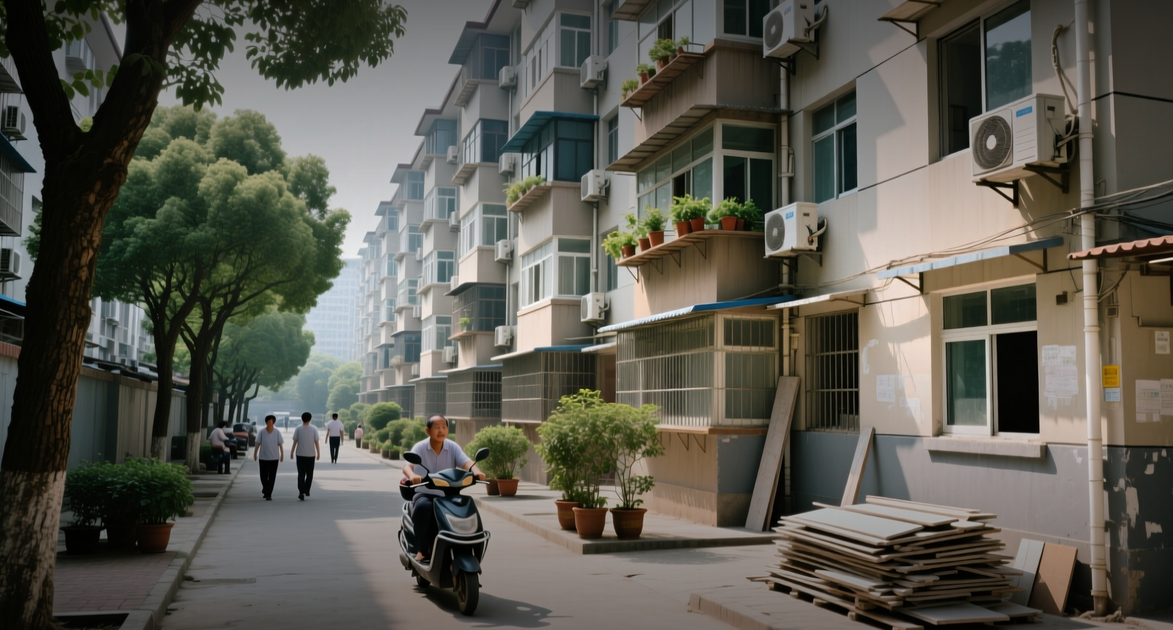
Resales have overtaken new builds as the center of gravity in Chinese housing. Second-hand transactions made up 52% of nationwide residential deals in January-August 2026, Zhang Xuetao, director of the Real Estate Market Supervision Department at the Ministry of Housing and Urban-Rural Development, said at a State Council Information Office briefing on September 18 — the first time the share has crossed half. "Exceeding 50% marks the entry into the stock era," Zhang said.
The declaration, delivered as part of the "Launching the 15th Five-Year Plan" series, was followed two days later by a People's Daily editorial arguing the shift is not a contraction of the industry but a change in what it is for. The editorial, written by the dean of Peking University's Guanghua School of Management, framed the transition as a return to housing's residential function after a long period in which its investment attributes were "continuously amplified."
The arithmetic behind the framing is stark. Nationwide new commercial housing sales area reached 498.8 million square meters in January-August, down 12.1% from a year earlier, while second-hand online-signed transaction area hit 549 million square meters, up 10.6%, according to National Bureau of Statistics data. In August alone, second-hand net-signed area grew 14% year-on-year. The two series have now crossed for several consecutive months.
That divergence is the core of the policy argument. Chen Shaowang, vice minister of Housing and Urban-Rural Development, described the sector as undergoing "two shifts, two changes, and three transformations" — urban-rural development moving from large-scale incremental expansion to stock-based quality improvement, housing undergoing both a supply-demand reversal and the arrival of the stock era, and construction turning toward intelligence, green development and integration.
Why 52% is a demand signal, not a demand collapse
The supply-side case for saturation is not new, but the ministry is now stating it as settled fact. Urban per-capita housing floor area in China exceeds 40 square meters, households own more than 1.1 units on average, and the urbanization rate is approaching 67%, according to the People's Daily editorial. On those numbers, the incremental-expansion model that drove two decades of land sales has run out of households to sell to.
What replaces it, on the ministry's account, is upgrading. The editorial describes household demand shifting from "whether you have a home" to "whether it's a good home," with "sell old, buy new" and "trade small for large" replacement transactions now the mainstream of activity. NBS price data for 70 large and medium-sized cities in June-August supports the read: in most first-tier cities, units above 144 square meters outperformed those of 90 square meters or below, a pattern consistent with upgrade demand holding up better than entry-level demand.
Price indicators have also stopped deteriorating as fast. Commercial residential prices in first-tier cities rose month-on-month in August, while month-on-month declines in second- and third-tier cities narrowed overall and year-on-year declines narrowed across all tiers. The last time resales took a majority share of a major housing market's volume — the United States in the mid-2000s and again after 2008 — resale dominance coincided with a shift in brokerage, renovation and property-management spending rather than a recovery in land revenue.
The policy stack: existing-home sales, project companies, lead banks
The ministry paired the diagnosis with three institutional changes aimed at the delivery-risk problem that has weighed on new-home demand since 2021. Zhang said the 15th Five-Year Plan period will see accelerated construction of a New Model for Real Estate Development, with an existing-home sales system promoted in commercial housing so buyers get "what you see is what you get" and delivery risk is prevented at the source. New projects will prioritize existing-home sales, supported by coordinated land, finance and tax measures; projects that still use presales will face tighter supervision of presale funds.
On the development side, the ministry will enforce a project company system — one project, one company, with independent legal-person rights and an explicit prohibition on headquarters improperly siphoning project company funds. On financing, a lead-bank system will assign a single responsible lender per project. Both measures target the capital-misallocation pattern that turned individual developer failures into sector-wide contagion.
Quality standards have moved from advocacy to enforceable specification. Chen said the new residential standards raise ceiling heights to 3 meters from 2.8 meters, require elevators in all residential buildings of four stories or more, and lift guardrail heights on balconies and open corridors to no less than 1.2 meters. The ministry's "Good Housing Construction Guide (Trial)" has completed a second round of public comment, defining four dimensions — safety and durability, comfort and health, green and low-carbon, and smart and convenient — across standards, design, materials, construction and operations. Government-subsidized housing has been designated the first implementation area.
The sequencing matters for the investment case. The 15th Five-Year Plan outline in March 2026 included "good housing" for the first time; the State Council's Urban Renewal 15th Five-Year Plan in May linked stock renovation to new-home quality; and the Expanding Consumption 15th Five-Year Plan approved in July folded housing quality improvement into the scope of major durable-goods upgrades. Urban village, dangerous building and old-community renovation are now positioned as the replacement for new construction as a stable-investment channel — a substitution that matters directly to local government balance sheets, where land-sale revenue continues to shrink.
Equities priced the framing in a single session
The market reaction was immediate and broad. The A-share real estate index closed up 3.34% on September 18, with 83 constituents advancing against 11 declining. China Vanke (000002.SZ), World Union (002285.SZ), Seazen Holdings (601155.SH) and Greenland Holdings (600606.SH) hit the 10% daily limit; China Merchants Shekou (001979.SZ) rose 6%, Binjiang Group (002244.SZ) gained 5.78% and Poly Developments (600048.SH) advanced 5.56%.
Hong Kong-listed mainland developers moved further. Jingye Mingbang Group (2231.HK) surged 17.65%, Zhenro Properties (6158.HK) climbed 13.04%, Greenland Hong Kong (0337.HK) gained 11.7%, OCT (Asia) (3366.HK) rose 11.58% and Sunac China (1918.HK) advanced 9.91%. China Vanke's H-shares (2202.HK) added 6.82%, while Yuexiu Property (0123.HK) and Seazen Group (1030.HK) each gained more than 4%.
The rally is a bet on the policy stack, not on the volume data. A rising second-hand share does not by itself mean the housing market has recovered — total transaction volume, price direction and household willingness to buy remain the variables that decide whether the decline stops. The stock era also implies a different set of institutional gaps: pricing, transaction and financing mechanisms for second-hand homes are less developed than the presale-and-land-sale machinery they are replacing, and effective demand for renovation and urban renewal has to be created rather than unlocked.
For developers, the revenue implication is mechanical. New-home sales area is already contracting at a double-digit annual rate, so earnings growth cannot come from volume; it has to come from stock asset operation, property management and renovation services, where margins are thinner and capital intensity is lower. Brokerage platforms, building-materials suppliers and home-furnishing retailers sit on the other side of the same rotation. The next hard test comes with September and third-quarter data from the National Bureau of Statistics, which will show whether the August stabilization in first-tier prices and the 14% second-hand volume growth held after the policy framing was published.
This article is for informational purposes only and does not constitute investment advice.