
China's sharp reduction in crude imports since the Middle East war began has kept Brent below $100 a barrel, but Societe Generale warns this buffer will fade as inventories tighten.
China's sharp reduction in crude imports since the Middle East war began has kept Brent below $100 a barrel, but Societe Generale warns this buffer will fade as inventories tighten.
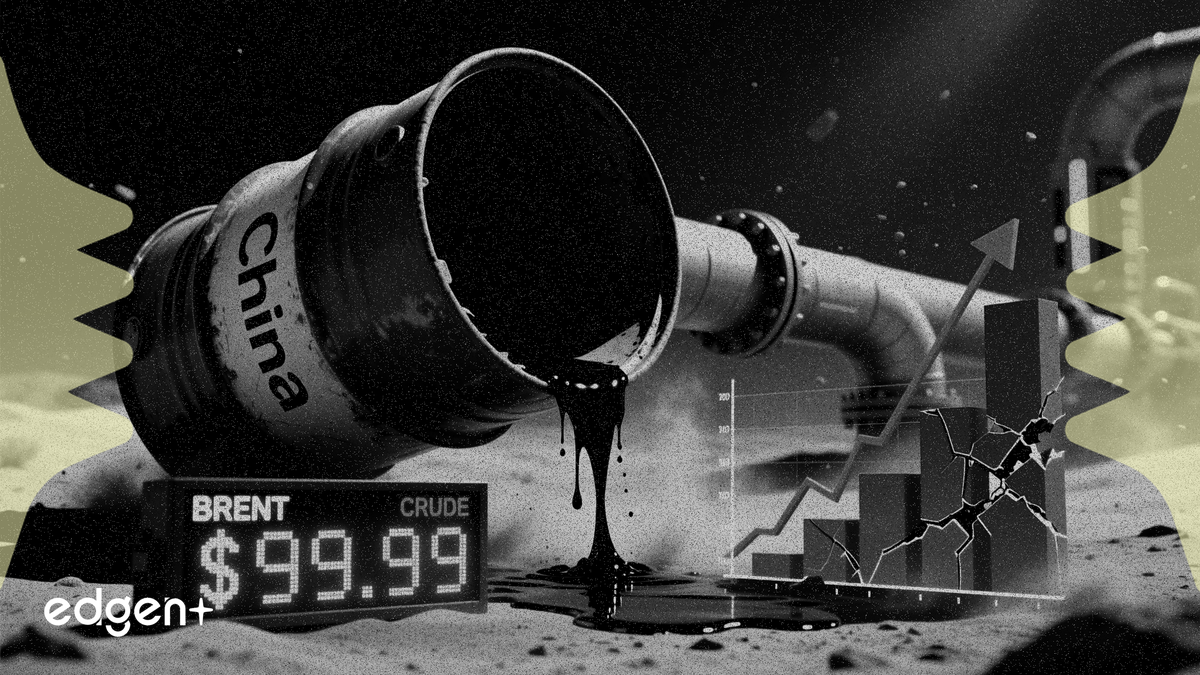
China's crude imports have fallen sharply since the outbreak of the US-Israeli war on Iran in late February, providing a critical buffer that has kept Brent crude below $100 a barrel even as the Strait of Hormuz disruption removes 14.4 million barrels of daily supply from global markets.
"The demand-side cushion from China is temporary — as inventories fall and strategic reserves are rebuilt, Brent will need to climb," a Societe Generale analyst said, warning that the current price suppression masks a tightening market.
Brent crude is trading 30 percent above pre-war levels, according to the International Energy Agency, with the Strait of Hormuz flow halted for 14 weeks. Global daily oil consumption reached 104 million barrels in April against supply of 95.1 million barrels, leaving a deficit of nearly 9 million barrels per day. Chinese refiners have delayed projects during the supply disruption, further reducing import demand.
The OECD estimates that if the war persists, global economic growth could weaken to as low as 2.1 percent in 2026, while Fitch Ratings has already cut its 2026 growth forecast by 0.2 percentage points to 2.4 percent. The Strait is not expected to reopen until July, according to Fitch, meaning oil markets will tighten further over the next two months as inventories decline and China eventually resumes normal import volumes.
The supply-demand imbalance is stark. The daily loss for Gulf oil producers versus pre-war levels reached 14.4 million barrels with the Strait of Hormuz flow halted, affecting around 20 percent of global oil and LNG trade, the IEA reported. European gas prices are 50 percent higher because of supply constraints, while fuel costs for ships surged 59 percent during this period, according to the World Maritime Council.
China's role as a demand shock absorber has been critical. The world's largest crude importer has slashed purchases since late February, with refiners postponing projects as the supply route through the Strait of Hormuz remains blocked. This demand destruction has helped offset the supply loss, keeping Brent below the $100 threshold that many analysts had expected to breach within weeks of the conflict's start.
The $100 Threshold and the Rebuild Risk
The question is how long China's demand suppression can last. Societe Generale's warning centers on two dynamics: falling global inventories and the eventual need for China to rebuild its strategic petroleum reserves. Once the Strait reopens — Fitch expects this in July — Chinese refiners are likely to ramp up imports aggressively to replenish depleted stocks, creating a demand surge that could push Brent above $100.
The OECD outlined two scenarios in its latest Economic Outlook. Under a time-limited disruption, global growth would slow from 3.4 percent in 2025 to 2.8 percent in 2026. Under a prolonged disruption scenario — which now appears more likely with the Strait closed for 14 weeks and counting — growth could fall to 2.1 percent this year and 1.8 percent in 2027, representing a potential loss of at least $700 billion for the global economy.
Broader Economic Fallout
The oil shock is rippling through the global economy. The UN Conference on Trade and Development estimates global economic growth will slow to 2.6 percent in 2026, warning that 65 net oil-importing countries — home to 1 billion people, more than 30 percent of whom live on less than $3 per day — face the most severe strain. The rise in oil prices could add more than $20 billion to the annual import bill of these economies.
On the positive side, the impact is being partially offset by stronger-than-expected momentum in tech investments led by artificial intelligence, supporting growth in global trade and exports from Asian countries, according to the OECD. The World Trade Organization expects global trade to decline to 1.9 percent this year following a 4.6 percent surge in 2025.
This article is for informational purposes only and does not constitute investment advice.
