
China's housing recovery remains confined to its wealthiest cities, with 16 of 70 tracked locations posting monthly price gains in May.
China's housing recovery remains confined to its wealthiest cities, with 16 of 70 tracked locations posting monthly price gains in May.
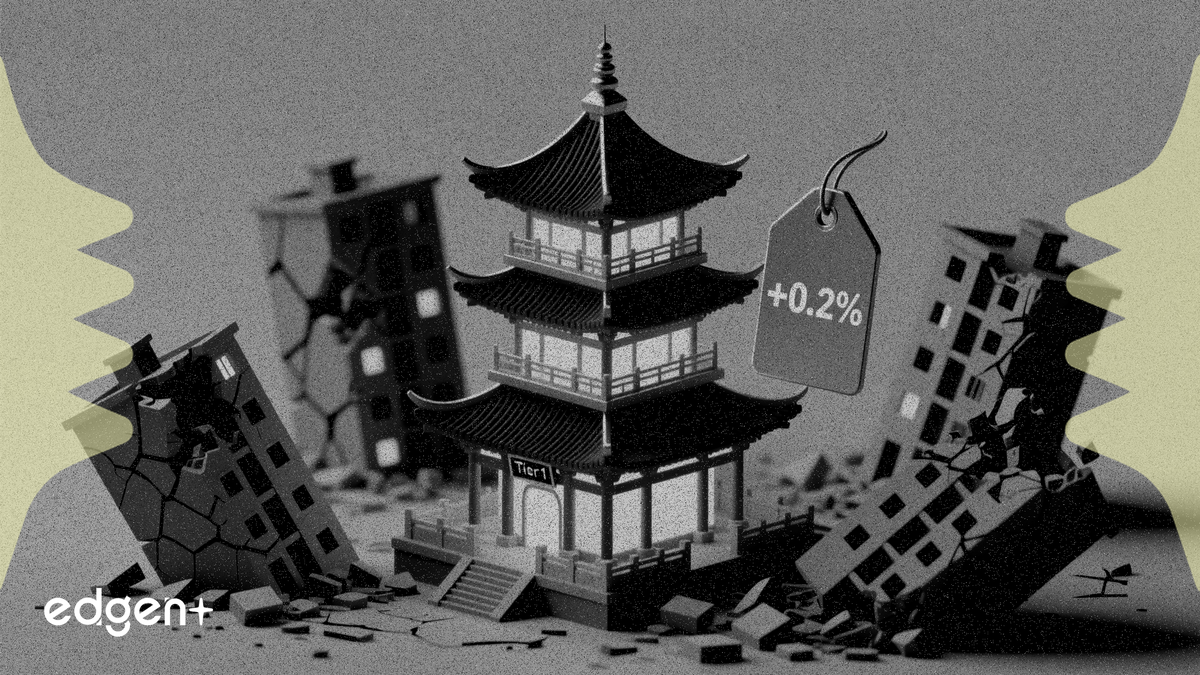
China's housing market deepened its bifurcation in May, with first-tier new home prices rising 0.2% month-on-month while third-tier cities posted a steeper 0.4% decline, data from the National Bureau of Statistics showed.
"Seemingly, a number of developers have turned more cautious in launching primary projects of late," said Jack Tong, director of research and consultancy at Savills Hong Kong, noting the divergence between premium and lower-tier markets.
Among first-tier cities, Shenzhen led with a 0.4% gain, followed by Shanghai and Guangzhou at 0.2% each. Beijing bucked the trend with a 0.2% decline. The number of cities reporting month-on-month price increases rose to 16 from 14 in April, though the share of improving markets remains below 23% of the 70-city sample. Second-tier cities fell 0.1%, unchanged from the prior month, while third-tier declines widened to 0.4% from 0.3%.
The divergence poses a challenge for policymakers seeking to stabilize the property sector, which remains a drag on economic growth. With lower-tier cities accounting for a larger share of total housing inventory, the widening gap suggests aggregate price recovery may remain elusive. The data comes ahead of Tuesday's release of May activity indicators, where retail sales are expected to come in flat year-on-year and fixed asset investment is forecast to contract 2%, according to consensus estimates.
The property market's weakness in lower-tier cities reflects persistent oversupply and weakening demand in regions that drove much of China's construction boom over the past decade. While first-tier cities benefit from population inflows and policy support including relaxed home purchase restrictions, smaller cities face the dual headwind of inventory overhang and slowing migration. The last time first-tier prices showed sustained improvement was in the first half of 2024, when a series of stimulus measures temporarily boosted sentiment before fading within three months.
The divergence is also visible in cross-border capital flows. Mainland Chinese buyers purchased 5,777 homes in Hong Kong in the first four months of 2026, equivalent to more than 41% of last year's total transactions, according to Midland Realty data. April registrations surged nearly 48% month-on-month to 1,892 deals, the highest in two years, with transaction value reaching HK$18.9 billion. This suggests affluent mainland buyers are channeling capital into Hong Kong's recovering market rather than lower-tier domestic cities.
The housing data adds to a mixed picture for China's economy. While new energy vehicle sales hit a record 62.9% penetration rate in May, with all top-10 selling passenger vehicles being NEVs, the property sector continues to weigh on household wealth and local government finances. The onshore yuan traded near 7.25 against the dollar following the release, while the CSI 300 index edged lower as investors weighed the implications of a prolonged property downturn for bank asset quality and local government revenue.
This article is for informational purposes only and does not constitute investment advice.
