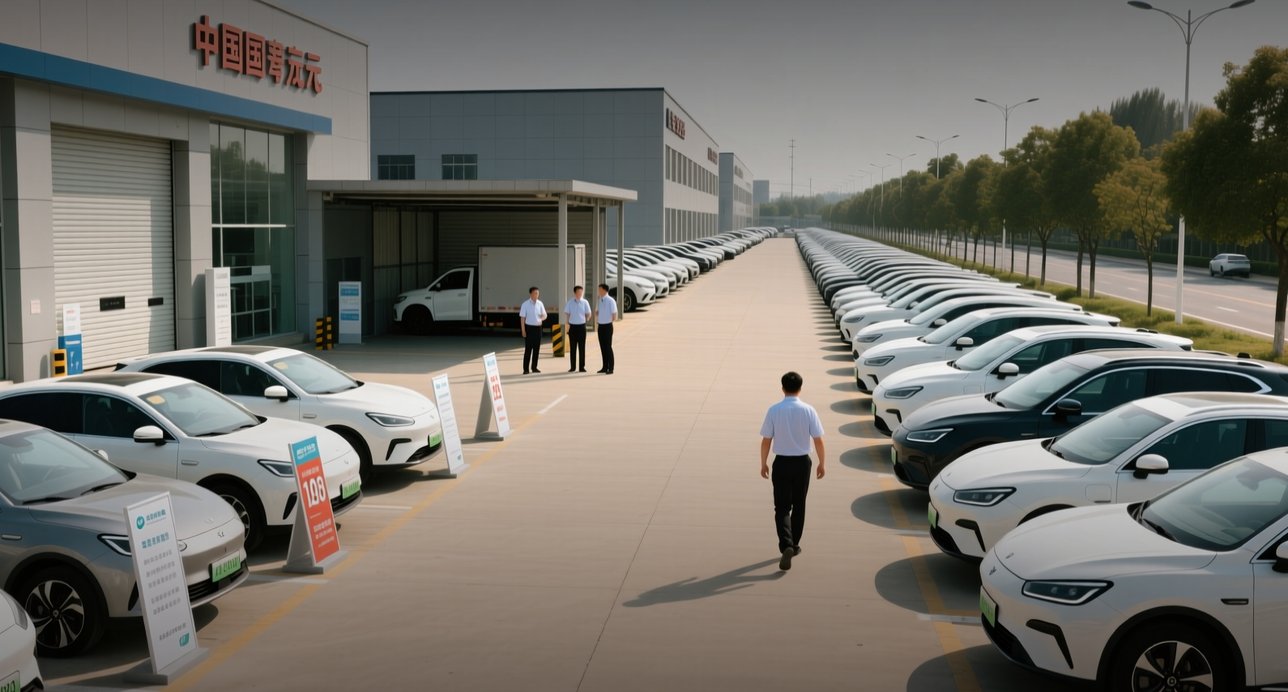
Chinese automakers booked 22% fewer electric-vehicle orders in the week of 14-20 September than in the prior week, dealer data compiled by Citigroup shows, putting the full month on track for a retail sales decline of 6.7% to 12% from a year earlier.
The weekly slump is steeper than the underlying trend. Stripping out Xiaomi Corp. (1810.HK), whose order book swings on delivery-batch timing, the decline narrows to 5% week-on-week, according to the Citi note published 23 September. Even on that cleaner read, orders for the month to date are down 29% from a year earlier while rising 23% month-on-month — a combination that points to a soft September rather than a collapse.
"September is shaping up as a month where the year-on-year comparison does the damage, not the sequential run rate," Citigroup's China autos team wrote in the note, which is based on dealer-level order intake rather than factory shipments.
The forecast band splits into a bull case of -6.7% year-on-year and a base case of -12%, with month-on-month gains of 23% and 16% respectively. The gap between the two hinges on one variable: whether Xiaomi's incremental deliveries land inside September. If they slip into October, Citi estimates full-month retail sales would rise just 8% month-on-month and fall 18% year-on-year — a six-percentage-point deterioration from the base case on a single company's logistics schedule.
Brand-level data shows the weakness is not evenly spread. Li Auto (2015.HK) led with sales up 113%, followed by Tesla Inc. (TSLA) at 38% and Geely's Galaxy line at 10%. BYD Co. (1211.HK) grew 8%, roughly in line with the industry, while NIO Inc. (9866.HK) was flat. The laggards were concentrated: Huawei's Harmony Intelligent Mobility Alliance fell 27%, Zeekr dropped 15%, Leapmotor (9863.HK) lost 13% and XPeng Inc. (9868.HK) slipped 5%.
That divergence matters because it separates companies with fresh product cycles from those managing older lineups. Li Auto's 113% gain reflects a low base and the ramp of its battery-electric models after a year spent defending its extended-range franchise. HIMA's 27% decline is the sharper signal — the alliance built around Huawei's driver-assistance stack had been the sector's volume story through 2025, and a drop of that size suggests the premium end of China's EV market is absorbing the slowdown first.
Short sellers have positioned accordingly. Leapmotor carried the highest short-selling ratio among HK-listed EV names at 47.4%, followed by XPeng at 40.1%, Xiaomi at 38.4% and NIO at 35.9%, according to exchange data as of 23 September. Li Auto's ratio stood at 26.4% and BYD's at 32.3%. The pattern is not a uniform sector bet: the heaviest bearish positioning sits on the names that underperformed on orders, while Li Auto — the strongest performer — carries the lightest.
For investors, the read-through is about timing rather than direction. China's EV market has spent two years in a price war that has compressed gross margins across the board, and a month of negative year-on-year retail growth would be the first hard evidence that the sequential recovery of the first half is stalling. Xiaomi's delivery schedule is the near-term binary: the company's order backlog has been the sector's most reliable incremental demand source, and its timing is a logistics question, not a demand one. The month-end CPCA retail data, due in early October, will settle which end of Citi's band the market gets — and whether the 22% weekly order drop was a holiday-adjacent blip or the start of a weaker fourth quarter.
This article is for informational purposes only and does not constitute investment advice.