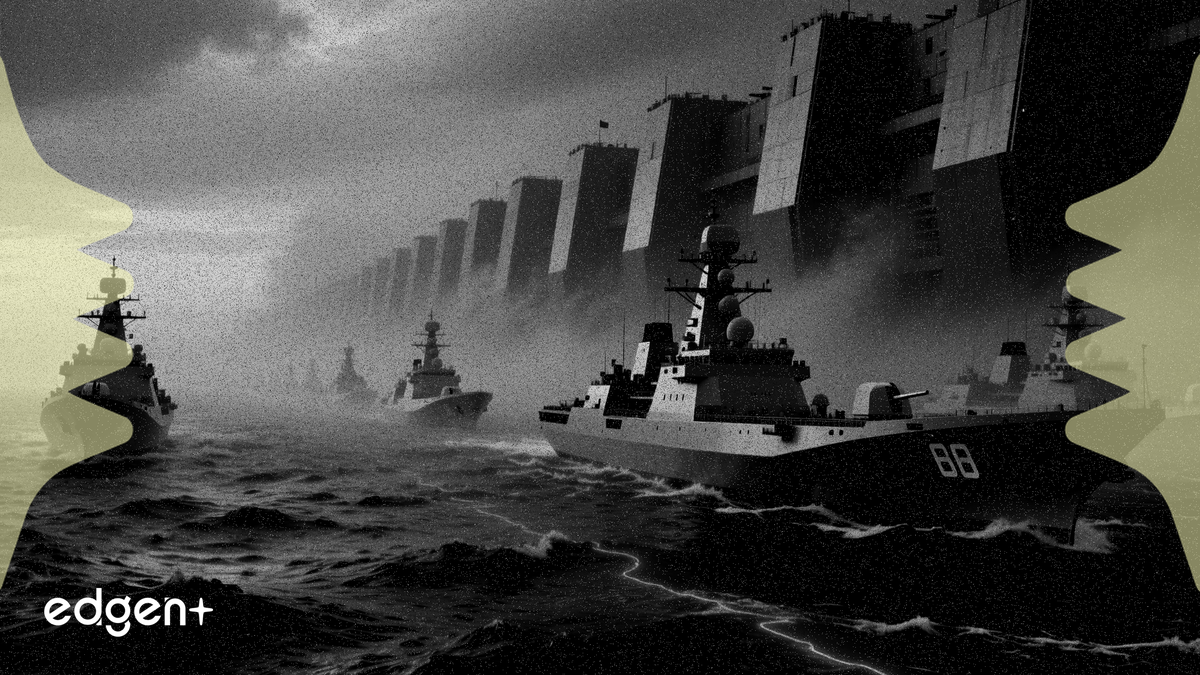
China is intensifying its campaign to dominate contested waters across Asia, deploying hundreds of non-military vessels in a calculated strategy to expand its control without triggering open conflict.
Beijing is escalating its use of large-scale fishing fleets, coast guard ships, and maritime militias as instruments of state power, with nearly 200 Chinese vessels recently operating near a key U.S. naval base in Japan. The "gray-zone" campaign was highlighted over the weekend when a Chinese survey ship and two coast guard vessels were spotted landing personnel on sandbars within the territorial waters of the Philippine-occupied Pag-asa Island.
“They are not trying to start a war,” Victor Cha, president of the Geopolitics and Foreign Policy Department at the Center for Strategic and International Studies (CSIS), said. “But in the end, when everything is aggregated, they are the dominant presence.”
The strategy involves overwhelming key maritime zones with sheer numbers. On April 3, more than 600 Chinese fishing boats formed a straight-line formation for 18 hours in the East China Sea. In 2025, China’s coast guard patrolled the waters around the Japan-administered Senkaku Islands for 357 days. The activity extends globally, with a flotilla of 200 Chinese vessels also operating near Argentina's economic zone.
This gray-zone approach allows Beijing to gradually normalize its dominance in disputed waters, challenging the ability of sovereign nations to manage their own waters and testing U.S. influence. The strategy complicates naval operations for the U.S. and its allies and threatens to disrupt key commercial shipping lanes, potentially increasing freight and insurance costs and creating a risk-off sentiment in global markets.
A Multi-Front Maritime Campaign
The campaign's scope is vast, stretching from the Yellow Sea to the South Atlantic. In the Yellow Sea, China has deployed new data-collection buoys and a large salmon harvesting cage into waters shared with South Korea. In the South China Sea, it has doubled its coast guard presence near Scarborough Shoal and, since December 2025, started its first new island-building project in nearly a decade at Antelope Reef in the Paracel Islands, backed by a wall of militia vessels.
This expansion is not limited to Asia. Off the coast of Argentina, a fleet of around 200 Chinese squid-fishing boats has raised concerns of overfishing and potential intelligence gathering. Argentine officials have noted suspicions that some vessels were equipped with antennas inconsistent with fishing, possibly for intercepting communications or mapping the continental shelf.
From Research to Ranging
The dual-use nature of the fleet is a core component of the strategy. The recent incident near the Philippines involved the research vessel Xiang Yang Hong 33, which is capable of deep-seabed mapping. The Philippine Coast Guard reported the vessel had been conducting "illegal MSR (marine scientific research) activities" inside its exclusive economic zone for almost a month before its personnel landed on sandbars near Pag-asa Island on May 16.
Under international law, such research requires prior consent. The Philippine Coast Guard issued multiple radio challenges demanding the Chinese vessels "cease their illegal activities." This follows a pattern of behavior where China uses civilian and coast guard assets to press its expansive claims, which were invalidated by a 2016 arbitral tribunal ruling. The constant presence of these fleets serves to establish a de facto control that is difficult to counter without military escalation.
This article is for informational purposes only and does not constitute investment advice.