Chery is abandoning years of in-house autonomous driving development to bet on Huawei's standardized platform.
Chery is abandoning years of in-house autonomous driving development to bet on Huawei's standardized platform.
Chery is abandoning years of in-house autonomous driving development to bet on Huawei's standardized platform.
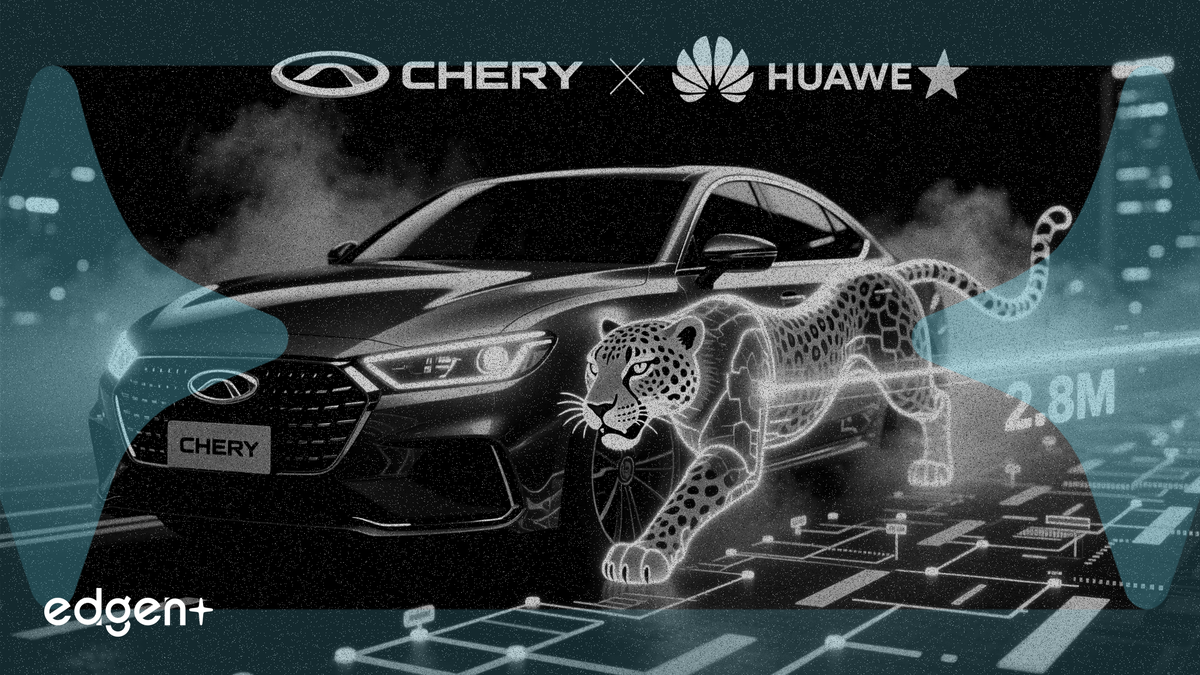
Chery's decision to deepen ties with Huawei-backed Yinwang marks a strategic retreat from in-house autonomous driving development, as the Chinese automaker prioritizes speed-to-market over proprietary technology in the race to deploy L3 and L4 systems.
"Chery and Yinwang will work together to promote the broader adoption of smart mobility globally and contribute a China solution to the transformation of the global automotive industry," the companies said in a joint statement after the June 11 signing.
The partnership follows Chery's May 2025 restructuring, when it consolidated its Xiongshi Technology, Dazhuo Intelligent, and research institute into a unified intelligent center. Dazhuo CEO Gu Junli, a former Tesla and XPeng executive hired in 2023 to lead Chery's self-driving push, departed as part of the reorganization. Chery sold more than 2.8 million vehicles in 2025, including nearly 1.35 million exports, making it one of China's largest automakers by volume.
The shift toward Huawei's standardized platform means Chery's future models will share core autonomous driving technology with vehicles from Changan, Seres, and other Yinwang partners, potentially eroding product differentiation in China's competitive EV market. Yinwang, which Huawei spun out as an independent intelligent vehicle solutions company, has attracted equity investments from multiple automakers, positioning itself as a shared technology backbone for China's auto industry.
The Self-Driving Pivot
When Chery founded Dazhuo Intelligent in February 2023, it aimed to develop cost-effective, vision-based autonomous driving systems that could scale across its portfolio without relying on expensive lidar sensors or high-definition maps. Gu Junli described the approach as "intelligent driving without burning cash," targeting Chery's export markets and mass-market brands.
But the rapid evolution of China's autonomous driving market forced a reassessment. Tesla's FSD V12 end-to-end neural network, released in early 2025, triggered a technology race that raised the bar for urban navigation capabilities. Huawei, XPeng, and other leaders responded with their own end-to-end systems, pushing the cost of development beyond what most individual automakers could justify.
"Chery's self-driving system showed a technology gap compared with the industry leaders in urban navigation capabilities," an engineer at an autonomous driving supplier told Wall Street CN. The company's vision-based approach, while cost-effective for overseas markets, struggled to compete in China's premium EV segment, where advanced driver assistance has become a key differentiator.
Standardization vs. Differentiation
Chery had already tested Huawei's technology through its Zhijie brand, a joint venture that reached monthly deliveries of more than 10,000 vehicles by the end of 2025. The success of that partnership paved the way for broader adoption, with Chery's Jetway brand and its Freelander joint venture with Jaguar Land Rover both adopting Huawei's ADS system.
The strategic calculus reflects a broader industry trend. As autonomous driving technology converges around a handful of proven platforms, automakers face a choice between investing billions in proprietary systems or adopting standardized solutions that reduce time-to-market. For Chery, a company that generated the bulk of its profit from traditional combustion-engine vehicles and exports, the decision to outsource high-level autonomous driving frees capital for its core strengths in manufacturing, quality control, and global distribution.
The risk is that Yinwang's expanding partner network will commoditize autonomous driving features. Yinwang already supplies technology to Changan's Deepal and Avatr brands, Seres' Aito, and Dongfeng's Voyah. As more automakers adopt the same sensor suite and control algorithms, the technology that once served as a competitive advantage becomes table stakes.
For investors, the question is whether Chery can maintain pricing power and brand differentiation when its core intelligent driving features are shared with competitors. The company's global distribution network, which spans more than 80 countries, provides one potential buffer. Chery exported nearly 1.35 million vehicles in 2025, giving it a scale advantage that few Chinese automakers can match. If it can pair Huawei's autonomous driving technology with its manufacturing efficiency and global reach, the trade-off may prove worthwhile.
This article is for informational purposes only and does not constitute investment advice.
