

BYD is recruiting more than 8,000 workers across multiple divisions at its Xi'an base, offering incentives up to 6,000 yuan ($896.15), as output ramps up after production-line adjustments at its largest manufacturing site.
BYD is recruiting more than 8,000 workers across multiple divisions at its Xi'an base, offering incentives up to 6,000 yuan ($896.15), as output ramps up after production-line adjustments at its largest manufacturing site.
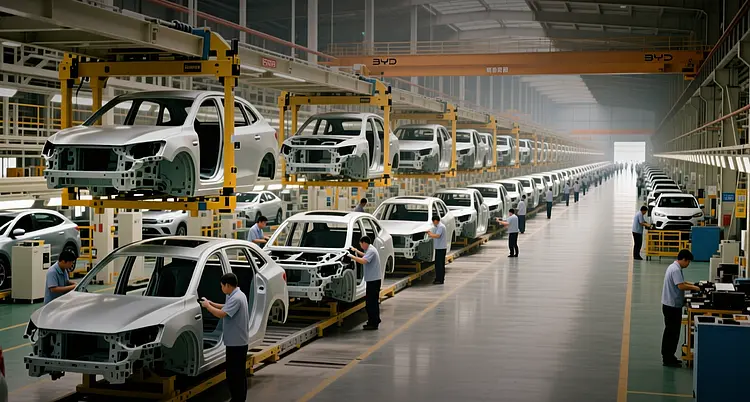
A recruitment drive spanning several plants and business divisions at BYD's Xi'an manufacturing base is seeking more than 8,000 new employees, with successful applicants eligible for incentives of as much as 6,000 yuan ($896.15) each. The campaign, promoted by local government and industry bodies, follows production-line adjustments at the site as output ramps up rapidly, Chinese media outlet Yicai reported on Sept. 21.
The scale of the recruitment points to a step-change in throughput rather than routine turnover. Xi'an is BYD's largest production base, with four planned phases of factory development targeting annual capacity of 1.5 million vehicles — roughly equivalent to the entire annual output of a mid-sized national auto industry. A hiring drive of this size across multiple divisions, rather than a single assembly line, indicates the company is staffing up several stages of the manufacturing process at once.
"Xi'an is the volume engine, and headcount is the cleanest real-time read we get on it," Lucas Herrera, an analyst covering the EV supply chain at Edgen, said. "You can delay a press release, but you cannot run a second shift without hiring the people to staff it."
The signal arrives against a sharply divided market. Short selling in BYD's Hong Kong-listed shares (01211.HK) totaled $562.52 million at a 39.303% ratio as of Sept. 21, according to exchange data — a level of bearish positioning that implies a substantial cohort of investors expects the volume ramp to disappoint on margin, price, or both. The stock traded at HK$0.250 higher, or 0.308%, on the session.
BYD's battery operations offer a template for what Xi'an could deliver. At the company's Xiangyang plant in Hubei province, export output rose 165% last year, double the 83.3% growth in BYD's total battery exports over the same period, according to Xiangyang FinDreams. The plant went from groundbreaking to production in 11 months, a pace the company internally calls "Xiangyang speed," and its output topped 10 billion yuan in both 2024 and 2025, with last year's figure up more than 60% year on year.
Utilization at Xiangyang sits near 90%, and the company expects annual output to exceed 14 billion yuan if that rate reaches 100%. Of the plant's roughly 8,000 employees, 90% are hired locally — a ratio that matters for Xi'an, where the recruitment campaign is being promoted by local government bodies that have their own incentive to see the base fully staffed. Xiangyang ships 500,000 battery units a month to Southeast Asia, its largest overseas market, with Thailand, Malaysia and Korea the main destinations.
The Xi'an hiring drive is the upstream half of the same equation. Battery cells and packs must be produced before vehicles can be assembled, and a 1.5 million-unit annual capacity target requires a correspondingly scaled workforce across cell assembly, pack assembly and final vehicle lines. BYD's Xiangyang cell assembly line has reached 100% automation with more than 300 pieces of equipment developed in-house, which limits how much of the ramp can be absorbed by automation alone.
Morgan Stanley said 2Q26 results for Chinese automakers came in broadly in line with expectations but that the quality of those results diverged across the sector, and adjusted target prices in a way that favors BYD and Geely Auto (00175.HK). The note places BYD on the preferred side of a sector where volume growth and pricing discipline are increasingly separating winners from the rest.
That framing matters for how the Xi'an hiring news should be read. A capacity ramp is only accretive if the incremental volume carries acceptable margins, and China's EV market has spent several years in a price war that has compressed per-vehicle profitability across the industry. BYD's advantage has rested on vertical integration — in-house batteries, motors and automotive electronics — which lowers unit cost but requires high utilization to pay off. The Xi'an buildout is a bet that demand will absorb 1.5 million units annually at a cost structure the company controls.
The competitive read-through extends beyond BYD. Dongfeng Motor, Hubei's homegrown automaker and the anchor of Xiangyang's industrial base, completed a smart manufacturing overhaul at its Xiangyang commercial vehicle plant in 2024 and now builds more than 600 vehicle variants on a single line, spanning internal combustion, electric, hybrid, natural gas and hydrogen models. Its Nammi 01 compact EV base in Xiangyang has annual capacity above 120,000 units, with cumulative sales passing 100,000 as of last October. Dongfeng is also weighing plans to build an EV jointly developed with Peugeot at its Wuhan plant and launch it in Korea.
For investors, the near-term question is whether the Xi'an ramp shows up in delivery figures before it shows up in margins. The 39.303% short ratio on 01211.HK sets up a binary: monthly delivery data that confirms accelerating output would pressure short positions, while any sign that the hiring is running ahead of demand would reinforce the bear case. Morgan Stanley's target-price adjustments favoring BYD suggest the sell side is leaning toward the first outcome. The company's next monthly delivery disclosure and its 3Q26 production figures are the data points that will settle it.
This article is for informational purposes only and does not constitute investment advice.