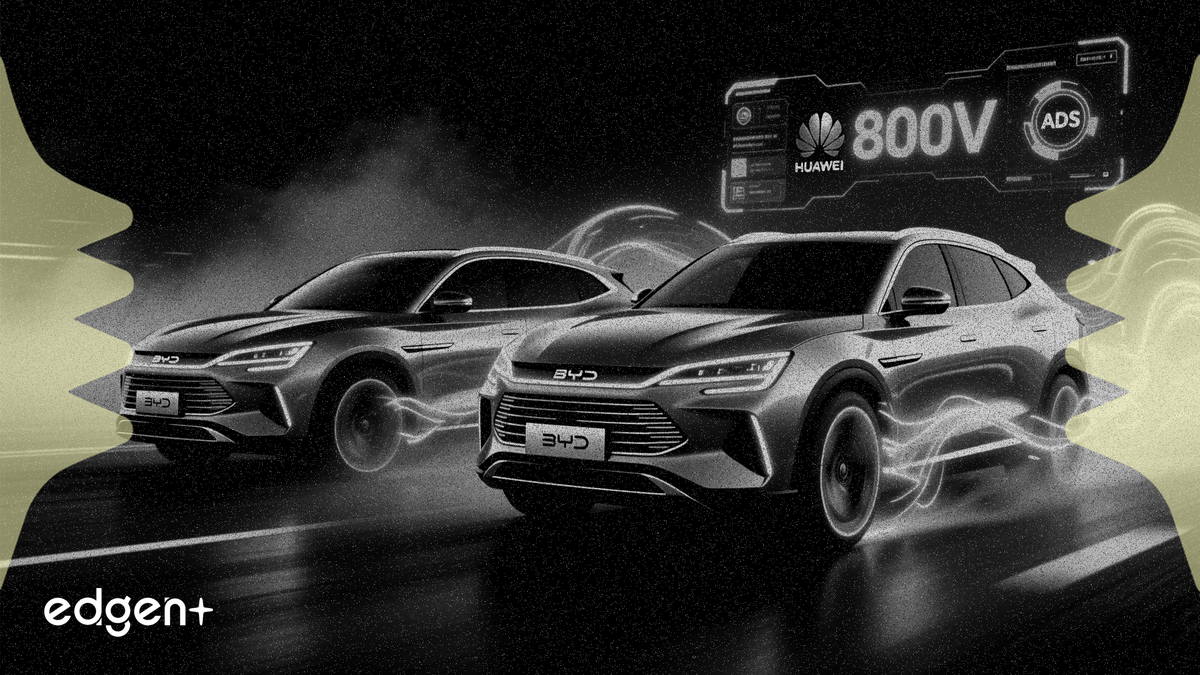
BYD is escalating competition in the premium off-road market with two new Fangchengbao models featuring 800-volt charging and a new hydraulic suspension, but the inclusion of Huawei’s high-end autonomous driving system in the flagship Bao 8 poses the most direct threat to rivals like Li Auto and Nio.
"The integration of the Yunnian-P Ultra system, with its wheel-lift recovery and rapid tire-change capabilities, is designed to enhance survivability under extreme terrain conditions," the company detailed during the launch event, emphasizing the vehicle's hardware credentials.
The new "Flash-Charge" editions of the Bao 5 and Bao 8 are built on an 800V high-voltage architecture with a second-generation Blade Battery, enabling a combined range of over 1,300 km. The flagship Bao 8 pairs a 2.0T engine with dual motors for 550 kW of power, while the Bao 5 uses a 1.5T hybrid system.
The key differentiation lies in the autonomous driving hardware. While the Bao 5 uses BYD's in-house DiPilot system, the Bao 8's adoption of Huawei's Qiankun ADS signals a strategic move to compete on premium tech features, a segment where Huawei's technology is a major consumer draw. This puts pressure on competitors who rely on their own or other third-party solutions.
Yunnian-P Ultra Suspension Redefines Off-Road Capability
Both the Bao 5 and Bao 8 debut the Yunnian-P Ultra, an intelligent hydraulic body control system that represents a significant upgrade over previous versions. The system features an ultra-long 200mm of height adjustment travel and, according to BYD, enables emergency functions like three-wheel driving and lifting the vehicle for a three-minute tire change without a jack. This focus on extreme-condition hardware provides a distinct selling point against competitors who primarily focus on on-road comfort and smart-cabin features.
The Huawei Factor and Export Compromises
The Bao 8's use of Huawei's Qiankun ADS 3.0 is a major development, marking it as the first vehicle from the BYD group to adopt the tech giant's most advanced "parking-to-parking" autonomous system. This move leverages Huawei's powerful brand recognition in China's tech-focused consumer market.
However, international buyers may not get the same features. The export version, rebadged as the Denza B8 for markets like Malaysia, is expected to use BYD’s own DiPilot Level 2+ system instead. According to recent reports, the export model will also omit the China-spec's integrated DJI drone bay and a 12.3-inch front passenger entertainment screen, highlighting the complex adjustments required for global launches.
Pricing and Market Positioning
With limited-time promotional pricing starting at RMB 299,800 ($43,900) for the Bao 5 and RMB 409,800 ($60,100) for the Bao 8, BYD is aggressively positioning the Fangchengbao brand in the premium segment. The company also confirmed its SHARK pickup series will be integrated into the Fangchengbao lineup, signaling a clear strategy to build a dominant, multi-category high-end off-road brand.
The dual-pronged strategy—offering both its own solid ADAS on the Bao 5 and a best-in-class system from Huawei on the Bao 8—allows BYD to attack the premium market from two angles. For investors, this tests whether a carmaker can successfully integrate a "tech-royalty" brand like Huawei to boost a model's appeal and command a higher price, a strategy that could significantly impact margins if successful. The stock (1211.HK) showed little immediate reaction, but the move challenges the software-defined vehicle thesis of rivals like Nio and XPeng.
This article is for informational purposes only and does not constitute investment advice.