

BYD's entry into humanoid robotics pairs automotive-scale hardware with an unresolved AI reasoning problem that could determine whether it leads or lags.
BYD's entry into humanoid robotics pairs automotive-scale hardware with an unresolved AI reasoning problem that could determine whether it leads or lags.
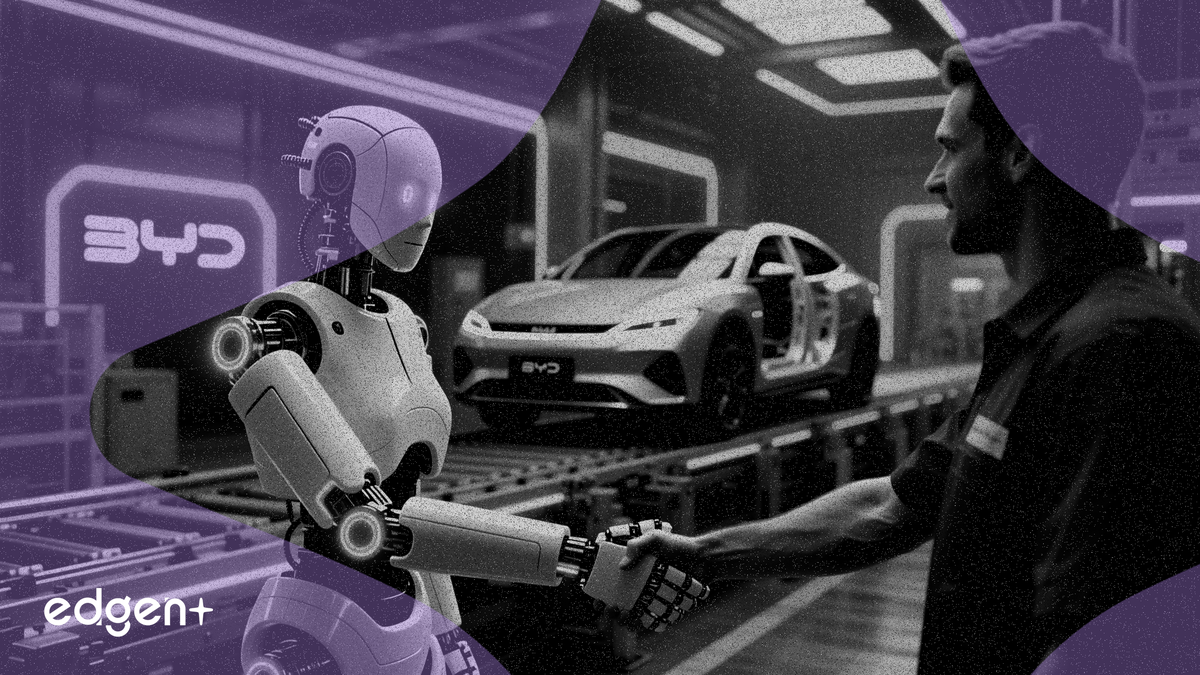
BYD confirmed on June 4 that it has been developing humanoid robots since 2022, bringing automotive-scale manufacturing to a sector where hardware cost has been the binding constraint on commercial deployment.
"China's robots lack a brain, while US robots have strong limbs," Executive Vice President Li Ke said at the public event. "BYD aims to produce robots that excel in both dimensions."
The project, codenamed Yao-Shun-Yu, is testing its seventh-generation prototype at factories in Shenzhen and Changsha. BYD plans to deploy the robots initially for factory floor shift work and as retail greeters across its global dealer network of more than 35,000 locations — the same channel that sells its electric vehicles in 70-plus countries.
BYD built 3 million EVs in 2025 and manufactures its own batteries, motors and power semiconductors at automotive scale. That gives it a structural cost advantage over pure-play robotics companies such as Figure and 1X, which source components from the global supply chain at non-volume pricing. The open question is whether BYD can close the embodied AI gap before competitors scale their own manufacturing.
The Hardware Moat That EVs Built
The components that make humanoid robots physically capable overlap heavily with electric vehicle technology. BYD's Blade Battery, designed for high energy density in flat form factors, is better suited to robot torso and limb integration than the cylindrical cells most competitors use. The company's in-house IGBT power semiconductors — the chips that control high-voltage power delivery in EVs — are directly transferable to robot motor control. BYD also operates its own chip design team that could eventually produce edge inference chips for on-board AI.
Tesla's Optimus program, which runs on the company's FSD neural network inference stack with Dojo training infrastructure, is approaching mass production with a target price below $20,000 per unit. Figure, backed by $675 million from investors including OpenAI, uses GPT-4o-class vision and language models for task planning and has deployed robots at BMW manufacturing and Amazon warehouse facilities. 1X has delivered 20,000 Neo units at $35,000 to $40,000 each.
BYD's manufacturing scale changes the cost assumptions. The company's Shenzhen and Changsha campuses run at automotive-grade tolerance for millions of components per year. Humanoid robot assembly at scale requires the same just-in-time supply chain management and production line optimization that BYD has deployed for EVs. The Xi'an industrial park, eventually targeted at 50,000 robots annually, would make BYD a mass manufacturer of humanoid robots rather than just an operator.
The Brain Problem Remains Unsolved
The embodied AI stack — the system that lets a robot understand natural language instructions, form spatial plans and adapt when something goes wrong — is where BYD has not yet demonstrated capability. US companies hold a significant lead. OpenAI's investment in Figure gives it a reasoning layer trained on text, vision and robotics manipulation data simultaneously. Tesla's FSD stack has 15 billion miles of real-world data informing its spatial reasoning.
Chinese AI foundation models including DeepSeek V4, Baidu Ernie 4.5 and Zhipu's GLM-4 have made progress on language and coding benchmarks but have limited published results on embodied reasoning. BYD's path to solving the brain problem is either to build a proprietary embodied AI team internally — a five-to-10-year effort — or to partner with one of China's leading AI labs.
For investors, the question is whether BYD's hardware cost advantage can sustain a market lead long enough for its AI capabilities to catch up. BYD shares trade on the Hong Kong Stock Exchange under ticker 1211.HK. The humanoid robot sector is approaching a defining period: Tesla's Optimus V3 product launch and supply chain volume targets are becoming clearer, and Unitree's successful IPO listing review in China shows the market is beginning to assign real valuations to embodied AI companies. If BYD solves the brain problem through a partnership or internal development, the combination of hardware cost leadership and software capability would be difficult for Western competitors to match at volume pricing.
This article is for informational purposes only and does not constitute investment advice.
