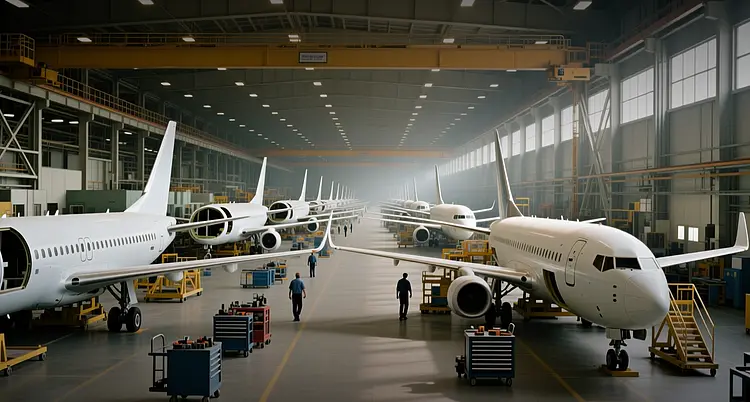
Boeing and Turkish Airlines closed a purchase agreement for as many as 150 737 MAX jets on Sept. 23, ending a year of stalled talks and adding the carrier's largest single-aisle commitment to Boeing's order book. The deal covers 100 firm aircraft with options for 50 more, per a Turkish Airlines stock exchange filing, and concludes a framework first outlined in 2025.
"This order supports our growth plans and strengthens our short- and medium-haul network," Turkish Airlines said in the filing. Boeing did not disclose list value, and neither company released financial terms or a delivery schedule beyond the filing's 2033-to-2037 window.
The narrowbody tranche sits inside a 225-aircraft package Turkish Airlines announced last year, which also included 50 firm 787 Dreamliners and 25 options. That widebody portion moved ahead while the 737 leg stalled over engine maintenance terms with CFM International, the GE Aerospace and Safran joint venture whose LEAP-1B is the only powerplant certified for the MAX. Turkish Airlines had sought CFM Premier maintenance status to service the engines in Turkey, and Chairman Ahmet Bolat publicly warned the carrier could turn to Airbus if terms did not improve. Whether that maintenance demand survived into the final agreement is not yet disclosed.
The MAX 10 is 30% of the 737 backlog
The order lands as Boeing approaches certification of the 737 MAX 10, one of the two variants Turkish Airlines selected alongside the 737-8. Chief Executive Kelly Ortberg said this month that all flight testing required for MAX 10 certification is complete, leaving three Boeing deliverables before the Federal Aviation Administration reviews documentation and grants approval. The variant accounts for roughly 30 percent of the 737 backlog, which makes a certification slip a direct constraint on how quickly the Turkish aircraft can be scheduled.
Boeing has already begun assembling the MAX 10 ahead of approval. Two of the first four aircraft on the company's fourth 737 MAX line, opened at its Everett factory in July, are MAX 10s — a build-ahead that ties working capital to a regulatory date the company does not control.
For Turkish Airlines, the order is one leg of a fleet plan that targets roughly 800 aircraft by 2033 and a full transition to new-generation equipment by 2035. The carrier has been evaluating aircraft at both ends of its requirements, including the Airbus A220 and Embraer E2 at the small end and the Airbus A350-1000 and Boeing 777X at the large end, so the Boeing commitment does not close off competing purchases.
The delivery window is the detail that matters most for Boeing's near-term financials. Aircraft arriving from 2033 do not add to revenue this decade, and they do not relieve pressure on the production rate Boeing needs to convert its existing backlog into cash. What the order does is extend the visible demand runway for the 737 line into the late 2030s, giving Boeing a firmer basis for the rate increases it has been negotiating with suppliers.
The last comparable signal came in 2025, when Turkish Airlines committed to the 787 tranche and left the 737 portion conditional. That structure meant Boeing carried the order as a framework rather than a firm booking for roughly 12 months — a gap that kept the MAX backlog headline flat even as the underlying demand was already agreed.
Investors get two dates to watch. The FAA's MAX 10 certification decision is the nearer one, and it gates both the variant's revenue contribution and the pace at which Everett's fourth line can be filled. The first delivery under this agreement, scheduled no earlier than 2033, is the point at which the order converts from backlog to cash. Between those two events, the number that matters is Boeing's monthly 737 output, not the size of the order book.
This article is for informational purposes only and does not constitute investment advice.