

Key Takeaways:
- Bloom Energy shares surged 69% in three months on AI data center demand
- Forward P/S of 15.64x is more than triple the industry average of 4.99x
- 27% to 38% of data centers expected to rely on onsite power by 2030
Key Takeaways:
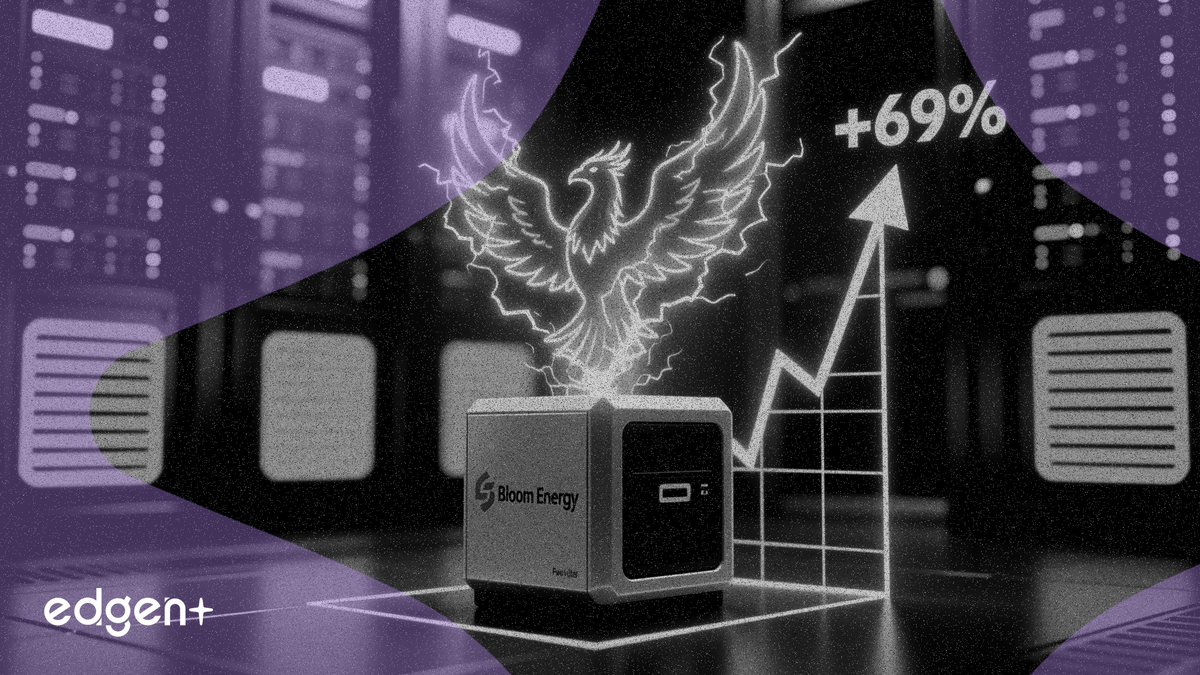
Bloom Energy's fuel cell technology is emerging as a key solution for data center operators racing to secure onsite power as grid capacity fails to keep pace with AI-driven demand.
Bloom Energy Corp. shares have surged 69% in three months as the onsite power provider capitalizes on a structural shift: data center operators, facing grid constraints, are turning to fuel cells to power AI infrastructure. The company's forward price-to-sales ratio of 15.64 times stands more than three times the industry average of 4.99 times and well above its own three-year median of 2.3 times.
"Power availability has become the single most important factor in deciding where to build a data center," the company said in its 2026 Data Center Power Report, citing a survey where 84% of operators ranked it as their top site selection criterion. The report projects that AI data center capacity will nearly double its share of new additions, climbing from 13% in 2026 to 23% by 2030.
Bloom's return on equity of 43.41% far exceeds the industry average of 7.11%, reflecting the company's ability to generate profits from shareholder capital more efficiently than peers. The Zacks Consensus Estimate calls for 2026 revenue growth of 80.3% year over year and 2027 growth of 66.7%, with earnings expected to rise 151.3% and 108.5%, respectively.
The company's Energy Server platform, built on proprietary solid oxide technology, generates electricity through an electrochemical process rather than combustion. Its modular design allows customers to scale from a few hundred kilowatts to several hundred megawatts, connecting directly to a customer's primary electrical system and bypassing strained transmission and distribution networks. US data center operators are expected to add 55 gigawatts of IT capacity over the next five years, with the current installed base at roughly 25 gigawatts.
The Onsite Power Pivot
The grid bottleneck is forcing a dramatic shift in how data centers source electricity. By 2030, between 27% and 38% of data center facilities are expected to rely on onsite power for their primary energy needs, up from just 13% projected in last year's survey. Even more striking: 27% of data centers are expected to be fully powered onsite by 2030, compared with 1% in the prior year's forecast.
Texas is emerging as the critical market, with projected grid demand potentially surpassing 40 gigawatts by 2028. One in five data center campuses is expected to exceed 1 gigawatt of capacity by 2030, climbing to one in three by 2035. Bitcoin mining facilities are also being repurposed for AI workloads, the report noted, as both share the same fundamental requirement for massive, reliable electricity at competitive rates.
Valuation and Competitive Positioning
Bloom's premium valuation reflects the market's bet that its fuel cell platform will become the preferred architecture for onsite power generation across data centers, advanced manufacturing, and critical infrastructure. The company holds a Zacks Rank of 1 (Strong Buy) and a Growth Score of A.
Among peers, Talen Energy Corp. has gained 13.6% and Plug Power Inc. has risen 23.2% over the same three-month period, both trailing Bloom's 69% surge. The Zacks Alternative Energy — Other industry has declined 2% during that time, while the S&P 500 has risen 11.1%.
Bloom continues to invest in research and development to improve system efficiency and lower production costs, while also benefiting from government incentives supporting clean energy deployment. The company aims to establish solid oxide fuel cell technology as the standard for onsite power generation worldwide as electricity demand accelerates and organizations seek alternatives to traditional grid-based power.
Bloom Energy shares, trading at a premium that some analysts view as justified by growth trajectory, will need to deliver on the steep earnings expectations baked into its valuation. The 2026 and 2027 consensus estimates have seen no upward revision in the past 30 days, suggesting the market is waiting for execution before assigning additional multiple expansion.
This article is for informational purposes only and does not constitute investment advice.
