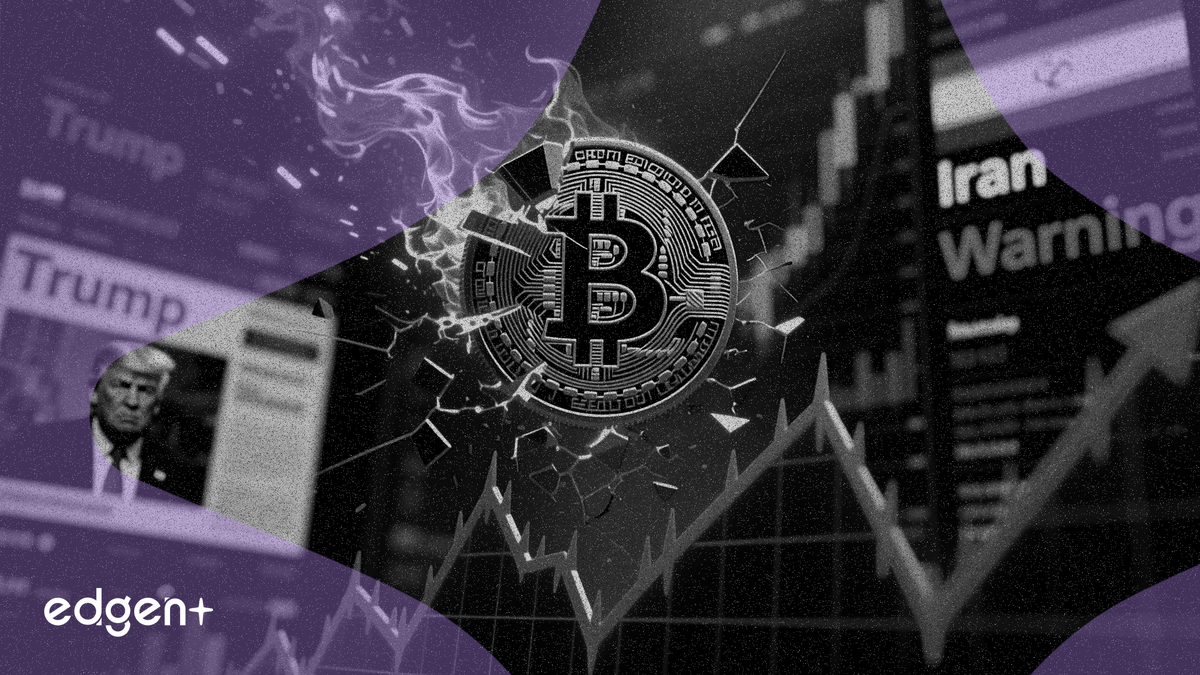
Bitcoin (BTC) fell approximately 1.4% to $76,959 Sunday evening after former President Donald Trump issued a sharp warning to Iran, escalating geopolitical tensions and triggering a broad risk-off move in digital assets. The sudden drop caused a cascade of liquidations as the market priced in heightened conflict risk in the Middle East.
"Bitcoin is consolidating near the $77,000 level as rising geopolitical tensions in the Middle East push investors toward a risk-off stance," Akshat Siddhant, Lead Quant Analyst at Mudrex, said. "Selling pressure has increased after Bitcoin ETFs ended a six-week inflow streak, recording nearly $1 billion in net outflows."
The sell-off was technically severe, with derivative markets seeing over $580 million in liquidations in just four hours, according to Coinglass data. Long positions accounted for the vast majority of the damage, at roughly $550 million. The move was compounded by a full week of institutional selling, with US spot Bitcoin ETFs snapping a six-week inflow streak to post a $1 billion net outflow for the week ended May 17.
The geopolitical developments add a complex new layer to a macro environment already weighing on crypto. President Trump’s social media post warning Iran that the “clock is ticking” sent Brent crude surging 1.78% to $111.20 per barrel, reinforcing inflation fears. With the Federal Reserve no longer expected to cut rates in 2026, the primary tailwind for Bitcoin's spring rally has vanished. For now, traders are watching the $76,000 level as critical support, with a break below opening a path toward the $74,000 liquidity zone.
Iran's Digital Chokepoint
The focus on the Strait of Hormuz has intensified as Iran signals a strategy to monetize both digital and physical infrastructure. Tehran is reportedly considering charging tech giants like Google and Microsoft for subsea internet cables passing through the strait, a move that could turn the waterway into a "digital chokepoint" [1].
More directly impacting crypto markets, Iran's Ministry of Economy recently launched "Hormuz Safe," a Bitcoin-based maritime insurance platform for commercial vessels. While some see it as a proof-of-concept for Bitcoin as a neutral settlement asset, the immediate market reaction has been negative, tying Bitcoin's narrative more closely to the region's conflict dynamics and their effect on global oil prices.
Market Outlook
The confluence of geopolitical risk and a hawkish Fed leaves Bitcoin in a fragile position. US spot Bitcoin ETFs, a primary driver of the market, saw significant withdrawals, with BlackRock's IBIT fund alone accounting for $136 million in outflows on one day.
"The crypto market remains under pressure after Bitcoin faced rejection near the $82,000 resistance zone, triggering a broader pullback," Riya Sehgal, Research Analyst at Delta Exchange, noted. With the 21-week exponential moving average near $79,000 acting as firm resistance, the path of least resistance appears to be downward unless tensions ease. The market now looks to the upcoming FOMC minutes for guidance, but the combination of high oil prices and sticky inflation suggests little room for a dovish pivot.
This article is for informational purposes only and does not constitute investment advice.