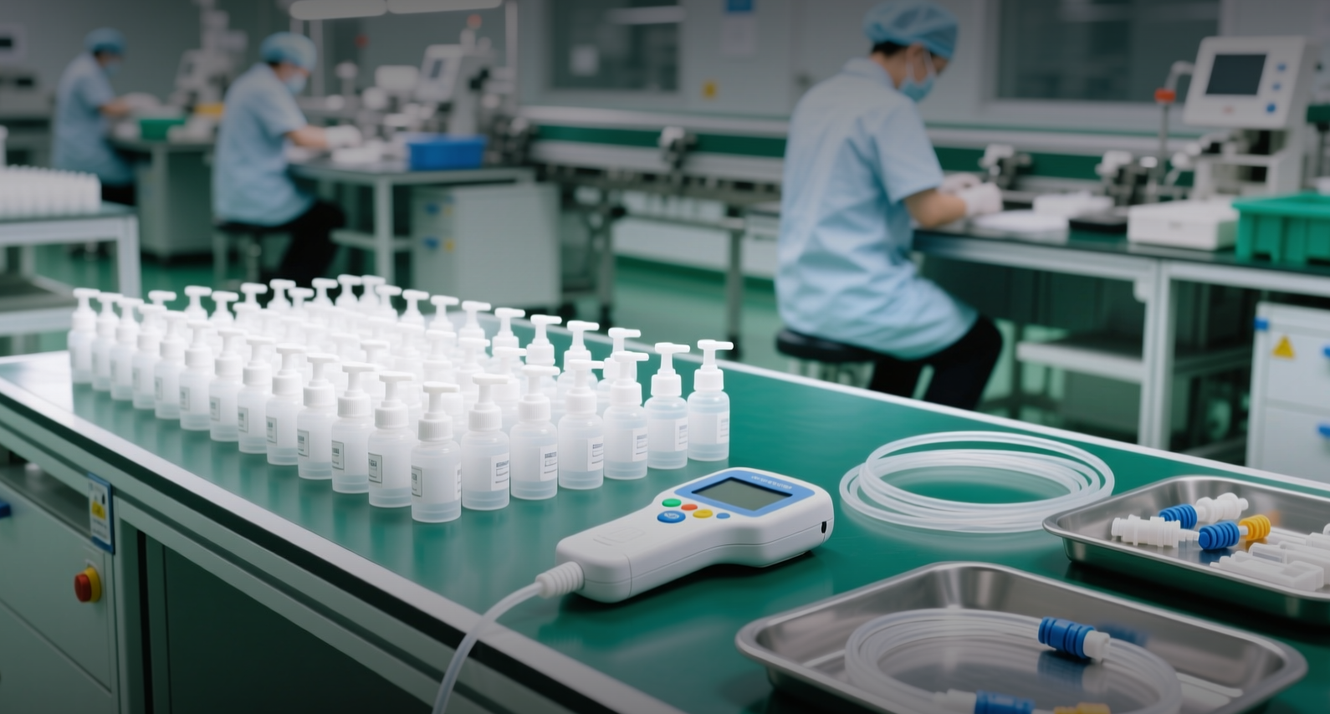
A regulatory gate that had kept Beta Bionics out of the fastest-growing corner of insulin delivery is now open, after the FDA cleared the company's Mint patch pump and set the clock on a 2027 commercial launch against Insulet and Medtronic.
"Clearance removes the last regulatory gate between us and the patch segment," Chief Executive Officer Sean T. Saint said on the company's fourth-quarter call, held Feb. 17, 2026, adding that Mint remains on schedule for an unconstrained commercial introduction in 2027.
Mint pairs a reusable controller with disposable fluidics, needs no recharging, integrates with industry-leading continuous glucose monitors, and runs on iOS and Android smartphones, according to the Sept. 14, 2026 announcement. Beta Bionics did not disclose the 510(k) predicate device, the clearance number, or pricing. The company also unveiled 3D Intelligence, a next-generation insulin dosing algorithm that extends the adaptive control software behind its existing iLET Bionic Pancreas.
The financial stakes rest on a base that is still small. Beta Bionics reported full-year 2025 net sales of $100.3 million, up 54% from the prior year, and guided 2026 revenue to $130 million to $135 million. Mint is not in that guidance. The company ended 2025 with $265 million in cash, cash equivalents and investments, and a sales force of 63 territories that management says delivered the highest per-territory productivity in the durable insulin pump market. At least 20 more territories are planned for 2026, most onboarded in the first half.
Why the reusable-disposable split matters
Patch pumps trade tubing for an adhesive pod worn on the body, and the category's economics have historically been defined by disposability. Insulet's Omnipod platform, the dominant U.S. patch pump, requires users to discard the entire pod every three days. Beta Bionics' architecture keeps the expensive electronics and reuses them, which changes the recurring-cost math for patients and the gross-margin math for the manufacturer.
That distinction matters because Beta Bionics has already proven it can move patients onto a cheaper channel. Pharmacy represented a high-twenties percentage of new patient starts for full-year 2025 and a low-thirties percentage in the fourth quarter, up from high single digits previously. The iLET is offered with no upfront patient cost in pharmacy, generating roughly $450 in monthly recurring revenue per active user through supply sales. Management expects pharmacy to reach 36% to 38% of new starts in 2026.
The company holds formulary agreements with every major U.S. pharmacy benefit manager, and Saint said Mint's coverage approach will build on those existing PBM relationships, with commercial terms expected to align closely with or improve on current iLET arrangements. That inherited distribution is the single largest advantage Mint carries into launch — a new patch pump from a company without PBM contracts would face a multi-year access build.
Fourth-quarter operating expenses rose 42% to $35.1 million from $24.7 million, with research and development spending on Mint and the bihormonal program among the drivers. Gross margin reached 59% in the quarter, up 179 basis points year over year.
Insulet and Medtronic are not standing still
Mint enters a patch market where Insulet has spent two decades building manufacturing scale and prescriber habits, and where Medtronic has moved to defend the screenless end of the category. Medtronic's MiniMed Flex, a screenless insulin pump, has already received FDA clearance, according to the company's product communications. Beta Bionics is developing a tubeless patch pump set to launch in 2027.
The competitive question is less about whether Mint works than about whether Beta Bionics can manufacture and supply it at scale. Insulet's advantage is volume; Medtronic's is an installed base of pump users and a CGM franchise. Beta Bionics' counter is algorithmic — the fully adaptive dosing engine that produced real-world efficacy data management says matches or exceeds its pivotal trial results and meets or beats American Diabetes Association standards.
3D Intelligence extends that engine. Beta Bionics did not publish benchmark data, dosing-accuracy comparisons, or head-to-head results against competing automated insulin delivery algorithms, so the improvement over the current iLET algorithm cannot be independently assessed.
The FDA letter is the near-term risk
The clearance arrived against a regulatory backdrop that is not clean. Beta Bionics received communication from the FDA in late January 2026 concerning complaint management, Medical Device Reporting definitions, instances of late filings, and corrective and preventative action procedures at its Irvine, California manufacturing facility. Saint said an elevated rate of Medical Device Reports would persist through the second quarter of 2026 because of remediation work involving backdated reporting of complaints previously not deemed reportable, with full compliance targeted by the end of that quarter. Management said the matter has not disrupted Mint's internal timelines.
Investors should watch three dates. First-quarter 2026 revenue is guided to decline sequentially from the fourth quarter, more sharply than in prior years, because there were no late-2025 product launches and pharmacy coverage expansion is incremental rather than a step change. The 2026 revenue range of $130 million to $135 million carries a slightly more first-half-weighted profile than 2025. And the Mint launch itself, targeted for 2027, is the point at which the addressable market expansion becomes measurable rather than theoretical.
Beta Bionics trades as a small-capitalization medical device name, a category defined by market values between $300 million and $2 billion. The stock sits in the middle of its 52-week range and near its 200-day simple moving average, with shares down $0.02, or 0.12%, at the last close. That positioning suggests the market has not yet priced Mint as a revenue event — consistent with a clearance that carries no disclosed financial guidance and a launch still more than a year out.
The comparison that will define the story is patient starts. Beta Bionics added 5,592 new patients in the fourth quarter of 2025, a 37% year-over-year increase, with 69% transitioning from multiple daily injections and 25% to 30% of starts coming from people with type 2 diabetes, largely off-label. If Mint converts even a fraction of the multiple-daily-injection population that has resisted tubed pumps, the 2027 launch becomes the first real test of whether Beta Bionics is a durable pump company or a single-platform story.
This article is for informational purposes only and does not constitute investment advice.