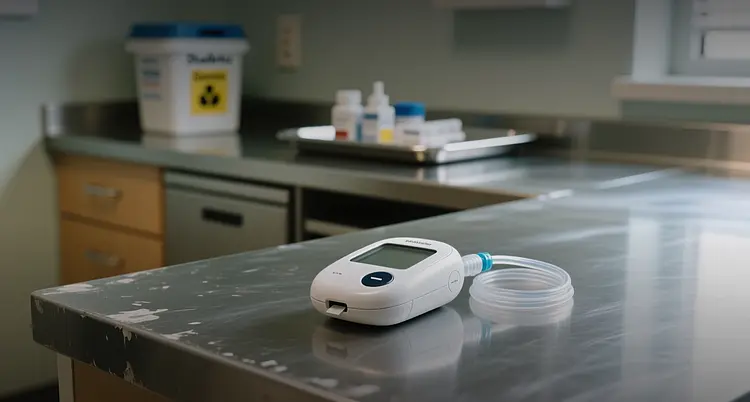
A securities fraud complaint announced Sept. 21 by Kaplan Fox & Kilsheimer LLP targets Beta Bionics Inc. (NASDAQ: BBNX) and covers anyone who bought the stock across a seven-month stretch that ended the same day the FDA published a warning letter describing violations the company had spent months calling benign. The suit alleges the iLet Bionic Pancreas drew thousands of customer complaints, including reports of severe hypoglycemia requiring hospitalization, and that the device's dosing algorithm sat at the root of those events.
"The warning letter made clear that Defendants' prior interpretation of FDA reporting requirements had not been reasonable, and had excluded numerous serious patient incidents that clearly should have been reported," the complaint states, according to Kaplan Fox's notice of the action.
The class period runs from July 30, 2025 to February 24, 2026 and is bracketed by two disclosures. On January 8, 2026, Beta Bionics missed on new iLet patient starts, its key growth metric, and the stock fell 37% in a single session. On February 24, 2026, the FDA released a warning letter detailing violations and what the complaint describes as a failure to correct them. Investors seeking lead plaintiff status must file with the court by November 3, 2026; class membership does not require serving as lead plaintiff to share in any recovery.
What the iLet does, and why the algorithm matters
The iLet is an automated insulin delivery system — a pump that reads continuous glucose monitor data and calculates insulin doses without requiring the user to count carbohydrates or set basal rates. That autonomy is the product's commercial pitch and its regulatory exposure. An algorithm tuned toward aggressive correction shortens the path to target glucose ranges, but it also widens the tail of hypoglycemic events, the low-blood-sugar episodes that in severe cases require emergency treatment.
Beta Bionics competes in a market dominated by Medtronic's MiniMed line and Tandem Diabetes Care's t:slim X2 with Control-IQ, alongside Insulet's Omnipod 5. Those systems generally require more user input on meal dosing, which is precisely the friction the iLet was designed to remove. The trade-off is that a dosing error scales across the entire installed base rather than one patient's settings, which is why complaint volume functions as a leading indicator for device makers in a way it does not for most medtech categories.
The FDA pathway matters for how much protection the company has. Automated insulin delivery systems typically reach market through the 510(k) route, cleared as substantially equivalent to a predicate device, a lower evidentiary bar than a premarket approval. That makes post-market surveillance and adverse event reporting the primary safety net — and makes the adequacy of that reporting the central factual question in the litigation.
The 37% session that reset expectations
The January 8 patient-start miss was the first crack. New starts are the metric investors use to gauge whether a device is winning share from Medtronic and Tandem, and a miss on that line undercuts the growth multiple a commercial-stage medtech carries. The 37% one-day decline repriced the equity before any regulatory document was public.
The February 24 warning letter supplied the second half of the story. A warning letter is the FDA's escalation step short of seizure or injunction, and it typically requires a written corrective action plan with a defined response deadline. Remediation at that stage carries direct costs — quality systems work, possible retrospective complaint review, potential field corrections — plus the indirect cost of slowed new-patient onboarding while sales representatives answer clinician questions about the letter.
Beta Bionics has not disclosed the financial scope of any remediation, and no recall has been announced. Those figures are not yet disclosed.
What BBNX holders are actually pricing
For investors, the litigation creates a two-sided problem. The damages theory rests on the gap between what the company said about back-filed complaints and what the warning letter described, which means the class period's boundaries define who can claim losses and how large the potential class is. A longer certified period with a 37% drawdown inside it raises the theoretical exposure.
The operational problem is separate and arguably larger. Beta Bionics is commercial-stage but not yet consistently profitable, so any slowdown in iLet starts hits cash burn directly, and any institutional exit tied to the litigation adds selling pressure on a stock with a limited float. Peer read-through is muted: Medtronic and Tandem face no allegations here, so the risk is company-specific rather than a sector re-rating.
The next hard dates are November 3, 2026, the lead plaintiff deadline, and the company's response to the warning letter, which has not been made public. Until both resolve, BBNX trades on legal uncertainty rather than on the patient-start trajectory that drove the stock before January.
This article is for informational purposes only and does not constitute investment advice.