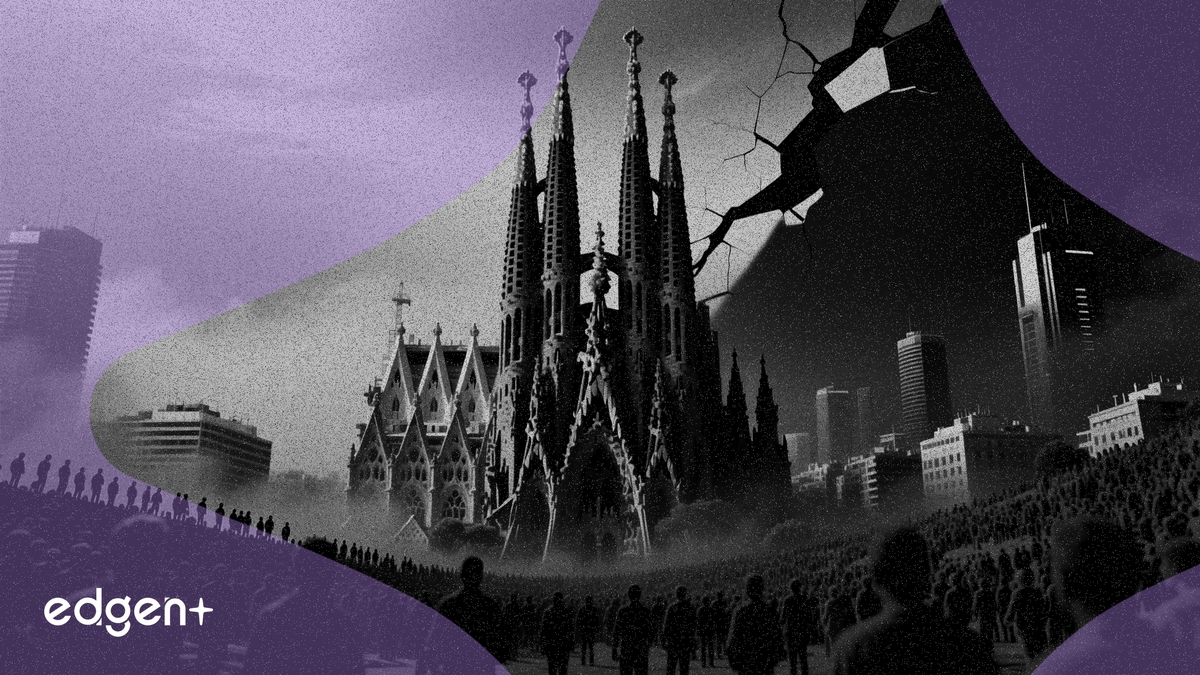
The completion of Antoni Gaudí's Sagrada Família after 144 years has turned Barcelona's most iconic landmark into a flashpoint for Europe's intensifying backlash against mass tourism.
Pope Leo XIV will travel to Barcelona on June 10 to inaugurate the basilica's 18th and final tower, a 172.5-meter spire that makes the Sagrada Família the tallest church in the world. The ceremony coincides with the centenary of Gaudí's death and marks the symbolic completion of a project that began in 1882 — though finishing the Glory Facade, the main entrance Gaudí designed, could require demolishing hundreds of apartments and displacing an estimated 3,000 residents.
"The ambition of Gaudí was to write the Bible in stone. He never ever could have predicted this," said Gijs van Hensbergen, author of a biography of the Catalan architect, referring to the circus-like atmosphere that now surrounds the basilica.
The Sagrada Família draws 5 million ticketed visitors each year, making it Spain's most-visited tourist attraction. Millions more crowd the surrounding streets daily, where street performers, souvenir vendors and social-media influencers cater to the throngs. The private foundation that manages the church caps simultaneous visitors at 1,500 and recently introduced a daily quiet hour for prayer, but it has limited control over the chaos outside its walls.
The backlash extends well beyond the basilica's neighborhood. A Europe-wide YouGov poll published in September 2024 found that 28 percent of Spaniards held a negative view of foreign tourism, the highest share of any country surveyed, and two-thirds sympathized with protests against excessive visitor numbers. Spain received 97 million international tourists in 2025, and April 2026 set a new monthly record with 9.1 million arrivals, up 5.2 percent from a year earlier.
Housing Crisis Fuels Regulatory Crackdown
The central grievance tying tourism to local anger is housing. In Barcelona, the proliferation of short-term rental apartments has pushed residential rents beyond the reach of many residents. Landlords increasingly set rents based on what foreign visitors can pay rather than local salaries, according to Jordi Vila, a representative of the Sindicat de Llogateres tenants' union.
"The owners of properties no longer think about setting rents according to local salaries, but rather the salaries of people visiting from abroad, which might be three or four times higher," Vila said. "So local people end up getting pushed out of their homes."
The response from authorities has been swift. Barcelona's city government plans to revoke licenses for all 10,000 short-term tourist apartments by 2028 and has doubled the tourist tax to 8 euros for cruise passengers on short stays. Prime Minister Pedro Sánchez warned in 2025 that "there are too many Airbnbs and not enough homes," and his government fined the holiday rental platform 65 million euros in December for advertising unlicensed apartments.
The Sagrada Família's own expansion plans have become entangled in the housing debate. Completing the Glory Facade as Gaudí envisioned would require demolishing residential blocks that now occupy the site — a prospect that has galvanized opposition from local residents like Salvador Barroso, who represents a group of potentially affected families.
"We have a theme park called Sagrada Família, and it is dedicated uniquely and exclusively to tourism," Barroso said.
Tourism contributes 13 percent of Spain's gross domestic product and has been a crucial driver of the country's economic growth, which has outpaced France, Germany, Italy and the UK in recent years. The industry's success has also created a tension that Fede Fuster, president of Benidorm's local tourism association, acknowledges is existential.
"The way we welcome people and we care about them and our happiness, the way we live, I think that's something the tourist really appreciates — that's the key," Fuster said. "That's why we have to work a lot in these places, mostly in cities, where there is a feeling of not welcoming tourists. It's very important for us because if we lose that, we're dead."
The decision on whether to proceed with the Sagrada Família's expansion rests with Barcelona's local government, which must weigh Gaudí's architectural legacy against the housing needs of the 3,000 residents who could be displaced. Similar regulatory battles are playing out across Spain's Mediterranean coast, the Balearic Islands and the Canary Islands, where summer protests against tourism have become an annual fixture since 2024.
This article is for informational purposes only and does not constitute investment advice.