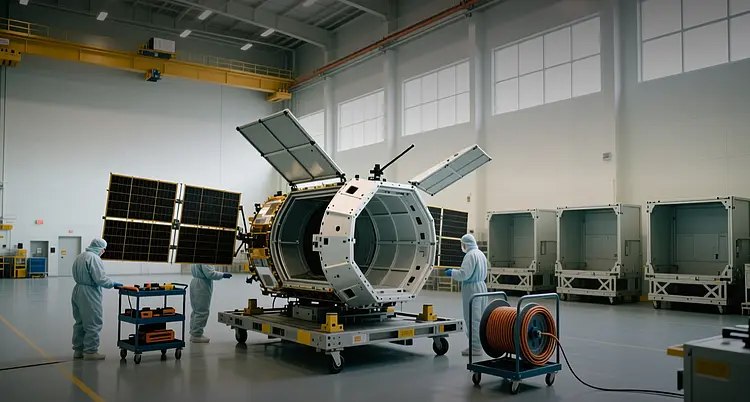
AST SpaceMobile (NASDAQ: ASTS) now has about $3.7 billion of liquidity to fund a satellite build-out whose revenue arrives no earlier than 2027, after the company moved its 45-satellite commercial service date back a full year.
The company raised $1.15 billion through a convertible bond sale after the second quarter closed, lifting total liquidity to approximately $3.7 billion, according to the company. That cushion now has to stretch across a revenue timeline that shifted to the right.
"Building and launching satellites isn't easy," Reuben Gregg Brewer, an analyst at The Motley Fool, wrote in a Sept. 23 note, adding that the company "is aware that it needs cash."
The arithmetic is unforgiving in the near term. AST SpaceMobile burned about $145 million on operating activities in the first half of 2026 and spent another $1 billion on capital investments, mostly satellite construction. At that pace, the $3.7 billion runs out in roughly 18 months. On the more generous 2025 comparison — about $1.6 billion across operating and investing activities for the full year — the runway extends to a bit over two years.
Either way, the cash-out date lands before the 2027 launch window, which is the crux of the problem. The company has no meaningful commercial revenue to offset the spend until the constellation is in orbit and switched on.
The delay matters because AST SpaceMobile's business model depends on scale, not on a single satellite. Its technology connects directly to unmodified cellphones, and it has agreements with large mobile network operators to sell service to their existing subscribers. That gives it a built-in customer base — but only once enough satellites are flying to provide continuous coverage. Forty-five satellites is the threshold management has pointed to for that service.
The competitive backdrop sharpens the stakes. SpaceX's Starlink already operates a functioning satellite network and has moved into direct-to-device service through partnerships with terrestrial carriers, meaning AST SpaceMobile is spending to catch up to a rival that is already generating revenue from orbit. AST SpaceMobile's market capitalization stood near $19 billion as of Sept. 23, against a gross margin of negative 24,279 percent — a figure that reflects a business with essentially no product revenue against fixed costs.
Shares fell 5.83 percent to $59.98 on Sept. 23, within a 52-week range of $47.50 to $133.86. The stock has given back more than half its high, and the decline reflects the market repricing the gap between the launch date and the cash balance.
For holders, the signal is straightforward: the raise removed near-term financing risk but did not remove the timeline risk. The convertible bond extends the runway past the launch, yet it also adds debt that converts into equity, and a lower share price makes that conversion more dilutive per dollar raised. Any further slip in the launch schedule would force another capital raise into a weaker market.
The next hard data point is the company's third-quarter results, where investors will look for updated capital expenditure guidance and any revision to the satellite production cadence. Watch the quarterly cash burn line specifically — if operating and investing outflows hold near the first-half pace, the runway math tightens with every passing quarter.
This article is for informational purposes only and does not constitute investment advice.