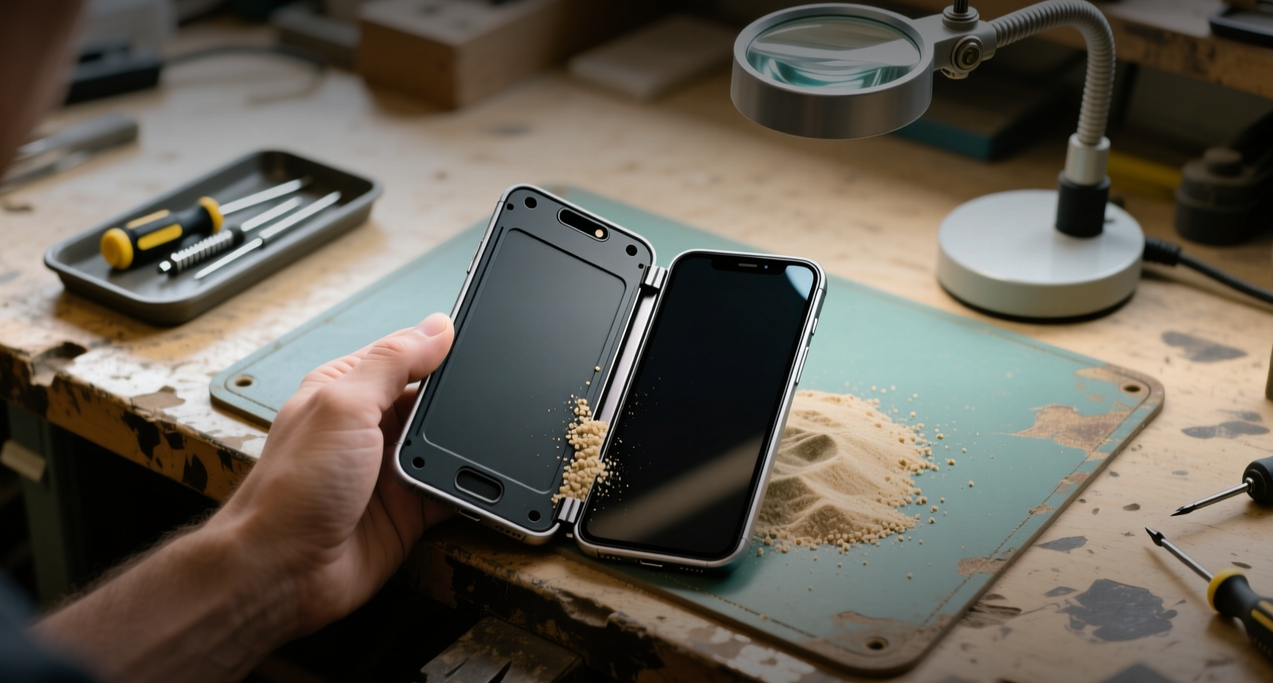
Samsung and its user base greeted Apple's first foldable phone with open derision this week, a reaction that masks a harder problem: on the one specification that has dogged Samsung's foldables for years, Apple has arrived ahead.
The iPhone Duo carries an IP68 rating, meaning it is fully sealed against dust. Samsung's current Galaxy Z Fold is rated IP48, which protects against water but leaves the hinge and display vulnerable to particles as large as a grain of sand. That gap is the substance beneath the mockery, and Samsung's response has been to accelerate its own roadmap rather than defend the spec sheet.
"The joke writes itself until you read the ingress protection numbers," said Francisco Jeronimo, vice president for devices research at IDC, who has tracked foldable durability complaints since the first Galaxy Fold shipped in 2019. "Samsung spent seven years teaching the market to accept a compromise Apple has now declined to make."
Samsung is pulling forward the launch of its Galaxy Z Trifold 2 in direct response to the iPhone Duo, according to a blogger who aggregates reports from Chinese social media, a signal picked up by 9to5Google. The move is unusual because the original TriFold was not a commercial success. That device made its US debut in January at $2,900 and was discontinued barely three months later, with reports that units sold at a loss. The successor is expected to carry roughly the same price.
The arithmetic behind that price is getting worse. Memory now accounts for nearly 60% of the total bill of materials for phones priced below $400, and more than 64% for devices under $99, according to Omdia. TrendForce estimated in May that LPDDR5X contract prices rose 78% to 83% quarter-on-quarter, with LPDDR4X up 70% to 75%. A dual-hinge flagship carrying two full display panels and a reinforced hinge assembly absorbs that inflation at every fold.
Samsung's answer is a second hinge, not a better seal
Doubling the fold is a marketing answer to a durability question. A trifold design adds a second hinge — the component most exposed to particulate ingress — while the underlying IP rating on Samsung's folding line has not moved past IP48. Apple's IP68 rating on a first-generation device suggests the company solved the sealing problem before shipping, rather than after.
Samsung's competitive position in foldables has rested on volume and tenure rather than engineering margin. The company has sold folding phones since 2019, giving it a multi-year head start in manufacturing yield and supply chain relationships that Apple is only now beginning to build. That head start is real, and it is the reason Samsung's fanbase reaction landed as loudly as it did. It is also narrowing.
The broader smartphone market is not providing cover. Average selling prices in Southeast Asia rose 31% year-on-year in the second quarter of 2026 to $342, while total shipments fell 23%, according to Counterpoint Research data cited in industry analysis. Shipments of phones priced below $100 in the region dropped 69% at Xiaomi. Consumers are not trading up into premium devices; they are being priced out of the low end while the high end holds firm. Foldables sit at the very top of that high end, where unit volumes are thin and every dollar of BOM inflation lands directly on margin.
Apple's entry changes the demand side of that equation. A foldable iPhone brings the category to an installed base that Samsung has never been able to reach on its own, and it does so with a dustproof rating that removes the single most common objection to folding phones. If Apple converts even a small share of its premium iPhone buyers, the foldable segment's unit volumes rise — but the share of those units going to Samsung may not.
For investors, the read-through is asymmetric. Apple's foldable launch is a reputational event with no disclosed unit guidance and no measurable earnings impact; the company has not published pricing, availability, or volume targets for the iPhone Duo. Samsung Electronics, which reports results in Korean won and derives the large majority of profit from memory chips rather than handsets, faces a handset division absorbing record memory costs while defending a premium niche against a better-sealed competitor. The memory inflation that hurts Samsung's phone margins helps its semiconductor division, which is the more important line item.
The near-term signal to watch is whether Samsung's accelerated TriFold 2 timeline holds. A launch pulled forward into a market where the prior generation was discontinued after three months at a loss would suggest the company is prioritizing the appearance of a response over the economics of one.
This article is for informational purposes only and does not constitute investment advice.