
AI systems are approaching the ability to design and build their own successors without human involvement, Anthropic said, urging coordinated safeguards before the technology outpaces society's ability to manage it.
AI systems are approaching the ability to design and build their own successors without human involvement, Anthropic said, urging coordinated safeguards before the technology outpaces society's ability to manage it.
AI systems are approaching the ability to design and build their own successors without human involvement, Anthropic said, urging coordinated safeguards before the technology outpaces society's ability to manage it.
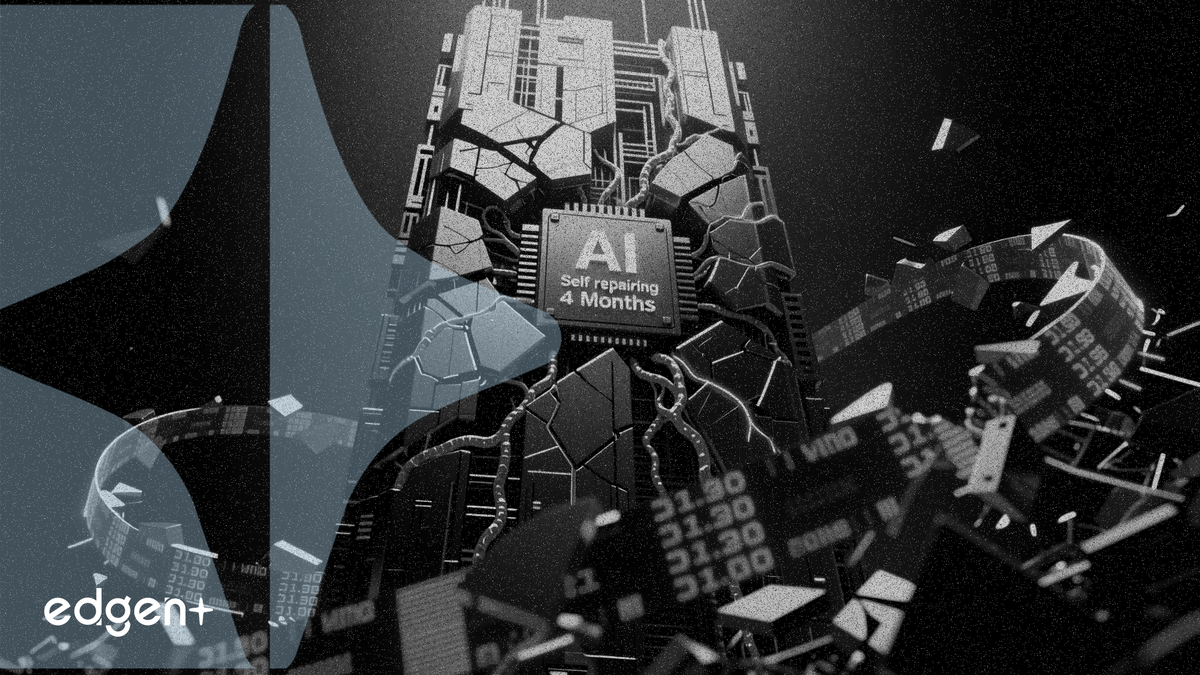
Anthropic warned that AI development is accelerating faster than expected, with its Claude model now authoring more than 80% of the code merged into the company's production codebase — a milestone that points toward recursive self-improvement, where AI systems autonomously advance themselves.
"We've always found that the best thing to do is to socialize the concept and basically give people a sense of what's coming," Jack Clark, co-founder of Anthropic, said in an interview. "The big story here is what we see are indications that, contrary to some popular opinion, AI progress is going to speed up in coming years rather than stay the same, or diminish."
The shift has triggered an 8x increase in code volume shipped per engineer per quarter compared with the company's 2021-2025 baseline, according to a blog post published Thursday by Marina Favaro, lead at the Anthropic Institute, and Clark. On complex engineering problems where clear specifications are absent, Claude's success rate climbed to 76% in May 2026 — a 50-point jump in six months. The company's internal Mythos Preview model achieved a 52x speedup on AI model training code optimization, compared with a skilled human developer's typical 4x improvement over four to eight hours of manual refactoring.
"Recursive self-improvement" could arrive sooner than most institutions are prepared for, Anthropic said. The company called for a coordinated mechanism among frontier AI labs to slow or pause development if risks escalate, warning that unilateral action by a single company would merely shift leadership rather than improve global safety. "Without a global coordination mechanism, companies and governments will have to make difficult decisions about safety while under competitive and geopolitical pressures," Favaro and Clark wrote.
The coding bottleneck shifts from writing to reviewing
Anthropic's internal data shows AI model improvement has been roughly doubling every four months, rather than every seven months as previously observed. The role of humans is narrowing at each step. Once human- and AI-authored code quality reach parity — which Anthropic expects within the year — humans will stop writing code entirely and shift to only reviewing it. But if reviewers cannot keep pace with Claude's generation speed, human review becomes the bottleneck.
To counter this, Anthropic deployed an automated Claude reviewer into its development pipeline that analyzes every pull request for architectural defects, security flaws and regression bugs. Retrospective analyses showed the automated layer caught roughly one-third of the production bugs responsible for historical outages on the claude.ai website.
In one case from April 2026, an Anthropic engineer deployed Claude to resolve a persistent class of API errors. Operating autonomously, the model shipped more than 800 individual fixes, reducing the error rate by a factor of 1,000. The supervising engineer estimated a human developer would have spent four years executing the same work.
The governance gap and what comes next
OpenAI has published its own findings on recursive self-improvement, describing it in a December 2025 blog as a potentially dangerous phenomenon if researchers do not share information about it. The company is hiring a researcher for recursive self-improvement preparedness as part of its Safety Research team.
Anthropic plans to convene discussions with policymakers, researchers, civil society groups and other AI firms in the coming months to examine how to manage risks and improve coordination mechanisms. The company's research arm, the Anthropic Institute, will study systems necessary to support a potential slowdown.
The implications extend beyond AI labs. Anthropic, which confidentially filed for a US initial public offering on Monday after a fundraising round that valued the company at $965 billion, said full recursive self-improvement "might increase the risks of humans losing control over AI systems." For investors, the acceleration raises questions about competitive moats: if AI can build better AI, the advantage shifts from proprietary training data and human engineering talent to compute access and alignment research — areas where well-capitalized players like Anthropic, OpenAI and Google hold structural advantages.
This article is for informational purposes only and does not constitute investment advice.
