
Anthropic and OpenAI are exploring 20-30 MW data center deals across the U.K., the Nordics and the U.S., a shift from the gigawatt-scale contracts both labs signed over the past year as inference demand rises and hyperscale builds face delays.
Anthropic and OpenAI are exploring 20-30 MW data center deals across the U.K., the Nordics and the U.S., a shift from the gigawatt-scale contracts both labs signed over the past year as inference demand rises and hyperscale builds face delays.
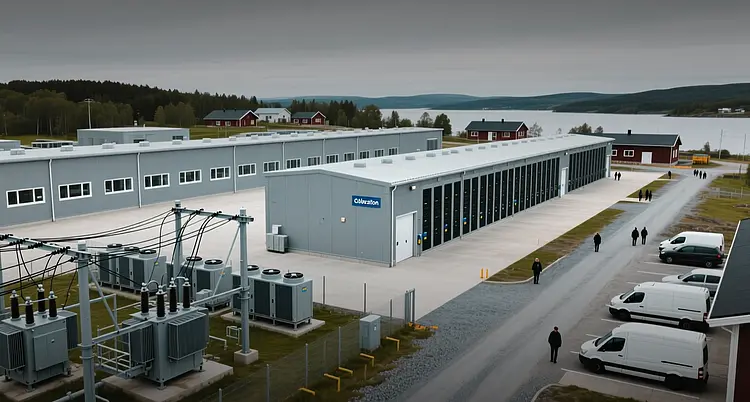
Two of the largest AI developers are now shopping for compute in blocks as small as 20 megawatts, a scale that would have been dismissed as rounding error during last year's gigawatt land grab. Anthropic has sounded out agreements in that range across the U.K. and the Nordics, and OpenAI has explored similar deployments in the Nordics, according to four people familiar with the discussions who spoke to CNBC. One source said both companies have also discussed U.S. capacity at that scale. The smaller blocks can be energized in months rather than years, letting the labs serve inference traffic without waiting on mega-campuses that are increasingly delayed by community opposition and power shortages.
"Securing a few megawatts at an existing powered site can be more practical than waiting for a much larger block in one location," Jabez Tan, head of research at Structure Research, said. "For workloads that can operate across separate sites, a collection of smaller deployments can add up to substantial capacity."
An OpenAI spokesperson said the company is "building a diversified compute portfolio to meet growing demand for AI around the world," adding that "different workloads need different infrastructure" and that it evaluates opportunities on requirements, performance, reliability, timing and cost. Anthropic declined to comment.
The pivot sits alongside, not instead of, the mega-deals. Anthropic agreed in August to rent roughly 460 MW at an Nscale data center development in West Virginia in a cloud deal valued at about $45 billion, two people familiar with the matter said. OpenAI said its Stargate project passed its original 10 GW commitment in April and has since added 3 GW in Georgia and 8 GW in Ohio.
The economics behind the smaller deals come down to what the chips are actually doing. Training a frontier model requires thousands of accelerators working in tight coordination inside one campus, which forces the gigawatt-scale design. Inference — running a finished model against live user requests — splits cleanly across smaller clusters in separate locations.
That split is about to become the dominant use case. Inference will overtake training as a share of total data center capacity in 2027, according to a JLL report, which puts inference at 9% of global data center workloads in 2025 against 14% for training. By 2030, JLL projects inference at 37% of capacity and training at just 13%.
Nvidia has already moved on the thesis. In February the chipmaker said it would work with several data center stakeholders to study smaller-scale facilities built for distributed inference — the same 20-30 MW profile Anthropic and OpenAI are now shopping for.
The supply side is repositioning too. Crusoe, which built the large Texas campus OpenAI uses, is now investing in smaller data centers that are faster and cheaper to deliver than the big builds facing delays across the U.S., the Wall Street Journal reported. Crusoe announced a $3.9 billion funding round on Thursday at a $30.9 billion post-money valuation, a marker of how much capital is chasing neocloud capacity outside the hyperscale tier.
For colocation operators and power suppliers, the shift widens the funnel. A 20-30 MW requirement can be met at an existing powered site with spare interconnection capacity — a category that includes regional colocation providers and utilities sitting on surplus grid headroom in the Nordics and parts of the U.K., where hydro and wind supply is abundant relative to local demand. Those operators were largely shut out of the gigawatt procurement cycle, where a handful of hyperscalers and the largest neoclouds absorbed available capacity.
The constraint that pushed the labs here is not going away. Large campuses in the U.S. face mounting local opposition, and much of Europe is short on both land and power, which stretches the gap between contract signature and energized capacity. That gap is the product being sold: speed to usable capacity, in Tan's phrasing, rather than headline megawatts.
The read-through for investors is that AI infrastructure capex is broadening rather than peaking. Nvidia Chief Executive Jensen Huang told investors the company expects to sell twice as many chips next year as it does now, a forecast that only holds if capacity keeps getting built somewhere. The 20-30 MW deal flow is the mechanism by which it gets built when the gigawatt path is blocked — which supports demand for electrical equipment, grid interconnection and power generation alongside the data center landlords themselves, and argues against the view that AI buildout is confined to a handful of mega-projects.
This article is for informational purposes only and does not constitute investment advice.