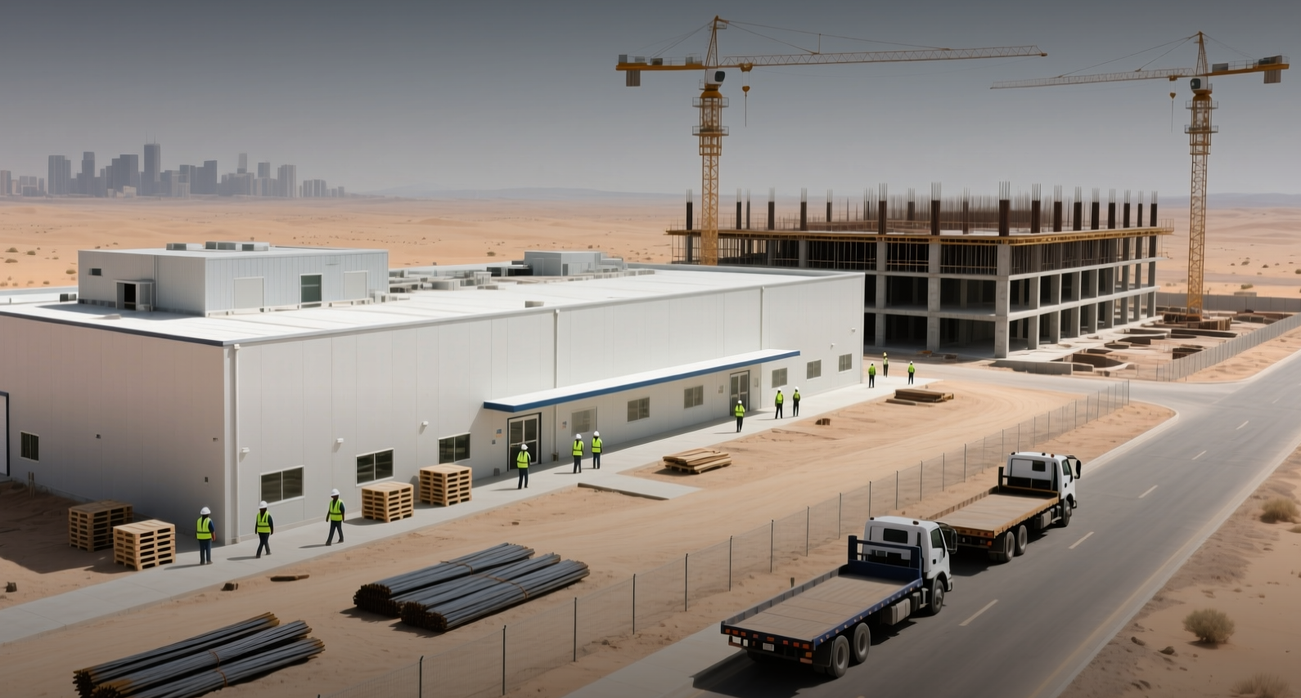
Amkor Technology will spend roughly $12 billion on its Arizona advanced-packaging and test campus after adding a second phase, a bet that outsourced assembly of AI accelerators stays capacity-constrained through the decade.
The Tempe, Arizona-based company said Phase 2 adds 60,000 square meters of cleanroom space, and that customer commitments for the expanded site have surpassed the 33,000 square meters planned under Phase 1. Amkor disclosed the higher figure alongside second-quarter 2026 results that showed record revenue of $1.90 billion, up 26% from a year earlier, with computing revenue also setting a record on data-center demand.
"Advanced packaging is where the AI roadmap gets decided, because you cannot ship a accelerator without somewhere to assemble it," Amkor chief executive Giel Rutten said on the company's second-quarter earnings call. Amkor did not disclose the test conditions or customer-by-customer breakdown behind the commitment figures.
The numbers behind the buildout are unusually specific for a company of Amkor's size. Amkor guided third-quarter 2026 net sales to $1.95-$2.05 billion, above the $1.90 billion just reported, and projected gross margin of 18.5%-19.5% versus 16.8% in the second quarter. Full-year 2026 capital expenditure is forecast at $2.5-$3 billion. The company's 10-year agreement with Taiwan Semiconductor Manufacturing Co. and a multi-year partnership with Nvidia underpin the capacity plan, and Amkor said it is working with leading customers on 2.5D packaging, HDFO (high-density fan-out, a technique that routes more signals through a thinner package) and co-packaged optics.
Why the packaging bottleneck moved to Arizona
Advanced packaging has become the tightest link in the AI supply chain because leading accelerators pair a logic die with stacks of high-bandwidth memory, and that assembly step — not the wafer fab — often sets shipment ceilings. Amkor's expansion puts it directly against TSMC, which said packaging capacity remains tight and is allocating 10%-20% of its 2026 capital budget to advanced packaging, testing and related activities. TSMC's CoWoS (chip-on-wafer-on-substrate) capacity has been the industry's binding constraint for AI accelerators, and the foundry's decision to fund it internally is a competitive signal for merchant packagers.
Intel is a second front. The company is pitching its EMIB-T advanced-packaging technology as a route to AI silicon designs beyond mainstream offerings, reporting high customer interest and a growing EMIB-T backlog, with yields and reliability at targets ahead of high-volume production supporting customer ramps in 2027. Intel's packaging push matters to Amkor because it competes for the same outsourced programs while also owning fabs that Amkor does not.
The demand side is what justifies the spending. Amkor said AI data-center demand remained strong, with HDFO programs and a new data-center CPU program ramping, and computing revenue reaching a record. That tracks the broader AI capex cycle: hyperscaler and accelerator programs are the volume driver for outsourced assembly and test, and Amkor's guidance implies sequential revenue growth of roughly 3%-8% in the third quarter.
What the $12 billion has to earn back
The risk sits in the margin math. Amkor's second-quarter gross margin of 16.8% is thin for a business absorbing $2.5-$3 billion of annual capital spending, and the company's own third-quarter guide of 18.5%-19.5% implies the Arizona ramp has to fill quickly to keep depreciation from outrunning revenue. Customer commitments covering more than 33,000 square meters of Phase 1 cleanroom is the closest thing to demand visibility Amkor has offered, but the company has not disclosed the dollar value or duration of those commitments.
For investors, the read-through cuts two ways. Amkor's capacity commitment supports the AI accelerator supply chain — Nvidia, whose multi-year agreement with Amkor is a named anchor, and TSMC, which supplies the logic wafers that Amkor packages — while raising the execution bar for Amkor itself. Peer packagers including ASE Technology Holding compete for the same outsourced programs, and Intel's EMIB-T backlog is a reminder that the packaging layer is no longer a single-vendor market. Amkor has not disclosed a valuation or price-target update alongside the Phase 2 announcement, leaving the market to price the capex against a gross margin guide that is still below 20%.
This article is for informational purposes only and does not constitute investment advice.