


AMD's data center revenue jumped 57% in Q1, but Intel's foundry pivot and Nvidia partnership show two paths to the same AI prize.
AMD's data center revenue jumped 57% in Q1, but Intel's foundry pivot and Nvidia partnership show two paths to the same AI prize.
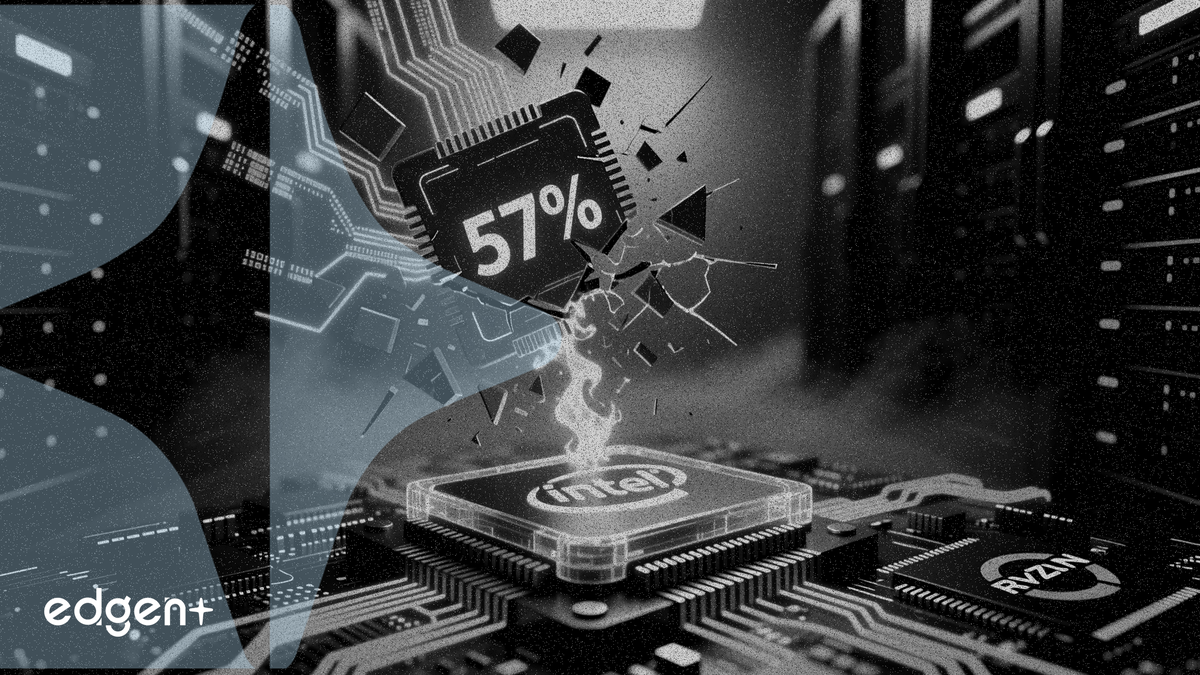
AMD's data center revenue jumped 57% in Q1, but Intel's foundry pivot and Nvidia partnership show two paths to the same AI prize.
Advanced Micro Devices posted $5.78 billion in data center revenue in Q1, up 57% year over year, while Intel's foundry business grew 16% — two diverging paths to the same AI infrastructure prize.
"Accelerating demand for AI infrastructure has made data center the primary driver of our revenue and earnings growth," AMD Chief Executive Officer Lisa Su said.
AMD's total revenue reached $10.25 billion, up 38% year over year, with non-GAAP earnings per share of $1.37 beating the $1.29 consensus. Intel reported $13.58 billion in revenue, up 7.2%, and a non-GAAP EPS of $0.29 against a near-zero consensus estimate, though a $4.07 billion restructuring charge tied to Mobileye pushed it to a GAAP net loss of $3.73 billion.
The divergence matters because both companies are chasing the same hyperscaler customers. AMD secured a deal with Meta for up to 6 gigawatts of Instinct GPUs, while Intel's Xeon 6 was selected as the host CPU for Nvidia's DGX Rubin NVL8 system. AMD shares have gained 129% year to date, while Intel has surged 86.5% since late April — but the two stocks trade at vastly different valuations, with AMD at 168 times trailing earnings and Intel at a fraction of that multiple.
Instinct vs. Foundry: Two Bets on the Same $800 Billion Market
AMD's strategy is pure fabless acceleration. The company designs Instinct GPUs and EPYC server CPUs on TSMC's process nodes, partnering with Samsung on HBM4 memory supply for its MI455X chips. The Meta deal for up to 6 gigawatts of Instinct GPUs across multiple product generations, anchored by a custom MI450 accelerator, gives AMD a multi-year revenue pipeline. Chief Financial Officer Jean Hu said MI450 will start to ramp in the third quarter and ramp significantly in the fourth, though she noted the product's gross margin will be below corporate average.
Intel is pursuing a more capital-intensive path. Chief Executive Officer Lip-Bu Tan is rebuilding the company as an integrated device manufacturer with U.S. government backing through the CHIPS Act, which includes an equity stake. Nvidia previously invested $5 billion in Intel, and the selection of Xeon 6 as the host CPU for Nvidia's DGX Rubin NVL8 system gives Intel a foothold in the AI rack architecture. Intel Foundry revenue rose 16% in Q1, though the segment remains a drag on overall profitability.
What Q2 Will Reveal About the Trajectory
AMD guided second-quarter revenue to approximately $11.2 billion, implying about 46% year-over-year growth, with gross margin ticking up to 56%. The key question is whether MI450 shipments convert the Meta and OpenAI pipeline into reported revenue. Intel guided to $13.8 billion to $14.8 billion in revenue with non-GAAP EPS of $0.20. The risk for Intel is whether its 18A process node wins enough external foundry customers to justify the capital expenditure, as the company posted negative free cash flow of $3.87 billion in Q1.
For investors, the choice comes down to business model preference. AMD offers visible growth with a clean fabless model but trades at a valuation that leaves no room for error. Intel offers a government-backed turnaround story with a lower valuation but carries execution risk on its foundry ambitions. Both are betting the AI data center market will exceed $800 billion in cumulative spending — the question is which business model captures more of it.
This article is for informational purposes only and does not constitute investment advice.
