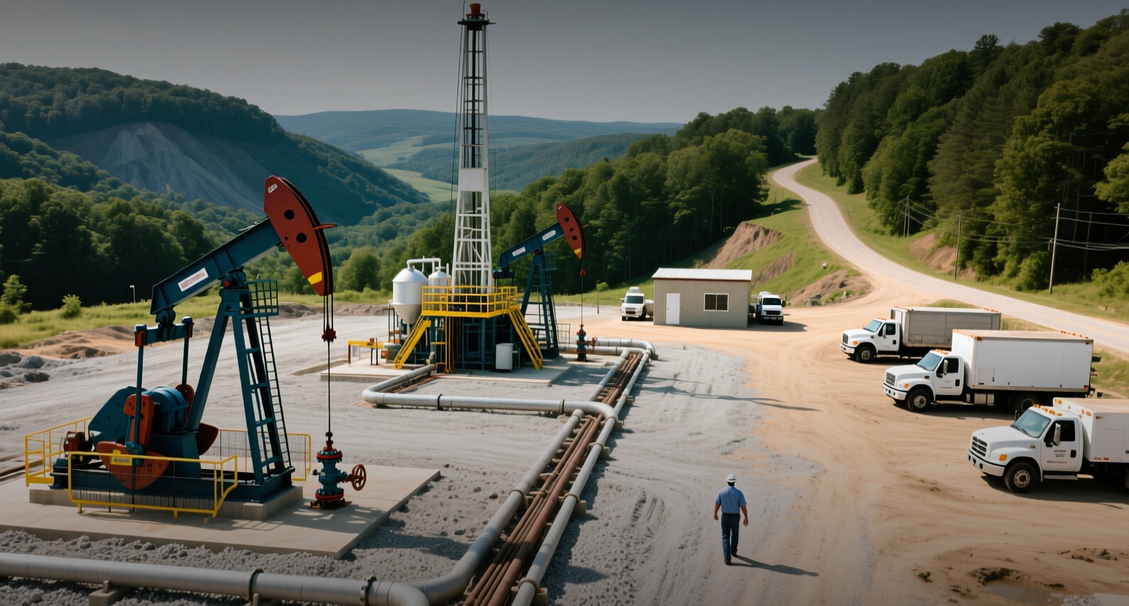
Alpha Compute Corp. will pay $5.5 million for a Pennsylvania oil and gas business holding more than 300 acres of Utica and Marcellus shale rights, a bet that owning the fuel is cheaper than buying the electricity for a planned 200 megawatt data center.
The Pittsburgh-based company said it executed definitive real estate and asset purchase agreements covering surface, mineral and gas parcels in both shale formations. The package includes more than 75 existing wells, pump jack inventories, maintenance facilities, heavy equipment and gathering infrastructure.
"Securing these land and energy rights in Pennsylvania provides a highly resilient foundation for our next-generation compute infrastructure," Brittany Kaiser, chief executive officer of Alpha Compute, said. "By honoring local county ordinances, adhering strictly to Pennsylvania DEP regulations, and partnering with regional grid authorities, we are ensuring that our growth creates long-term value, environmental stewardship, and clean economic development for the state."
The company is leaning on a historical third-party assessment by Haliburton that estimates an average of 10,000 barrels per acre of light Pennsylvania sweet crude across the subsurface parcels. Alpha Compute said it is running updated geological assessments, modern appraisals and site reviews to map reserve potential, and did not disclose the methodology or vintage of the Haliburton work. Executive Chairman and President Enzo Villani said preliminary evaluations indicate roughly 4% of surface oil has been extracted, leaving the site "both profitable and financially self-sustaining."
Shares of Alpha Compute rose 5.52% to $4.81 on the news, trading in a range of $4.65 to $4.89. The company's market capitalization stands at about $7.46 million, a figure that makes the $5.5 million purchase price material relative to the equity base. Recent insider records showed net buying of 43,897 shares and zero shares sold, according to StockTitan data, separate from the acquisition terms.
Why an AI company is buying oil wells
The logic runs against the prevailing model in AI infrastructure, where operators such as Microsoft, Amazon and Google sign long-term power purchase agreements with utilities or independent generators rather than owning fuel. Owning upstream acreage converts a variable operating cost — electricity, which can consume 40% to 60% of a data center's lifetime expense — into a fixed asset with its own revenue stream. For a company of Alpha Compute's size, that structure also sidesteps the interconnection queue delays that have pushed wait times for new grid capacity in PJM, the regional transmission organization covering Pennsylvania, to multiple years in some territories.
The arithmetic is the open question. A 200 MW facility running at high utilization consumes roughly 1.75 terawatt-hours annually, and at PJM industrial rates that implies an eight-figure annual power bill. Whether 300 acres of Pennsylvania shale can supply gas at a cost below grid pricing depends on well productivity, decline curves and gathering economics that Alpha Compute has not yet published. The company's own forward-looking statements flag "gas availability, projected power costs, well and generation plans" as unconfirmed.
The asset base is also small in industry terms. A 200 MW campus places Alpha Compute well below the gigawatt-scale buildouts announced by Microsoft, Meta and Oracle, and the $5.5 million price tag is a fraction of the $1 billion-plus that comparable hyperscale projects require. The company said the planned facility will replicate the design and architectural framework of its Northern Pennsylvania site, with development subject to local county ordinances, regional grid interconnection standards and Pennsylvania Department of Environmental Protection regulations, including operator registration and bonding requirements.
The compliance and plugging overhang
Owning producing wells brings obligations that a pure power-purchase contract does not. Pennsylvania's DEP requires operators to register and post bonds, and the state has tightened rules on well plugging and abandonment after decades of orphaned wells from legacy producers. Alpha Compute said it plans post-closing environmental compliance, plugging assurances and responsible well management under DEP oversight, and intends to form binding covenants with local and county governments. Those covenants and obligations are planned, not completed.
The company is domiciled in the British Virgin Islands with offices in New York, Los Angeles, Miami, Amsterdam and Toronto, and is a founding partner of the Right2Compute Coalition. Its stated customer base spans finance, defense, intelligence and media — sectors that demand confidential computing environments and, in several cases, domestic power sourcing.
For investors, the trade hinges on disclosure that has not yet arrived. Alpha Compute has not published the closing timeline, the financing structure for either the acquisition or the data center, confirmed reserve figures, or production volumes from the existing wells. The stock's $7.46 million market cap means the $5.5 million deal is roughly three-quarters of the equity value, so any revision to the reserve estimate or a financing shortfall would move the shares sharply. The company's Form 20-F for the year ended March 31, 2026 lists "confirmation of mineral title, recoverable resources and energy supply" and "the ability to secure additional financing" among its risk factors.
The next data points to watch are the updated geological assessment, the closing of the purchase agreements, and any filing that quantifies production or power costs. Until those land, the market is pricing a strategy rather than a cash flow.
This article is for informational purposes only and does not constitute investment advice.