Alibaba's cloud unit grew external revenue 45% in the June quarter, a 22-quarter high, while capital expenditure climbed 75% year over year to RMB 67.68 billion ($9.5 billion) — a spending pace that cut quarterly net profit by 75% and left investors weighing whether the AI buildout pays for itself.
"AI-related products now represent 35% of external cloud revenue after 12 consecutive quarters of triple-digit growth," Alibaba management said on the June-quarter earnings call, guiding the annualized AI run rate toward $10 billion in the following quarter.
The arithmetic behind that guidance is where the tension sits. Alibaba Cloud's external revenue growth accelerated to 45% from 3% headline growth in fiscal 2026, and the segment's EBITDA margin already stands at 12% and is expanding. Management estimates a 2.5-year payback on AI infrastructure, which would place the earnings recovery inside the next 18 months. Against that, operating margin fell to 6% of revenue from 14% a year earlier, and the company raised $10.2 billion in August through 710 million new shares at HK$112.70 — a 3.6% dilution at an 8.4% discount to the prior close.
Bernstein analyst Robin Zhu cut his price target to $165 from $180 while keeping a Buy rating, citing execution risk and the credibility cost of raising capital after the company had highlighted a strong cash position. Susquehanna took the other side, maintaining a Positive rating and lifting its target to $190 in late August.
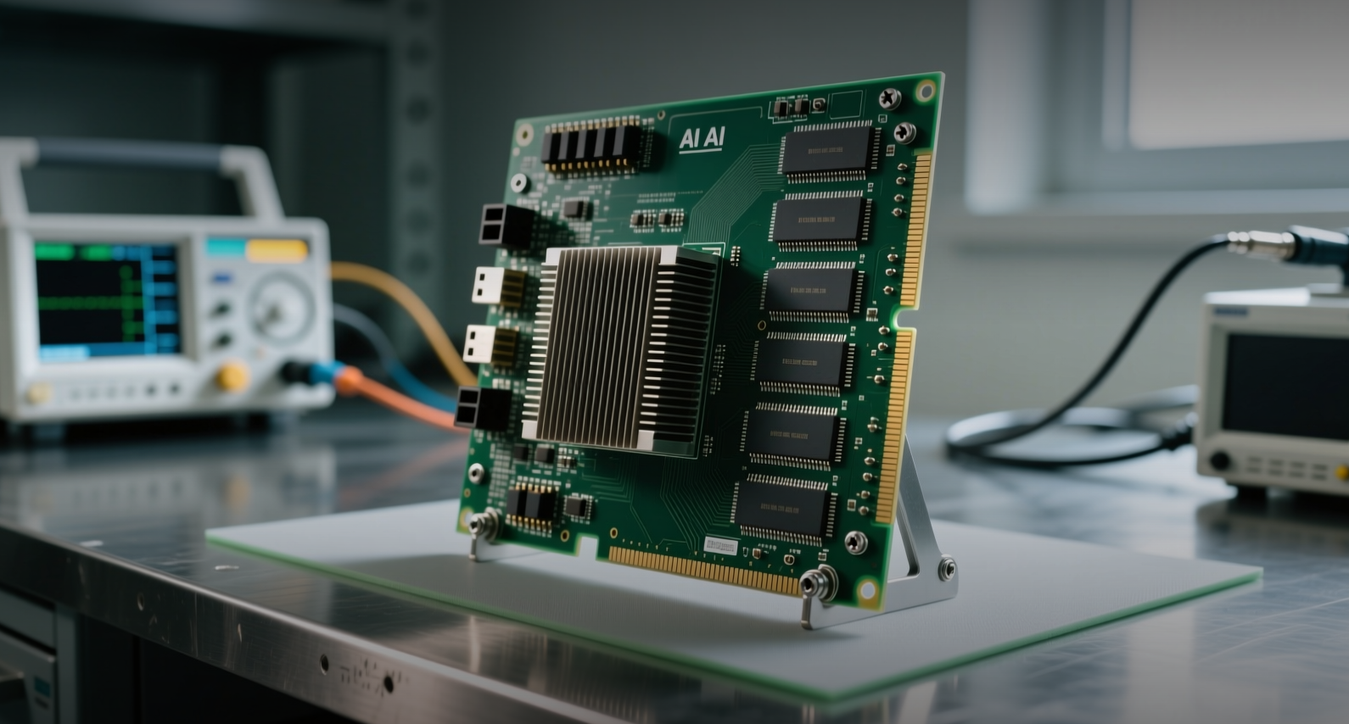
The competitive frame is what makes the capex number legible. Alibaba's Qwen family competes directly with DeepSeek's models on cost-per-token economics and with ByteDance's Doubao on domestic enterprise adoption, while its in-house AI chips are designed to reduce reliance on Nvidia's H20 and Huawei's Ascend 910B for inference workloads. Every dollar of that RMB 67.68 billion quarterly capex is a bet that owning the silicon and the model stack lowers the marginal cost of serving tokens below what a pure cloud reseller can match.
That bet carries a policy dimension Alibaba does not control. U.S. export controls have repeatedly reshaped which accelerators Chinese cloud providers can buy, pushing Alibaba toward in-house designs and domestic foundry capacity. The company has not disclosed the process node or performance specifications of its latest AI chip, and did not disclose the test conditions for any internal cost comparisons against Nvidia or Huawei parts.
The stock reflects the disagreement. BABA's tokenized shares traded at $115.40 on Sept. 21, above the 7-day simple moving average of $112.25 and the 20-day at $111.50 but below the 50-day at $118.81 — a recovery, not a resumption. The forward P/E of 17.67 sits against a consensus mean target of roughly $184 to $188 across 26 covering analysts, 21 of whom rate the stock a Strong Buy. The PEG ratio of 0.51 prices hyper-growth cloud metrics like a slow-growth value name.
The dilution overhang has not fully cleared, and a securities class action carries an Oct. 5 lead-plaintiff deadline. Offsetting that, Chairman Joe Tsai and CEO Eddie Wu bought a combined HK$120 million of BABA shares in the open market after the equity raise, and the company holds $385.7 billion in total cash.
The next verdict point is Alibaba's November earnings report, estimated for Nov. 24. If cloud external revenue holds above 45% growth and segment EBITDA margin expands, the forward-multiple de-rating case weakens and a move toward $135 to $140 becomes the base case on a simple re-rating to 22-23x. If capex keeps outrunning monetization, the 75% net-profit decline stops looking like a buildout phase and starts looking like the run rate.
This article is for informational purposes only and does not constitute investment advice.