

China's largest cloud provider now says its in-house T-Head silicon can train frontier models at a scale that previously required imported hardware, and it wants 20 gigawatts of data-center capacity by 2032 to run it.
China's largest cloud provider now says its in-house T-Head silicon can train frontier models at a scale that previously required imported hardware, and it wants 20 gigawatts of data-center capacity by 2032 to run it.
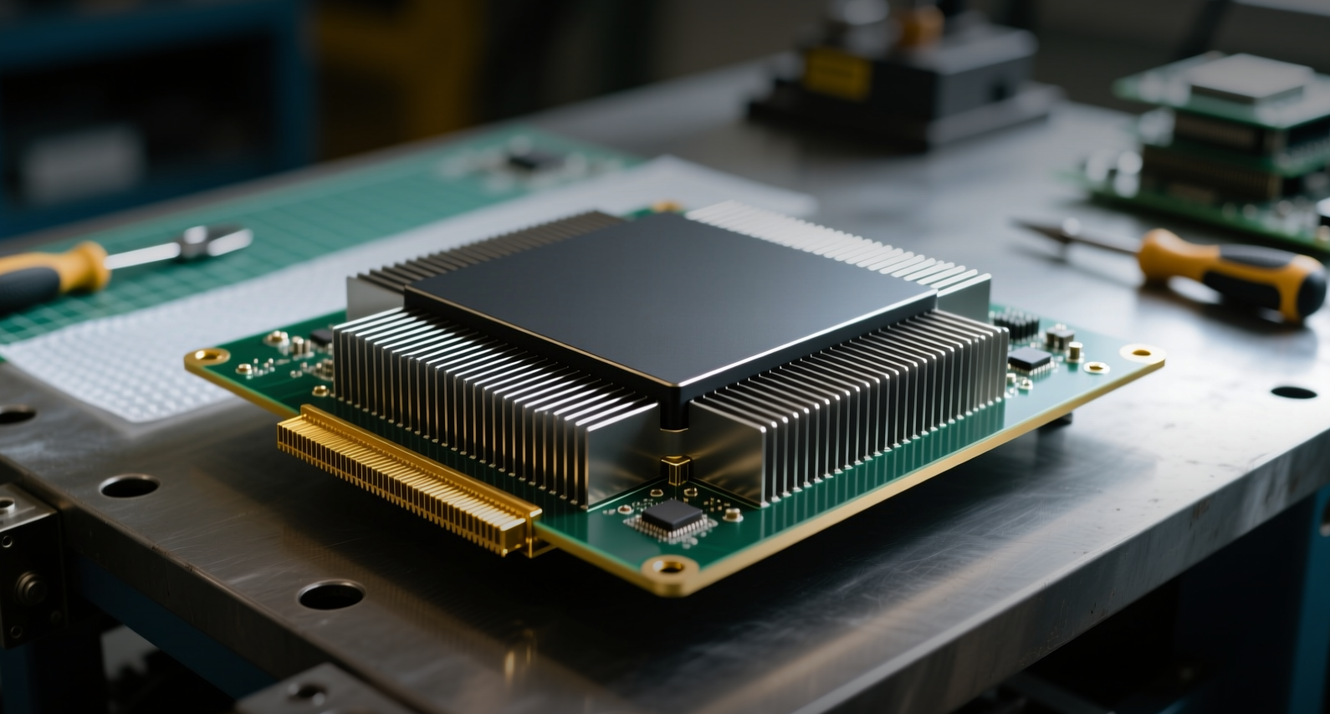
Alibaba Group Holding Ltd. introduced the Zhenwu V900, an accelerator it calls China's most powerful AI chip, claiming three times the performance of its M890 predecessor and clustering up to 500,000 units for frontier-model training. Chief Executive Officer Eddie Wu unveiled the part Tuesday at the company's flagship conference in Hangzhou, alongside a target of more than 20 gigawatts of data-center capacity for Alibaba Cloud by 2032.
"Machine intelligence today is not a substitute for human intelligence," Wu said at the event, predicting machines will eventually produce more than 1,000 times the "thinking" of all humanity combined, up from less than 3% now.
The V900 comes from Alibaba's T-Head chip design division, which the company plans to list separately to capture investor interest in the AI accelerator market, Bloomberg News has reported. Alibaba has committed more than $53 billion over three years to expand AI capabilities and raised about $10.2 billion in a Hong Kong follow-on share offering in August. Wu said global shortages across the AI data-center supply chain "are currently limiting the speed at which we can scale our compute infrastructure."
Alibaba did not disclose the V900's process node, transistor count, memory bandwidth, or the test conditions behind the three-fold performance claim, leaving the comparison unverified against Nvidia Corp.'s China-eligible accelerators. The company also said it plans to train a model at the scale of 5 trillion to 10 trillion parameters, far larger than its current Qwen3.8-Max at 2.4 trillion. Chinese startup Moonshot says its Kimi K3, released in July, is the world's largest open model at 2.8 trillion parameters.
The parameter target is the more consequential number. Frontier training at that scale requires sustained interconnect bandwidth and memory capacity that Chinese accelerators have historically struggled to supply, which is why domestic labs have leaned on Nvidia hardware for the largest runs. Alibaba's 20 GW capacity goal, set for 2032, implies a buildout roughly twice the scale SpaceX says it aims to reach in 2027, when the rocket company targets more than 10 GW. SpaceX had approximately 1.4 GW of AI computing capacity as of mid-year.
Huawei Technologies Co. unveiled new chip technologies last week in its own bid to challenge Nvidia, and analysts say Chinese-designed silicon is gaining ground in domestic training clusters even as U.S.-led export restrictions bar access to the most advanced chips and chipmaking equipment. Alibaba's announcement lands a day before Xi Jinping arrives in Washington for a state visit and meeting with U.S. President Donald Trump, where AI, trade, and tariffs are expected to dominate the agenda. Nvidia CEO Jensen Huang and Microsoft Corp. CEO Satya Nadella are set to attend a White House state dinner with the two leaders.
The timing cuts both ways for Nvidia. Every gigawatt Alibaba fills with T-Head silicon is capacity that does not convert into accelerator orders, and the V900 gives Beijing a domestic alternative to cite in Washington. Nvidia shares have swung on China-access headlines all year, and the stock's reaction Wednesday will be the first read on whether investors treat the V900 as a credible substitution threat or a specification sheet without independent benchmarks.
Alibaba's event coincided with a broader advance in AI-linked equities, after early signs of success for Meta Platforms Inc.'s new personal agent, Muse, revived optimism following weeks of uncertainty over AI spending returns. Meta shares rose 11.4% to $741.25, according to Seeking Alpha data, while Alibaba's U.S. depositary receipts traded at $115.75, up 2.2%, with pre-market quotes at $119.73.
The two catalysts pull in opposite directions for the same supply chain. Meta's Muse success supports demand for accelerators, high-bandwidth memory, and data-center power regardless of who builds the silicon. Alibaba's V900, if it performs as claimed, redirects a slice of that demand toward Chinese suppliers and away from Nvidia's China-eligible product line. Alibaba's own guidance frames the constraint as physical rather than financial: Wu said supply-chain shortages, not capital, limit how fast the company can add compute.
For investors, the read-through is that AI infrastructure spending remains the binding theme, but the beneficiary list is narrowing by geography. Alibaba's $53 billion commitment and 20 GW target put it in the top tier of global AI spenders, and a T-Head listing would give public-market investors direct exposure to Chinese accelerator design for the first time. The unresolved question is verification: without disclosed process node, bandwidth, or benchmark methodology, the V900's three-fold claim remains a company figure, and Nvidia's China revenue trajectory over the next two quarters will show whether customers treat it as one.
This article is for informational purposes only and does not constitute investment advice.