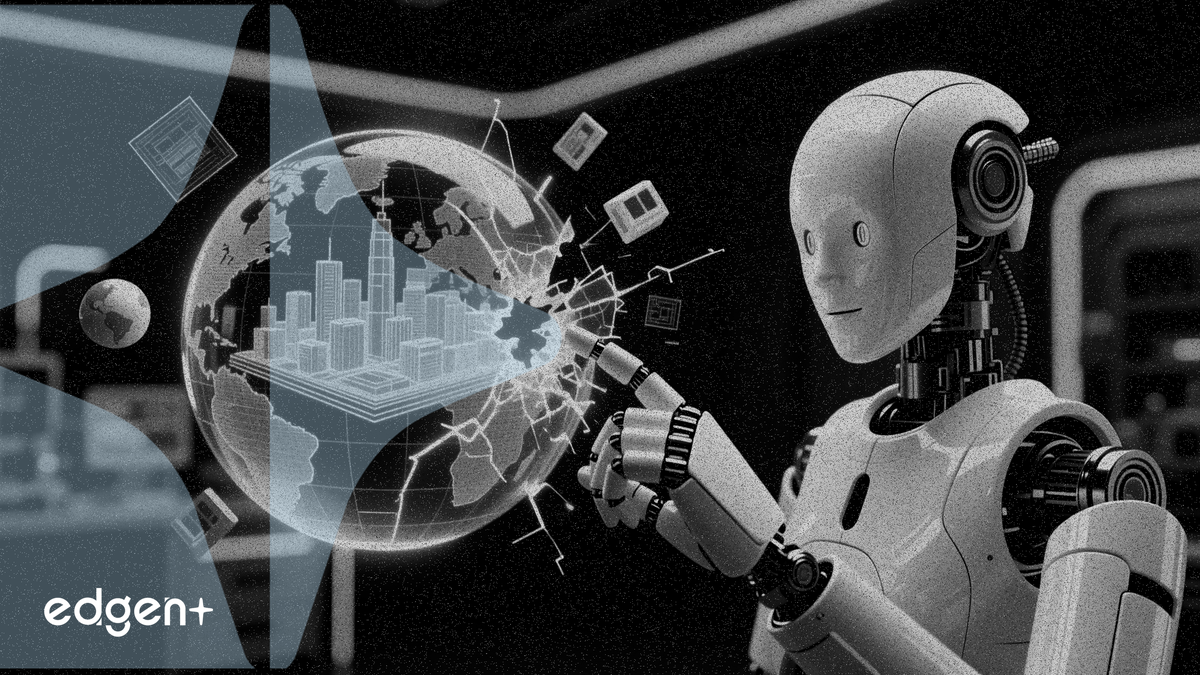
Alibaba Group Holding Ltd. released an artificial intelligence model designed to help robots perceive and interact with the physical world, joining a growing race among Chinese tech giants and global startups to build "world models" that go beyond traditional language-based AI.
The model, whose specific name and parameter count were not disclosed, aims to give robots the ability to understand spatial environments, object relationships and physical dynamics — capabilities that have long eluded conventional vision-language-action systems. Alibaba's move comes as the AI industry shifts focus from large language models to world models that can simulate and predict real-world physics.
"World models represent the next frontier in embodied intelligence, moving AI from text generation to physical-world understanding," Wang Xiaogang, chairman of ACE ROBOTICS, said in a statement earlier this month. His company's open-source Kairos world model recently topped four global embodied-intelligence benchmarks, including a 96.1 percent score on the RoboTwin 2.0 dual-arm manipulation benchmark.
Alibaba's entry pits it against a rapidly expanding field. ACE ROBOTICS' Kairos-4B model, with only 4 billion parameters, achieved a 9.30 overall score on the WorldModelBench Robot benchmark, outperforming systems with up to 28 billion parameters from Nvidia Corp. and others. Fei-Fei Li's World Labs, valued at $1 billion, launched its Marble app in November, using world models to generate interactive 3D replicas of spaces from visual or written prompts.
The competitive landscape spans both China and the US. Nvidia's Cosmos 3.0, introduced this year, adopts a unified architecture that brings vision reasoning, world generation and action prediction into a single system — the same design philosophy ACE ROBOTICS first introduced in December 2025. Alibaba's model will need to match or exceed these benchmarks to gain traction with robotics developers and hardware manufacturers.
For Alibaba, the model extends its AI ambitions beyond cloud computing and enterprise software. The company has invested heavily in its Tongyi Qianwen (Qwen) large language model family and is now pushing into embodied AI, a market that could unlock new revenue streams in industrial automation, logistics and smart retail. Alibaba Cloud, the company's cloud computing arm, would be the natural platform to offer the model to enterprise customers.
The robotics AI market represents a significant opportunity. ACE ROBOTICS has raised several hundred million dollars in the first half of 2026 from investors including Geely Capital and Shenzhen Capital Group, signaling strong investor appetite for embodied intelligence. Alibaba's scale and existing cloud infrastructure could give it a distribution advantage over smaller rivals, though its model's performance relative to established benchmarks remains unverified.
Alibaba shares traded higher on the announcement. The company's push into world models positions it to compete for a share of the growing robotics software stack, where the ability to generalize across unseen environments — lighting, layouts, objects and sensor noise — remains the central technical challenge. Without independent benchmark results, however, it is too early to assess whether Alibaba's model can match the scene-level generalization scores of leaders like Kairos, which achieved 89.0 on the LIBERO-Plus benchmark, or the parameter efficiency of models like Kairos-4B.
This article is for informational purposes only and does not constitute investment advice.