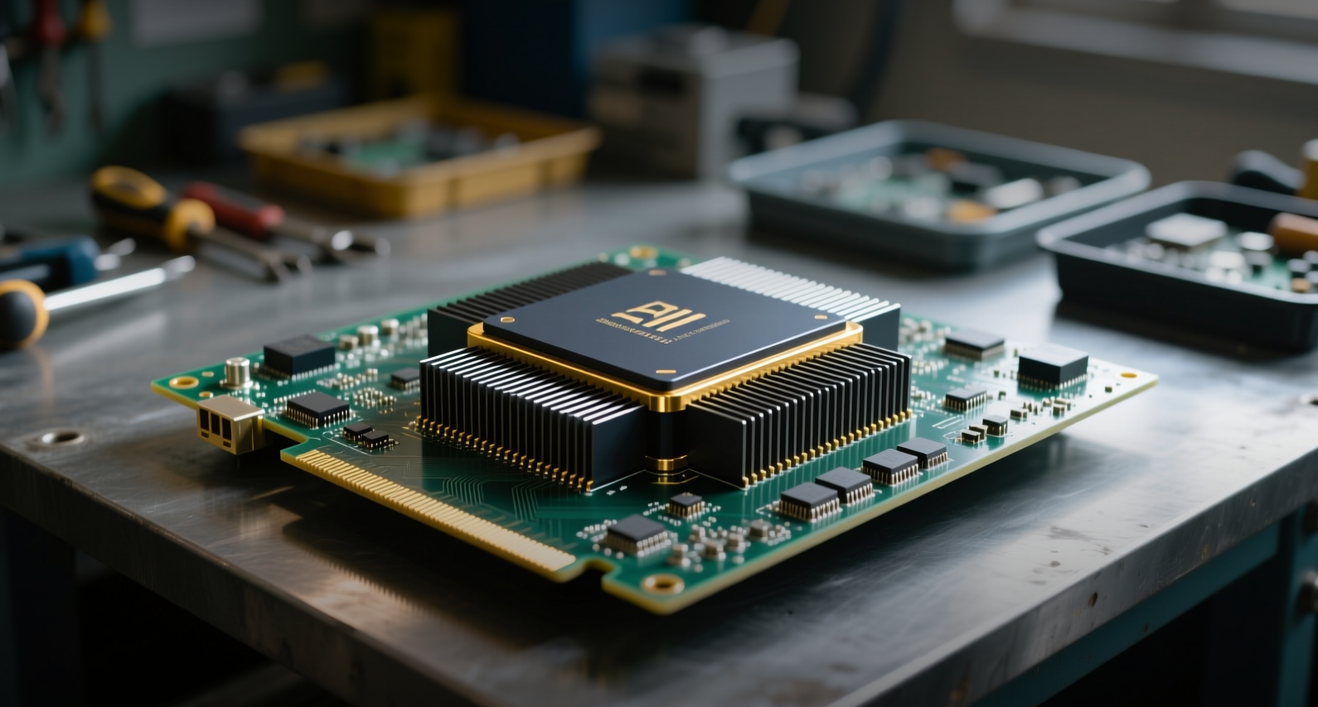
Alibaba Group Holding Ltd. plans to operate more than 20 gigawatts of Alibaba Cloud data center capacity worldwide by 2032, a buildout the company says its own Zhenwu V900 accelerator now makes economically defensible. Chief Executive Officer Eddie Wu set the target at the Apsara Conference in Hangzhou on Sept. 22, the same day Alibaba's T-Head chip unit unveiled the accelerator, which it says delivers three times the compute of the Zhenwu M890.
"Customer demand for AI is currently very strong, and Alibaba Cloud is fully deploying AI computing capacity to meet demand," Wu said. "The industry's medium- to long-term demand far exceeds supply capacity, and the global shortage in the AI data center supply chain is constraining the pace of computing power growth."
The 20GW figure is a capacity target, not a spending number, and Alibaba has not disclosed the capital cost attached to it. For scale, SoftBank Group Corp. has described a single 10GW-scale computing center in Ohio. Alibaba has already committed more than $53 billion over three years to expand AI capabilities and raised about $10.2 billion in a Hong Kong follow-on share offering in August. Wu's team has said the company expects to recoup its overall AI investment within three years, with annualized revenue from AI-related products reaching $10 billion in the current quarter and a goal of quintupling annual cloud and AI revenue to $100 billion in five years.
The V900 is the piece that changes the arithmetic. T-Head says a single cluster built on the chip can scale to 500,000 cards, enough to train and run frontier models, and that annual AI chip shipments will rise significantly on the back of an established product line. T-Head has delivered 560,000 units of the Zhenwu family, with processors deployed by more than 400 external customers, according to Alibaba. The company has not published the V900's process node, memory bandwidth, thermal design power or pricing, and did not disclose the test conditions behind the three-times comparison to the M890.
That disclosure gap matters because the comparison is against Alibaba's own prior generation, not against Nvidia Corp.'s current data center parts. Alibaba last released a new AI chip in May and plans to refresh the lineup annually, a cadence that mirrors the cluster-scale strategy used by Huawei Technologies Co. and Moore Threads Technology Co. — Chinese designers that compensate for weaker per-chip performance by wiring very large numbers of accelerators together.
The chip stack behind the gigawatts
T-Head has now filled out the silicon needed to build those clusters: Zhenwu series GPUs, Yitian series CPUs, Panmai series smart network interface cards and ICN interconnect chips. Alibaba says it is jointly optimizing across chips, servers, supernodes, networks, models and inference systems to lift token throughput across an entire AI cluster. The self-developed M890 supernode already supports inference for models exceeding 2 trillion parameters and is in scaled supply on Alibaba Cloud, with new service nodes to be added in the fourth quarter.
On the model side, the Qwen team is working on recursive self-improvement — models identifying their own weaknesses, designing experiments and iterating — and plans to train a new model with 5 trillion to 10 trillion parameters. That is far larger than the open-weight models Alibaba currently ships, and it is the clearest signal of how much compute the 20GW target is meant to absorb.
The buildout lands against a mixed financial backdrop. Alibaba's quarterly profit fell more than 75% in the most recent quarter after a spending spree of nearly $10 billion, and the company's Hong Kong-listed shares rose more than 5% on the day of the announcement. Alibaba also plans to list T-Head, Bloomberg News has reported, a move that would give the chip unit its own currency for funding expansion.
For suppliers, the read-through is direct. A 20GW program implies multi-year orders for servers, power distribution and backup generation, liquid cooling and optical modules — the same categories already tight globally, which is the constraint Wu cited. Chinese optical-module and power-equipment makers are the most immediate beneficiaries, while Nvidia's China data center exposure faces a slower erosion than a headline "3x" suggests, because the V900 has not been benchmarked against Nvidia parts and Alibaba has not said what share of its fleet the chip will power.
The near-term question is funding, not demand. Alibaba has not disclosed the capex schedule behind the 20GW target, and the profit decline shows what the spending already does to reported earnings. Investors get the next hard datapoint when Alibaba reports quarterly results and details cloud capital expenditure; T-Head's listing timeline, which the company has not dated, is the second.
This article is for informational purposes only and does not constitute investment advice.