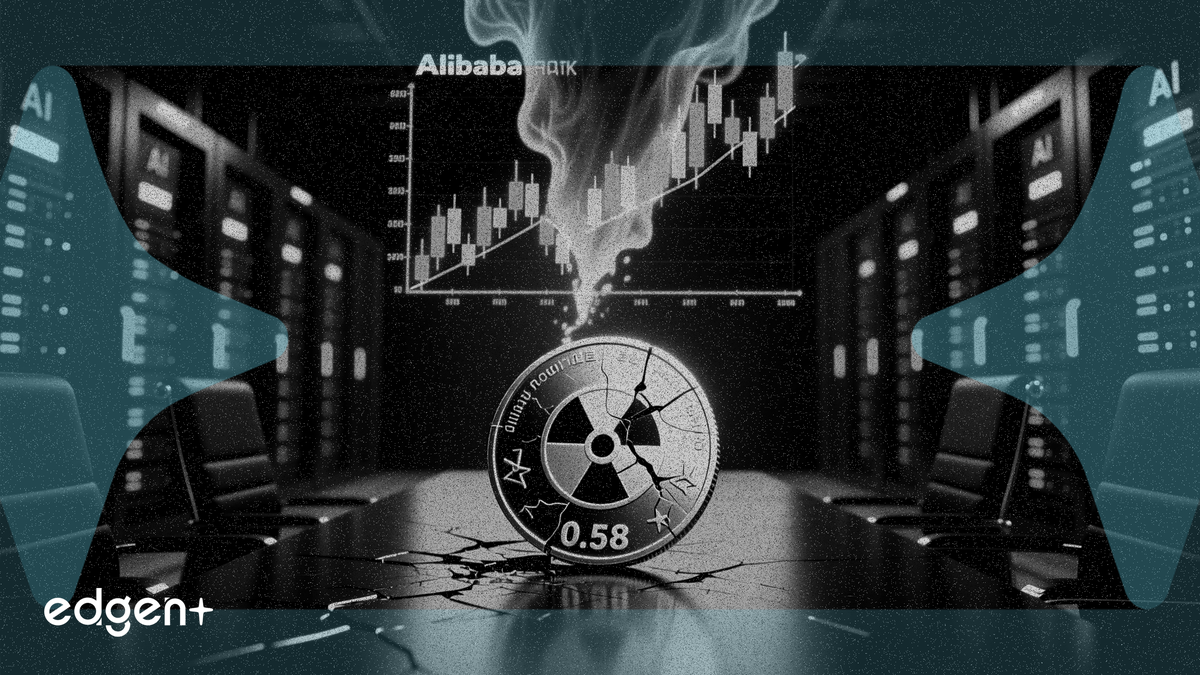
Alibaba's plan to power its AI data center with a small nuclear reactor has stalled over China's rigid electricity pricing rules.
Alibaba Group Holding Ltd. held talks with a state-owned nuclear power enterprise to build a small modular reactor for its Hangzhou Renhe Data Center, but discussions stalled over electricity pricing and grid connection rules, Chinese media reported.
"If all electricity generated by small modular reactors were transmitted through the public grid and settled at an electricity price of approximately 0.58 yuan per kilowatt-hour, it would be difficult for enterprises to effectively control electricity costs," a person familiar with the discussions said, according to the report.
The Renhe data center, described as Zhejiang's first cloud computing facility, provides computing power for AI companies including BrainCo and Lingban Technology. Alibaba sought a self-owned power plant model to bypass grid pricing, but Chinese policy requires captive power plants to connect to the public grid, making independent operation impossible under current rules.
The impasse highlights a growing tension between China's tech giants and its state-controlled power grid as AI infrastructure demand surges. China's data center capacity is expected to grow from 1.4 gigawatts to 9 GW by 2030, consuming about 3 percent of the nation's electricity, according to Deloitte India estimates. Without a dedicated power pricing framework for AI infrastructure, companies like Alibaba face rising energy costs that could erode the economics of domestic AI computing.
Why SMRs Matter for AI Infrastructure
Small modular reactors have emerged as a potential solution for the AI industry's insatiable power demand. Unlike traditional nuclear plants, SMRs can be built closer to consumption sites and scaled incrementally. Globally, tech companies are exploring nuclear options: Doosan Group recently expanded its AI alliance with Nvidia, with Doosan Enerbility's gas turbines and SMRs expected to power Nvidia's AI factory platform, DSX. In the US, hyperscalers including Google, Oracle, and Amazon Web Services have signed long-term deals with SMR developers.
The global scale of the challenge is immense. The International Monetary Fund has warned that by 2030, global data centers could consume as much electricity as all of India does today. China, with 3,431 GW of installed power capacity as of March 2025, is better positioned than most — but its grid architecture was designed for centralized industrial consumption, not distributed AI workloads.
The 0.58 Yuan Bottleneck
The core dispute centers on whether Alibaba can secure electricity at a price below the standard industrial rate. At 0.58 yuan per kWh, the cost of running a large-scale AI data center becomes a significant operating expense that undermines the economic case for on-site nuclear generation. A self-owned power plant model — where the reactor supplies electricity directly to the data center without grid intermediation — would offer meaningful savings, but current regulations prevent it.
This policy friction is not unique to Alibaba. Across China, private tech companies are confronting the limits of a power system built for state-owned heavy industry. Near-term regulatory clarity on pricing and grid interconnection for private offtakers remains unresolved.
For Alibaba, the stakes are high. The company's cloud computing division, Alibaba Cloud, competes directly with Huawei Cloud and Tencent Cloud in China's AI services market. Without a cost-effective power solution, Alibaba's AI infrastructure expansion could face margin pressure relative to peers. The company's shares traded at HK$118.30 on Monday, down 0.6 percent, with short interest at 13.8 percent of float.
This article is for informational purposes only and does not constitute investment advice.