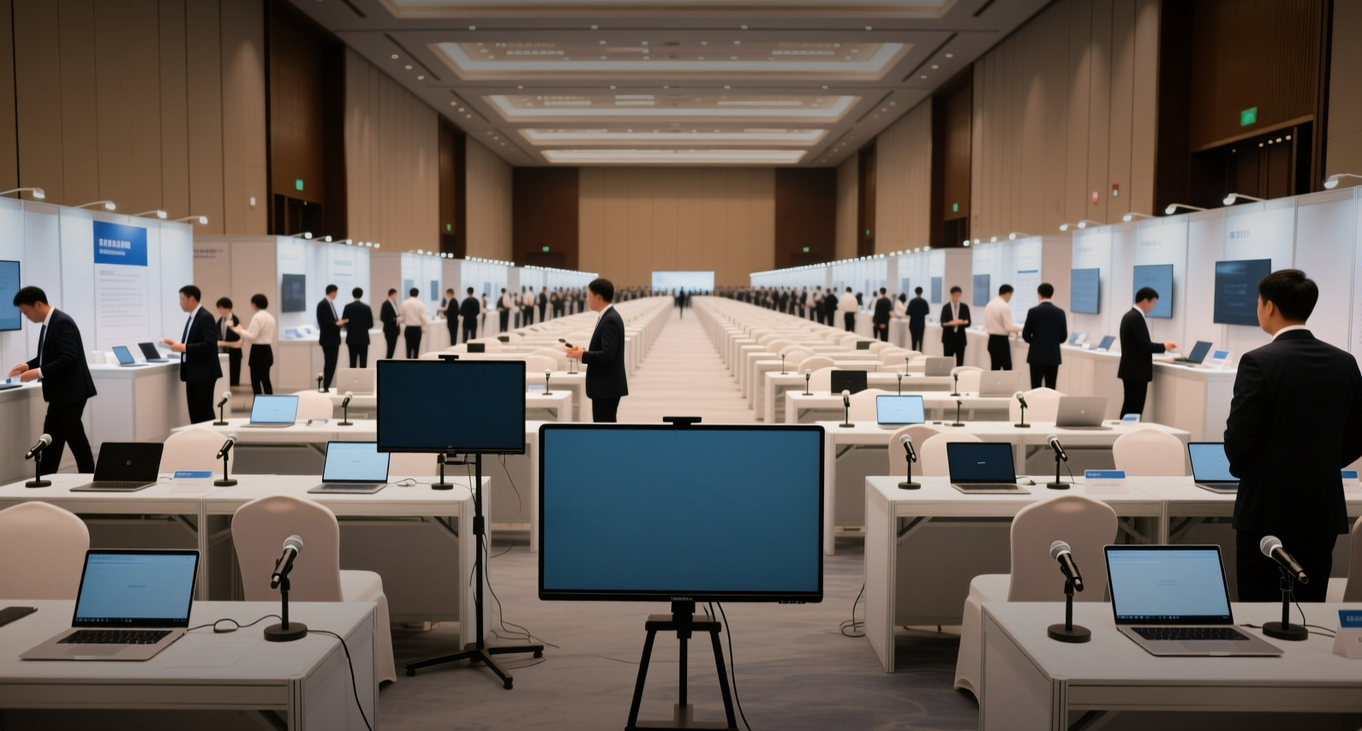
Alibaba Group Holding Ltd. unveiled a suite of enterprise AI Agent products at its Apsara Conference in Hangzhou on Sept. 22, claiming industry-first status for a system that gives software agents organizational identities, delegated authority and auditable execution records. The company's Qwen Office unit said its Mobile-Use Agent completes 90% of end-to-end tasks in testing, cutting average completion time to 59.5 seconds from 83.6 seconds.
"Qwen Office is the industry's first enterprise-grade Agent product," Chen Yusong, vice president of Alibaba Group and chief executive of Qwen Office, said at the conference. He said agents must understand business context, collaborate inside an organization like a person, and leave every task execution bounded and traceable.
The centerpiece is Enterprise Context, a data-management layer that compresses and structures corporate data through a dedicated model at low token cost, then refreshes it as business conditions change. Alibaba's pitch is that agents fail in enterprises not because models are weak but because they are fed either too much or too little relevant information. Digital employees built on that layer carry a name, department, manager and job description, plus an authorization scope and lifecycle that administrators can revoke. A collaboration space lets staff and agents work in one thread, and a security center sandboxes execution, routes high-risk actions through approval and keeps operation logs for recovery.
Alibaba paired the software with hardware. The QwenNote A2, a 67-gram AI assistant with a six-microphone array, runs independently of a phone and defaults to not recording: speech is transcribed once in the cloud and the original audio is permanently deleted. Chen said the predecessor DingTalk A1 sold several hundred thousand units in China and set a target of tens of millions for the new device.
Honor deal puts Qwen inside the handset
The same conference produced Qwen Intelligence, a full-stack AI-phone solution that Alibaba is building with Honor and its Magic OS. Alibaba reported 91.8% composite task accuracy for the joint system, with complex long-horizon tasks executing more than 100 steps and a 90% end-to-end service closure rate. Three components do the work: a Mobile Planner Agent that decomposes requests, a Mobile-Use Agent that operates the device, and a Mobile Creative Agent for image and video generation.
The launch lands against a crowded field. Microsoft bundles Copilot into Microsoft 365, Salesforce sells Agentforce, and Google pushes Gemini through Workspace, while in China ByteDance, Tencent and Baidu are all shipping agent tooling. Alibaba did not disclose pricing, seat counts or revenue targets for the new products, and it did not publish the test conditions behind the 90% and 91.8% figures, leaving the accuracy claims unverified against rival benchmarks.
The enterprise push sits inside a much larger spending program. Alibaba has committed more than $53 billion over three years to AI, raised about $10.2 billion in a Hong Kong follow-on share offering in August, and is targeting 20 gigawatts of Alibaba Cloud data center capacity by 2032. On the same day, CEO Eddie Wu outlined a Zhenwu V900 accelerator from the T-Head chip division that he said triples the performance of its predecessor and can be clustered up to 500,000 units, alongside plans for a model of 5 trillion to 10 trillion parameters.
For investors, the question is whether agents convert Alibaba's model investment into recurring enterprise revenue. The company's cloud and AI franchise is the asset that carries the story, and the agent suite is the first attempt to charge enterprises for execution rather than for tokens. Rivals with entrenched productivity suites — Microsoft, Salesforce and Google — already own the corporate workflow layer Alibaba is now targeting, and Chinese peers can match the model quality. Without disclosed pricing or adoption numbers, the announcement supports sentiment toward BABA more than it changes near-term earnings estimates.
This article is for informational purposes only and does not constitute investment advice.