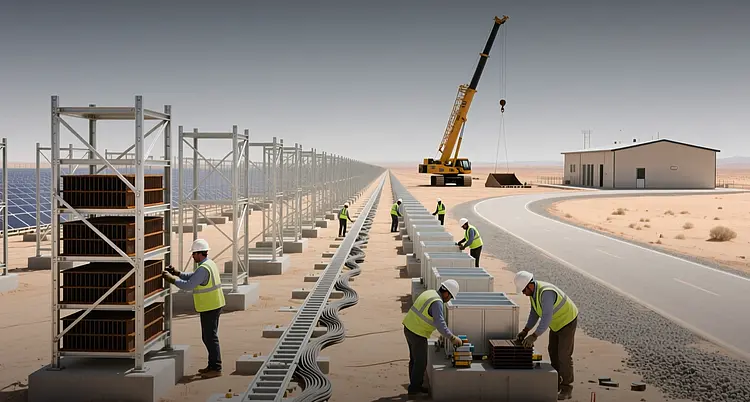
At least 150 gigawatt-hours of US long-duration energy storage projects have been announced, approved or financed since the start of 2025, more than five times the country's entire planned capacity at the end of 2024, with AI data centers accounting for most of the new demand, according to Bloomberg.
"Four hours of storage is nowhere near enough," Amanda Yang, Meta's head of clean and renewable energy, said. Lucia Tian, Google's director of advanced energy technologies, said some long-duration technologies avoid dependence on critical minerals such as graphite, reducing exposure to those supply chains.
The order book is now large enough to name. Google's February 2026 agreement with Form Energy covers a 300 MW / 30 GWh iron-air system for a Minnesota data center — the largest by energy capacity ever contracted — at an estimated cost of about $1 billion and a 100-hour discharge rating. In September 2026, Google partnered with MN8 Energy on the Mammoth Solar project in West Virginia, pairing 86 MW of solar with 10 MW / 100 MWh of zinc-based storage supplied by Eos Energy, phased from 2028 to 2030. Google also has a 23 MW / 200 MWh CO2 battery with Italy's Energy Dome planned for Ireland in 2028. Meta's April 2026 deal with Noon Energy reserves up to 1 GW / 100 GWh, starting with a 25 MW / 2.5 GWh pilot in 2028. Crusoe, the data center developer, is working with Energy Vault on gravity-based storage.
The economics explain why hyperscalers are shopping outside lithium-ion. A conventional four-hour lithium-ion system roughly doubles in cost when duration doubles, because energy capacity scales with the number of electrochemical cells. Iron-air, zinc and CO2 designs separate power capacity from energy capacity: the storage medium — iron pellets, zinc electrodes, compressed CO2 — is cheap, and duration is added by buying more of the cheap material rather than more cells. The trade-off is footprint and response speed, both worse than lithium-ion.
The reference customer problem, solved
For the startups, the procurement contract matters less than what it certifies. Aric Saunders, executive vice president at Noon Energy, said AI data centers now represent roughly half of the company's planned deployments, against close to zero two years ago. Other customers are growing too, he said, but few can match the pace and balance sheet of a hyperscaler.
Tom Sisto, co-founder and chief executive of XL Batteries, said an order from data center developer Prometheus Hyperscale gave his company market confirmation it could not have generated on its own. For hardware developers that need to build factories before they have revenue, that order is also what makes a financing round closeable.
Yiyi Zhou, a storage analyst at BloombergNEF, said early deployment at data centers should generate operating data and volume manufacturing that push costs down, opening other industries to the same technology.
The scale gap is the risk. Form Energy has not run an iron-air system anywhere near the 30 GWh Google has ordered, and most of the contracted capacity will not be operational until 2028 or later. A single missed milestone at pilot scale would test whether the financing that follows these orders is durable or merely order-book-deep.
Who gets paid, and when
The beneficiaries split into three groups. Developers with signed hyperscaler contracts — Form Energy, Noon Energy, Energy Dome, Eos Energy, Energy Vault and XL Batteries — gain revenue visibility that private storage companies rarely achieve, which is the currency for their next capital raise. The hyperscalers get dispatchable clean power in regions retiring coal, which is the constraint on their AI buildout rather than chip supply. And the lithium-ion incumbents lose the long-duration segment by default, not by competition: their cost curve simply does not extend past about four hours.
Eos Energy is the only name in the group with a public listing, and its inclusion in Google's Mammoth Solar storage scope is the clearest read-through for equity investors watching whether data center demand converts into booked revenue rather than press releases. Energy Vault and Energy Dome remain private or thinly traded, so the sector's exposure is still mostly available through the customers, not the suppliers.
The near-term test is the 2028 delivery window. If the Noon Energy pilot and the Form Energy Minnesota system hit their dates, the 150 GWh pipeline becomes a template for utilities and industrial power buyers. If they slip, the order book stays a data center story.
This article is for informational purposes only and does not constitute investment advice.