
AI's productivity gains are evaporating before they reach the bottom line, two new studies show, challenging the trillion-dollar investment thesis that has driven the sector's stock market rally.
AI's productivity gains are evaporating before they reach the bottom line, two new studies show, challenging the trillion-dollar investment thesis that has driven the sector's stock market rally.
AI's productivity gains are evaporating before they reach the bottom line, two new studies show, challenging the trillion-dollar investment thesis that has driven the sector's stock market rally.
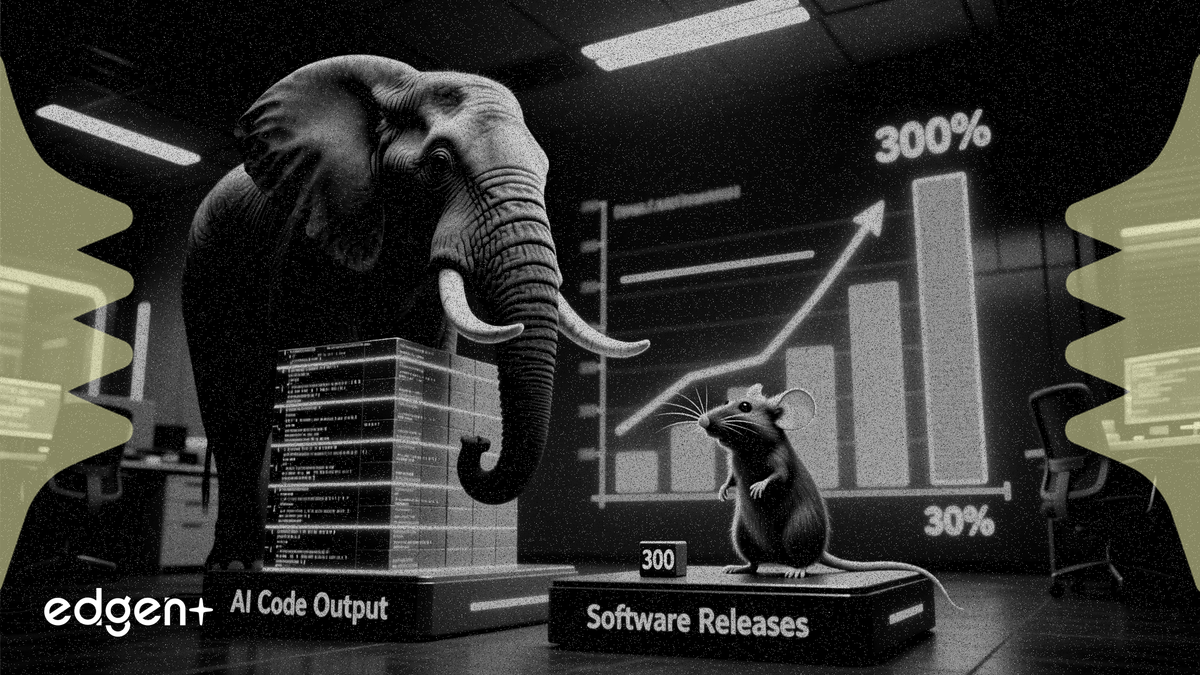
Artificial intelligence tools are generating code at an explosive rate, but the vast majority of that output never translates into finished software products, according to research from the Massachusetts Institute of Technology. Developers using AI assistants increased the number of code files they created or edited by nearly 300%, the study found. That gain narrowed to about 150% by the time code reached the review stage and collapsed to roughly 30% by the time it appeared in complete software releases.
"The bottleneck has shifted from writing code to everything that happens after — reviewing, integrating, testing, deploying," said Mert Demirer, a researcher at MIT and co-author of the study, which tracked developers across multiple levels of the software production pipeline. "AI accelerates the upstream task dramatically, but the downstream process hasn't changed."
The findings echo a parallel survey from Bain & Co. of 951 large enterprises across nine industries. Among companies that could quantify cost savings from AI, the largest group — 40% — reported reductions of 10% or less, far below initial expectations. Global corporate spending on AI has now surpassed $1 trillion, Bain estimates, yet the return on that investment remains elusive for most organizations.
The Funnel Problem
The MIT research offers the most detailed map yet of where AI productivity gains get lost. The study examined developer output at four stages: raw code file creation, individual file edits, code review submissions, and final software releases. At each stage, the AI boost diminished by roughly half or more.
The pattern extends beyond code to actual market demand. Mobile app releases have increased significantly over the past year as AI tools lowered the barrier to development, but app downloads have not risen correspondingly, the researchers found. Most new applications failed to attract even a modest user base, suggesting AI-accelerated production does not automatically create market value.
Bain's survey identified a more structural concern: 44% of large enterprises are funding their next round of AI investment with cost savings from the previous round that have not yet materialized. The consulting firm described the dynamic as "a circular bet with a structural flaw." Gartner projects that more than 40% of agentic AI projects will be abandoned by the end of 2027.
The Native vs. Incumbent Divide
The productivity gap is not uniform across the economy. Companies built around AI from the ground up are seeing dramatically different results than traditional enterprises grafting AI onto existing workflows.
Anthropic, the developer of the Claude model, reported that its AI now authors more than 80% of the code merged into its codebase, up from the low single digits before Claude Code launched in research preview in February 2025. The company said its engineers are shipping roughly eight times more code than they did in 2024. Lines of code per engineer per day had remained constant through the company's first four years before climbing sharply in 2025, Anthropic said in its report "When AI Builds Itself."
The contrast mirrors the electrification of factories in the early 20th century, the MIT researchers noted. When manufacturers simply replaced steam engines with electric motors without changing factory layouts, productivity gains were minimal. The real leap came decades later when engineers redesigned factories around individual workstations with dedicated motors. AI may follow a similar trajectory, with the full benefits requiring new organizational structures rather than bolt-on tools.
The Investment Reckoning
For investors, the data raises uncomfortable questions about the valuation of AI-exposed equities. The current premium on AI stocks — from Nvidia to hyperscale cloud providers to AI software companies — is built on expectations of future productivity gains, not realized returns. If the funnel effect persists, the gap between AI spending and measurable business outcomes could trigger a reassessment.
Uber Chief Executive Officer Dara Khosrowshahi recently disclosed that the company exhausted its full-year AI budget in a single quarter and plans to shift most AI usage to lower-cost models, reserving frontier tools only for specific use cases. Separate research on legal applications found that pairing low-cost open-source AI with premium models produced better results at a fraction of the cost.
"Technology works, but the value hasn't arrived," Bain wrote in its report.
Anthropic acknowledged the uncertainty in its own analysis. "None of this guarantees recursive self-improvement is on the horizon," the company said. "It's not yet clear that Claude is capable of research judgment — of choosing the right problems to work on."
For investors betting on AI-driven productivity gains, the wait may be longer than the market currently prices in. The technology is advancing faster than the organizations and processes needed to capture its value.
This article is for informational purposes only and does not constitute investment advice.
