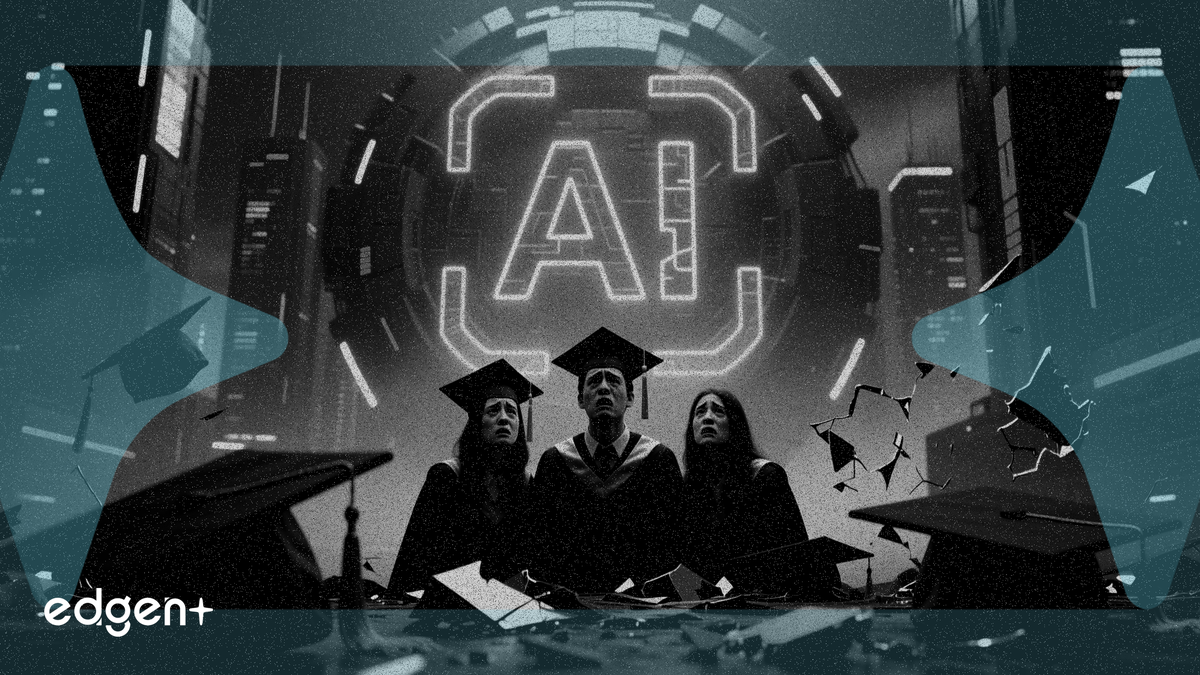
A growing backlash against artificial intelligence is moving from online forums to the center of cultural and academic life, as widespread anxiety over job security confronts the technology’s relentless march into the professional world. With 70 percent of U.S. college students now viewing AI as a threat to their job prospects, according to a Harvard Kennedy School poll, a generation educated for a white-collar economy is questioning the value of their degrees in an age of automation.
The tension was palpable at the University of Arizona's commencement, where former Google CEO Eric Schmidt was met with a chorus of boos when he addressed the rise of AI. “I know what many of you are feeling about that. I can hear you,” Schmidt acknowledged. “There is a fear in your generation that the future has already been written, that the machines are coming, that the jobs are evaporating.”
This sentiment is backed by troubling economic data. The unemployment rate for college graduates aged 22 to 27 has hit a 12-year high, and research from Stanford University found that employment growth for young workers in AI-exposed roles slowed by 16 percent between mid-2024 and September 2025. The decline is almost entirely due to a drop in hiring, not layoffs, suggesting companies are already using AI to absorb entry-level tasks once performed by recent graduates.
The paradox is that while AI threatens to erode the starting rungs of the white-collar career ladder, it is creating a boom for skilled blue-collar labor, potentially reordering the American workforce. “This is the largest infrastructure buildout in human history that is going to create a lot of jobs,” Nvidia CEO Jensen Huang said at the World Economic Forum, citing a “great shortage” of plumbers, electricians, and technicians needed to build and maintain the data centers powering the AI revolution.
A Tale of Two Economies
The cultural resistance is as visible as the economic shifts. At the 79th Cannes Film Festival, director Guillermo del Toro’s blunt "Fuck AI" declaration was celebrated as a political statement. Yet the festival itself, which stands for artistic integrity, was sponsored by Meta, whose AI tools were used in one of the festival’s own entries. This highlights the conflict between creative values and the powerful economic incentives driving AI adoption. One director at the festival noted that an AI-generated visual sequence cost just 500 euros, compared to an estimated 20,000 euros for traditional special effects—a 40-fold cost reduction that is difficult for any business to ignore.
This economic reality is not lost on industrial giants. AT&T CEO John Stankey has been vocal about the company's struggle to find skilled labor. "We need people who know how to actually work with electricity... It's not like we're growing them on trees in the United States," he told CNBC. The company plans to hire around 3,000 technicians this year, investing up to $80,000 per person in training to build out the fiber network required by AI data centers. This trend is not unique to the U.S.; Chinese courts have recently made precedent-setting rulings to protect workers from being illegally replaced by AI, showing that governments globally are beginning to grapple with the technology's social fallout.
For investors, this schism creates a complex landscape. Companies like Nvidia (NVDA) are clear beneficiaries of the infrastructure build-out. However, tech giants like Google (GOOGL) and Meta (META) face growing reputational risk and potential regulatory pressure stemming from the public backlash. The most significant shift may be in the perceived value of human capital. As the return on a four-year degree comes under pressure, the market may see a long-term revaluation of skilled trades and the industrial companies that employ them, challenging decades of economic assumptions about the surest path to the middle class.
This article is for informational purposes only and does not constitute investment advice.