

51World plans to deploy more than 1,000 embodied intelligent robots across five industrial sectors this year, signaling a major scale-up in physical AI commercialization in China.
51World plans to deploy more than 1,000 embodied intelligent robots across five industrial sectors this year, signaling a major scale-up in physical AI commercialization in China.
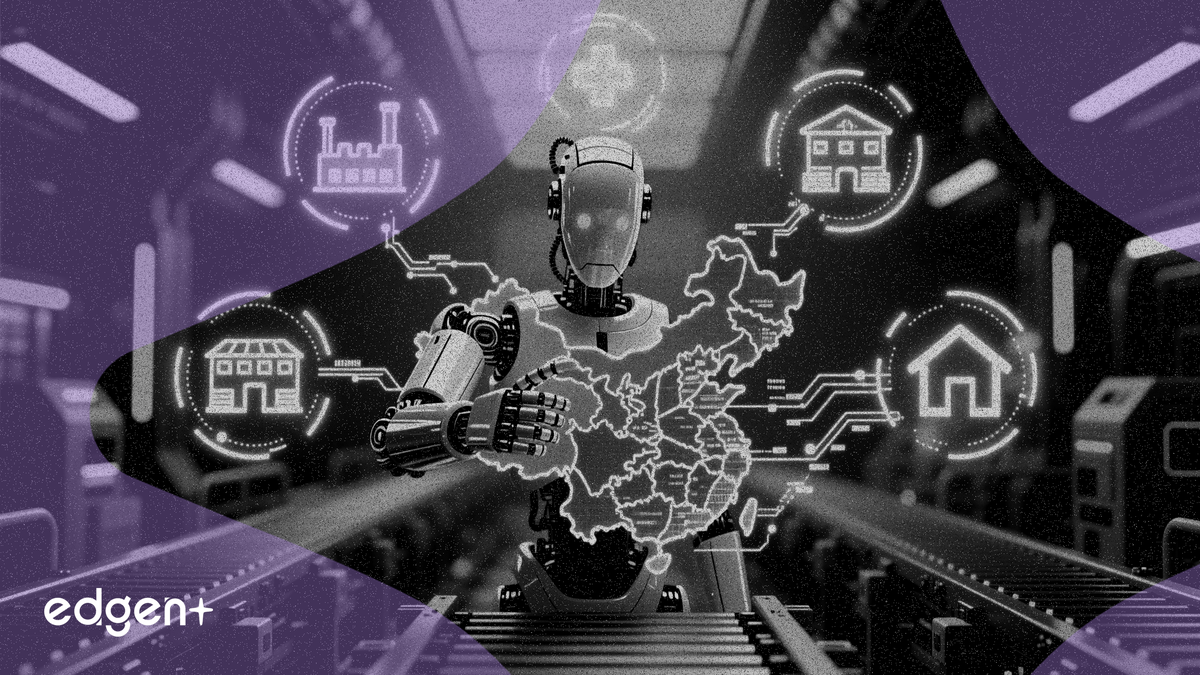
51World's plan to deploy over 1,000 embodied AI robots across building parks, energy, transportation and emergency response sectors marks one of the largest single-year commercial rollouts of physical AI in China, putting pressure on rivals like Cheetah Mobile and UFACTORY to accelerate their own deployments.
"Real-world operational data is the scarcest resource in robotics today," Sheng Fu, chief executive officer of Cheetah Mobile, said during the company's Q1 2026 earnings call. "The physical world is much more complex than the laboratory environment."
51World will leverage its 51World Model and physical AI capabilities to provide nearly 100 clients with scene reconstruction, simulation training and deployment verification across building and industrial parks, industrial manufacturing, energy, transportation and emergency safety. The company's platform creates digital twins of real environments where robots can train virtually before physical deployment, reducing the trial-and-error costs that have slowed commercial robotics adoption.
The deployment target comes as China's robotics sector shifts from laboratory demonstrations to revenue-generating commercial operations. Cheetah Mobile's robotics and others segment revenue surged 176% year-over-year to 51 million yuan ($7.1 million) in Q1 2026, approaching 20% of total revenue, while its adjusted operating loss in the segment narrowed 57%. If 51World meets its target, it would validate that physical AI — combining large models with real-world sensor data — can achieve the scale that pure software AI companies have already reached.
Why Real-World Data Is the New Battleground
The core challenge 51World aims to solve is the data scarcity that has plagued embodied AI. While large language models trained on decades of internet text have achieved rapid capability gains, robots lack equivalent training data from the physical world. Sheng Fu noted that even simple tasks like indoor navigation from point A to point B require massive datasets across different floor surfaces, wall reflections and noise environments — conditions that simulators cannot fully replicate.
51World's approach uses its digital twin platform to generate synthetic training data from real environments, then validates robot behavior before physical deployment. This mirrors the strategy of Nvidia, whose Omniverse platform serves a similar function for industrial robotics clients. The difference is that 51World is targeting Chinese industrial customers directly, offering an end-to-end pipeline from simulation to on-site operation.
Cheetah Mobile's experience illustrates the commercial opportunity. The company's smart wheelchair, which began mass production in May 2026, uses obstacle-avoidance algorithms trained on data from thousands of real-world robot deployments across carpets, tiles and outdoor surfaces. Sheng Fu said early sales in Europe have been "quite good," though he did not disclose specific unit numbers.
The Competitive Landscape Heats Up
51World's announcement intensifies competition in China's embodied AI market, where companies are racing to prove their technology can generate recurring revenue rather than one-off project fees. Cheetah Mobile's robotics revenue reached 51 million yuan in Q1, and the company expects the segment to grow strongly through 2026. UFACTORY, a robotic arm maker in which Cheetah Mobile has invested, also showed growth in Q1, according to Sheng Fu.
The broader market context favors companies with deployed fleets. Sheng Fu argued that wheeled robots — not humanoid forms — will dominate commercial applications for the next three to five years, because they offer better cost-effectiveness and reliability. "What clients care about is cost-effectiveness, ROI, input and output," he said. "This has been very significantly reflected in our operations in recent years."
51World's thousand-unit target, if achieved, would give it one of the largest deployed fleets of embodied AI robots in China, generating the kind of operational data that competitors have identified as the industry's core barrier to entry.
51World is not publicly traded, but its ramp-up has implications for listed peers. Cheetah Mobile (CMCM), which trades at a market cap of roughly $200 million with $186 million in cash, is investing its profitable internet services cash flow into robotics. If 51World's deployment validates the market, it could lift the entire Chinese robotics sector's valuation multiple. Conversely, if the thousand-unit target slips, it would reinforce Sheng Fu's warning that "the possibility of a particularly versatile robot appearing is very low" in the next two to five years.
This article is for informational purposes only and does not constitute investment advice.
